Earlier this week, I had lunch with a family member—a university professor—who loves making people talk about their interests. The first words out of his mouth were: “Hey man, tell me about Gen AI. Can it do this?”
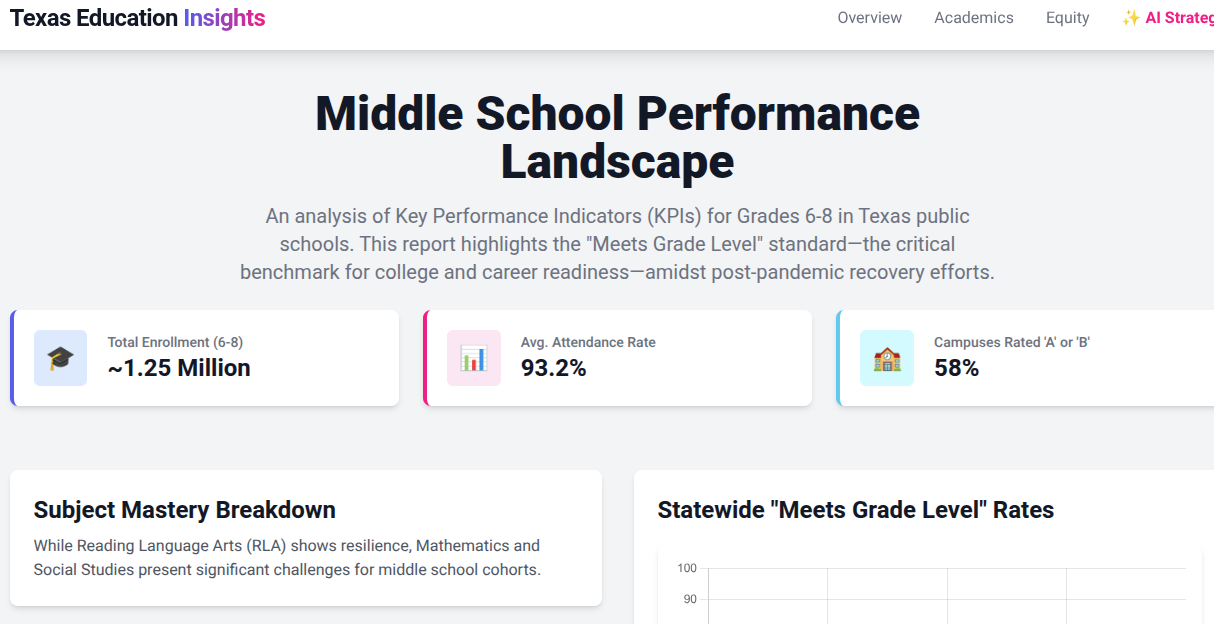
The “this” was a tall order: a comprehensive report on the Middle School Performance Landscape using verifiable web sources. I explained how Deep Research, Canvas, and image-based infographics via tools like Gemini, ChatGPT, and BoodleBox can synthesize that data.
View example generated using Gemini 3 Pro. You will find links, a copy of the infographic, as well as instructions for the APA Citation Guide Gem, too (you can use the instructions in ChatGPT or BoodleBox bot).
But as we ate, he cut to the chase: “How well does it handle APA style formatting?” He wanted to type a paper and have citations auto-formatted in real-time. I told him he could set the AI up for success by providing the specific rules from a style guide.
Note, this infographic below is NOT 100% correct. See end of blog entry for corrections via ChatGPT (see? Get the AI bots to check each other’s work…but the best check is to go look yourself):

Here is how that “Real-Time Research Assistant” workflow looks in practice.
Step 1: The “System Instruction”
To get accurate results, you provide the AI with a set of “marching orders” based on the APA 7th Edition Guide. You tell the AI:
- Act as an APA 7th Edition editor.
- Use the Author-Date System for all in-text citations.
- Use “et al.” immediately for any source with three or more authors.
- Distinguish between Parenthetical—(Author, Year)—and Narrative—Author (Year)—citations.
Step 2: The Real-Time Interaction
In a side-by-side editing tool (like Canvas), the professor provides the raw facts:
“I found a study by Smith, Jones, and Williams from 2023. They found that student engagement drops by 15% in 6th grade. Also, the National Institute of Mental Health released a report in 2023 saying anxiety is a factor.”
Following the guide, the AI instantly formats the text:
- Narrative: “Smith et al. (2023) found that student engagement drops by 15% in 6th grade”.
- Parenthetical: “Research indicates that anxiety is a major factor in performance (National Institute of Mental Health [NIMH], 2023)”.
Step 3: Building the Reference List
When the writing is done, the AI uses Reference List Entry Formulas to generate the final bibliography:
- Journal Articles: Includes the Author, Year, Article Title, Periodical, Volume(Issue), and Pages.
- DOIs: Formatted as active URLs (e.g.,
https://doi.org/...). - Formatting: Reminds the user that the final list requires a hanging indent and double-spacing.
The Evolving Academic Workflow
By front-loading the AI with the rules found in this APA 7 Infographic, you transform it from a chatbot into a specialized academic assistant.
For those looking to ground their research even further, tools like Google NotebookLM allow you to upload your specific source documents to ensure every claim is backed by your own curated library. The goal isn’t just to write faster; it’s to use AI as a guardrail against the tedious administrative parts of research, letting you focus on the actual scholarship.
Corrections to APA Infographic
What needs correction ⚠️
1) The Webpage/Website example is likely wrong as written
Infographic example (paraphrase):
“Centers for Disease Control. (2023, August 15). Flu prevention. CDC. URL”
Issues:
- If the author and site name are the same, APA says omit the site name to avoid repetition.
- APA also indicates you generally don’t put a group-author abbreviation in the reference entry (abbreviations are for in-text use).
A safer corrected pattern:
- Centers for Disease Control and Prevention. (2023, August 15). Flu prevention. URL
(And if the author and site name would match, don’t repeat the site name.)
Also note: if the page is designed to change over time (e.g., a wiki), APA may require a retrieval date—the infographic doesn’t mention that nuance.
2) The “AI tools/software” example may be outdated (format direction has evolved)
The infographic’s AI example uses something like:
- OpenAI. (2024). ChatGPT (Mar 14 version) [Large language model]. https://chat.openai.com/
APA’s more recent generative-AI reference examples include:
- OpenAI. (2025). ChatGPT [Large language model]. https://chatgpt.com/
So the structure (company as author + tool name + bracketed description + URL) is broadly consistent, but the specific URL/version labeling/year in the infographic may not match the newer example set.
Bottom line 🎯
- ✅ In-text rules and most reference templates: accurate
- ⚠️ Webpage example: needs adjustment (omit site name when same; avoid using the abbreviation as the site/publisher in the reference)
- ⚠️ AI tool/software example: structure OK, but details may be outdated (APA now shows examples using chatgpt.com and current-year labeling).
Discover more from Another Think Coming
Subscribe to get the latest posts sent to your email.
 Another Think Coming