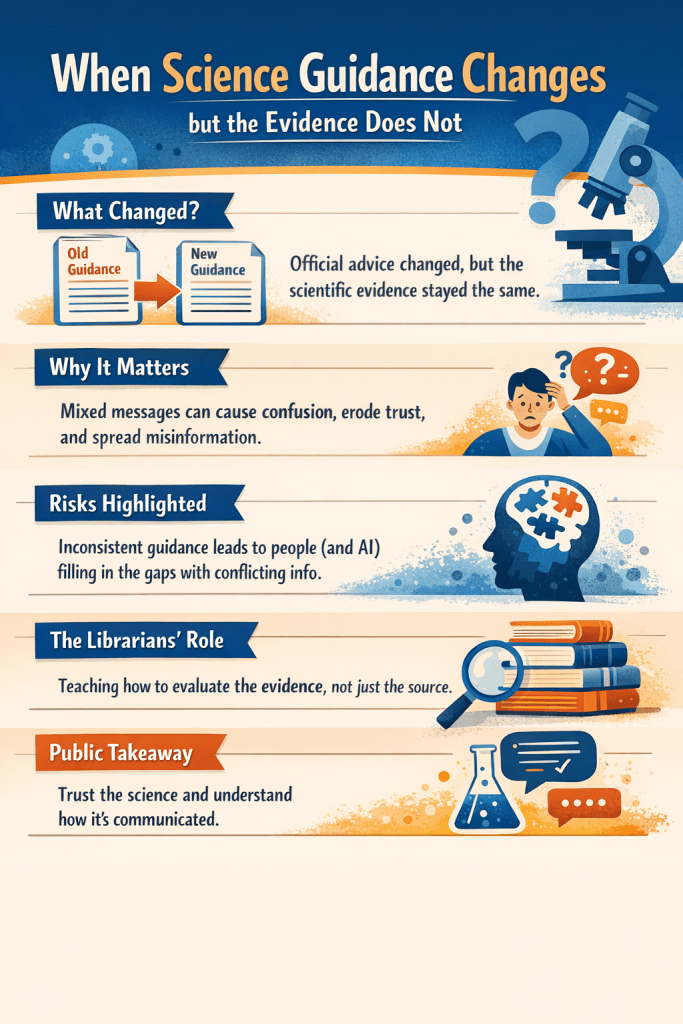
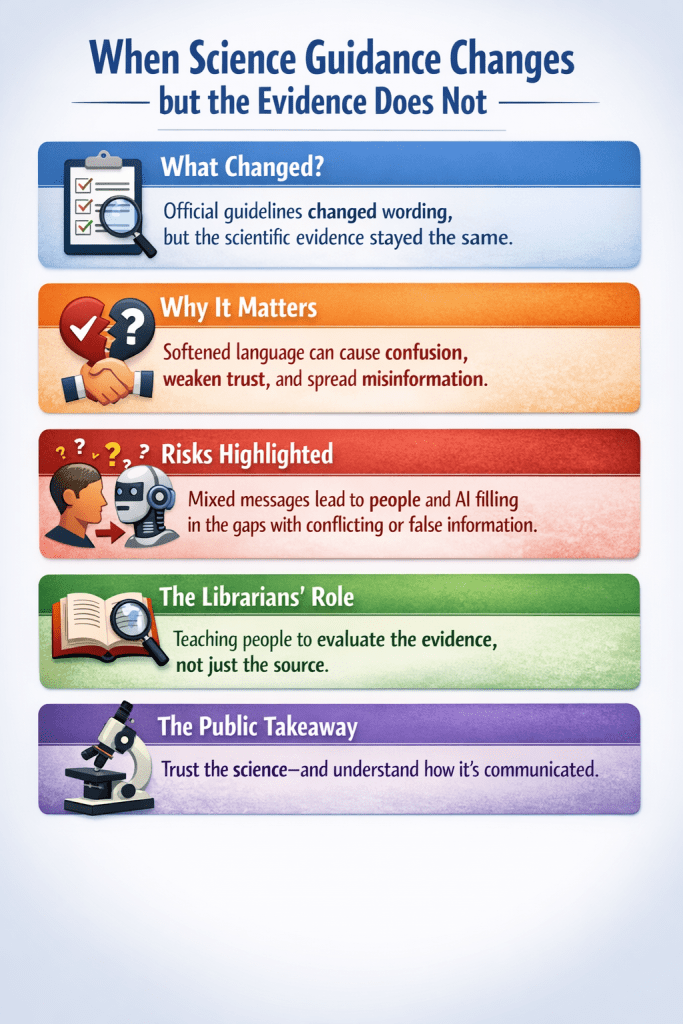
I read this from the AI School Librarian and just had to share it and generate infographic:
The most harmful misinformation is not always false. It often appears when accurate information is diluted, hedged, or stripped of clarity. https://aischoollibrarian.substack.com/p/if-official-science-guidance-can
A few points from her blog entry:
I. The Challenge of Shifting Scientific Guidance
“Science is not a collection of static facts to be memorized, but a dynamic process of continuous questioning, testing, and refining based on new evidence.”
A. The Public Perception of Scientific Authority
- Many students and parents view “science” as an absolute truth rather than a methodology
- When official guidance changes (e.g., during public health crises), it can lead to a breakdown in trust
- Distinguishing between “scientific consensus” and “absolute certainty”
B. Why Guidance Changes Over Time- The emergence of new data and improved technology
- The role of the peer-review process in correcting previous hypotheses
- How experts adjust recommendations to mitigate risk in real-time
II. Strategies for Teaching Information Literacy
“In a world where information is fluid, the most important skill we can teach is not what to think, but how to evaluate the process behind the information.”A. Implementing the SIFT Method
- S: Stop and check the source before reacting or sharing
- I: Investigate the original creator and their credentials
- F: Find better coverage or a consensus from established scientific bodies
- T: Trace claims, quotes, and media back to the original context
a. Ensure the original data supports the headline
b. Check if the study has been retracted or updated
B. The Importance of Lateral Reading- Moving beyond the “checklist” approach to website evaluation
- Teaching students to open multiple tabs to verify claims through outside sources
- Understanding that authority is constructed and contextual
III. Navigating Conflicting Information and Misinformation
“Our goal is to move students away from cynical skepticism and toward a healthy, evidence-based curiosity.”A. Identifying Cognitive Biases
- Confirmation bias and why we gravitate toward “facts” that fit our narrative
- The “echo chamber” effect in social media algorithms
- Strategies for exposing students to diverse, credible perspectives
B. The Role of the School Librarian and Educator- Modeling the process of updating one’s own opinion when presented with new data
- Curating “living” resource lists that reflect current scientific understanding
- Encouraging classroom discussions about the evolution of scientific knowledge
Next Steps and Action Items
For Educators- Integrate the SIFT method into current science and social studies curricula.
- Design lessons that explicitly show how specific scientific “facts” have changed over the last 50 years.
- Foster a classroom environment where “changing your mind” based on evidence is praised as a scientific success.
For School Librarians- Curate a digital toolkit of lateral reading resources and fact-checking websites.
- Conduct professional development workshops for staff on identifying scientific misinformation.
- Update library signage and research guides to emphasize the “Authority is Constructed and Contextual” framework.
For Students- Practice the “Stop” phase of SIFT whenever encountering a high-emotion headline.
- Use multiple databases to check if a scientific claim is supported by a broad consensus.
- Identify one example of a scientific guidance change and research the specific data that led to that change.
Discover more from Another Think Coming
Subscribe to get the latest posts sent to your email.
 Another Think Coming