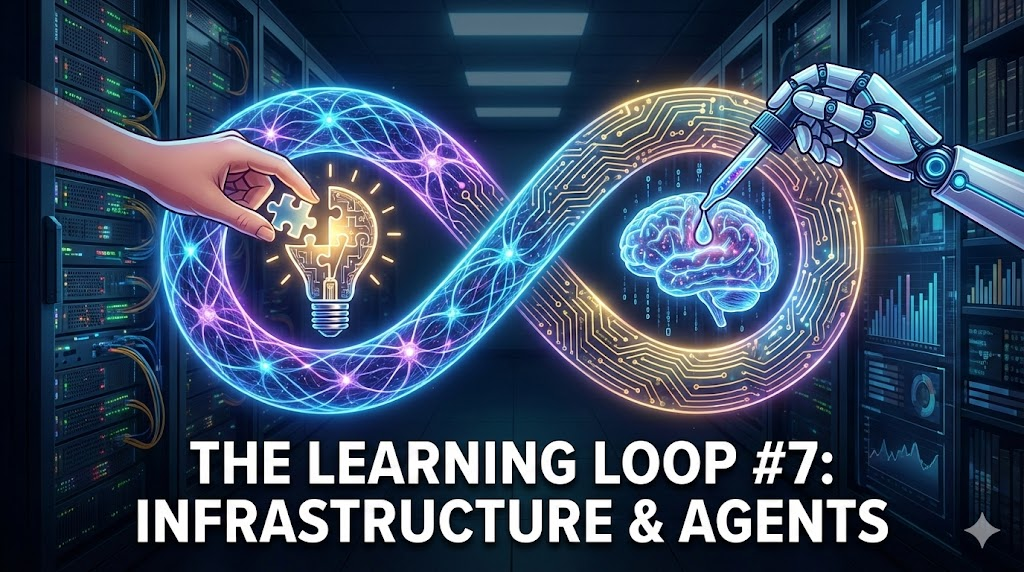
This issue of The Learning Loop explores the massive infrastructure being built for AI, the shift toward “raw” authenticity in social media, and the rapid evolution of autonomous agents that are moving beyond simple chat interfaces into persistent project managers.
In This Issue:
This week, we look at the massive physical foundations being built to support the AI revolution, with Meta betting on tens of gigawatts of power. We also explore a pivot in social media where “unpolished” content is becoming the ultimate proof of human authenticity in an age of AI-generated perfection. Finally, we dive into the world of autonomous agents—tools that no longer just answer questions but manage entire projects for months at a time.
📗 Meta Compute: The Infrastructure Arms Race
🔥 The Big Idea:
Meta has launched “Meta Compute,” a massive initiative to build AI infrastructure on an unprecedented scale, aiming for tens of gigawatts of capacity this decade. While AI infrastructure stocks have faced recent volatility due to investor demand for immediate returns, Meta is doubling down on the hardware necessary for the next generation of models. This shift suggests that the “moat” for future AI leaders is increasingly tied to access to massive power grids and specialized hardware clusters.
✅ Putting It into Practice:
- Infrastructure Awareness: Recognize that the “cloud” is a physical reality; consider the environmental and energy policy implications of local data center expansions.
- Strategic Planning: When planning institutional tech budgets, prioritize platforms that demonstrate long-term infrastructure stability over short-term “wrapper” startups.
- Digital Literacy: Use the “Meta Compute” scale as a teaching point for students to understand the massive energy and environmental costs associated with high-level generative AI.
Source: The Verge | Author: Editorial Staff
📗 The Human Factor: OpenAI’s State of Enterprise AI
🔥 The Big Idea:
OpenAI’s latest report reveals a significant gap: while 75% of workers can now complete tasks they previously couldn’t, 65% of leaders say “people problems” are their biggest barrier to AI adoption. This suggests that while the software is ready, organizational culture and human psychology are the new bottlenecks. The challenge of AI transformation is no longer a technical one; it’s a social and emotional one.
✅ Putting It into Practice:
- Empathy-First Implementation: Address worker anxiety directly through transparent conversations about AI’s role as an assistant rather than a replacement.
- Upskilling Focus: Shift professional development from technical “prompting” to high-level workflow management and oversight.
- Empower Early Adopters: Identify the 75% of “power users” and empower them to mentor peers who are struggling with the transition to augmented workflows.
Source: OpenAI Blog | Author: OpenAI Research
📗 The Death of Aesthetic: Instagram’s Pivot to Raw
🔥 The Big Idea:
Instagram’s leadership has declared that the rise of AI-generated perfection is killing the “curated aesthetic” that once defined social media. Users are increasingly gravitating toward unpolished, raw, and even “ugly” content as a way to verify that a post is authentically human. In a world of flawless AI-generated imagery, a blurry photo or a messy background has become the new status symbol of reality.
✅ Putting It into Practice:
- Authentic Branding: For educational and personal branding, prioritize “behind-the-scenes” unedited content over highly produced marketing materials.
- Document the Process: Encourage students to document the “messy middle” of their learning journey rather than just the final, polished product.
- Detecting the Human: Teach learners to look for “human friction”—imperfections that signal a real person was behind the creation of the content.
Source: Instagram / Adam Mosseri | Author: Adam Mosseri
📗 Professional Mastery: AI Passes the CFA Exams
🔥 The Big Idea:
New frontier models, including Gemini 3.0 Pro and GPT-5, have demonstrated their ability to pass all three levels of the Chartered Financial Analyst (CFA) exams with near-perfect scores. This marks a transition from AI being a generalist “chatbox” to a specialist capable of high-level professional reasoning. The implications for professional certification and the value of “expert knowledge” are being fundamentally rewritten.
✅ Putting It into Practice:
- Rethink Assessment: If an AI can pass a certification exam, educational systems must move toward performance-based assessments that require real-world application.
- Expert Tutoring: Use these specialized models as high-level tutors for complex subjects in finance, law, and engineering.
- Ethics of Expertise: Lead discussions on the ethical implications of using AI “experts” for critical advice without rigorous human oversight.
Source: Financial Times | Author: Tech Desk
📗 Autonomous Agents: From Chat to Action
🔥 The Big Idea:
Startups like “Do Anything” and Google’s experimental “CC” are shifting the AI paradigm from reactive chat to proactive action. These agents can manage entire projects for months, each with its own email address and the ability to work independently across platforms. We are moving into an era of “delegated agency,” where the user becomes a manager for a fleet of digital workers rather than just a prompter.
✅ Putting It into Practice:
- Pilot Workflow Agents: Experiment with small, low-risk administrative tasks (like email scheduling or data synthesis) using agentic workflows.
- Audit Skills: Focus on developing “auditing” skills—the ability to review and verify the multi-step work of an autonomous agent.
- Privacy Guardrails: Ensure any autonomous agent has strictly defined permissions to prevent unauthorized data access or accidental communication.
Source: TechCrunch | Author: Kyle Wiggers
Tech Alert: The Rise of “AI Slop” on Video Platforms
A recent study found that over 20% of videos shown to new YouTube accounts consist of “AI slop”—low-quality, auto-generated content designed to farm clicks. This makes information literacy more difficult, as educational searches are often buried under AI-generated misinformation or repetitive content. Users should be wary of videos with robotic voiceovers and generic stock footage that lack a clear, human-authored source.
Must Read / Listen To
- Claude Code for Slack: This video demonstrates how to use the new Claude Code integration within Slack to delegate development tasks directly from a chat thread.
- Claude Cowork: Claude Cowork is an AI agent from Anthropic that acts as a virtual coworker, allowing users to delegate complex, multi-step tasks on their computer, like organizing files, creating spreadsheets, or writing documents, by giving Claude access to specific folders on your machine.
- The Artificial Intelligence Show #190: In this episode, we explore the shift in AI capabilities that allows for non-technical leaders to build software and solve complex business problems in minutes.
Notable Gen AI Tools
- CrewAI (Agent Platform): A leading platform for building and managing “crews” of autonomous AI agents that handle complex enterprise workflows.
- Google CC: An experimental Gemini-powered productivity agent for Gmail that provides a “Your Day Ahead” morning briefing.
- Nvidia Nemotron 3: A new family of open models specifically optimized for high-throughput, multi-agent reasoning.
- ChatGPT Health: OpenAI’s secure environment for connecting personal medical records and wellness apps to AI for tailored health insights.
- Claude Code in Slack: An Anthropic integration that allows developers to trigger complex coding sessions directly from Slack conversations.
Another Think Coming by MGuhlin.org
Discover more from Another Think Coming
Subscribe to get the latest posts sent to your email.
 Another Think Coming