
The image above is an attempt to assign the level of scientific consensus (haha) to each of the claims in the controversial Brookings Study. What do you think about the study and the claims? Is the data really valid or just an opinion survey?
Most researchers now advocate for “AI Literacy” rather than “AI Prohibition.” The consensus is shifting toward the idea that if AI is used to show the work (process-based learning) rather than replace the work (output-based learning), some of these risks can be mitigated.
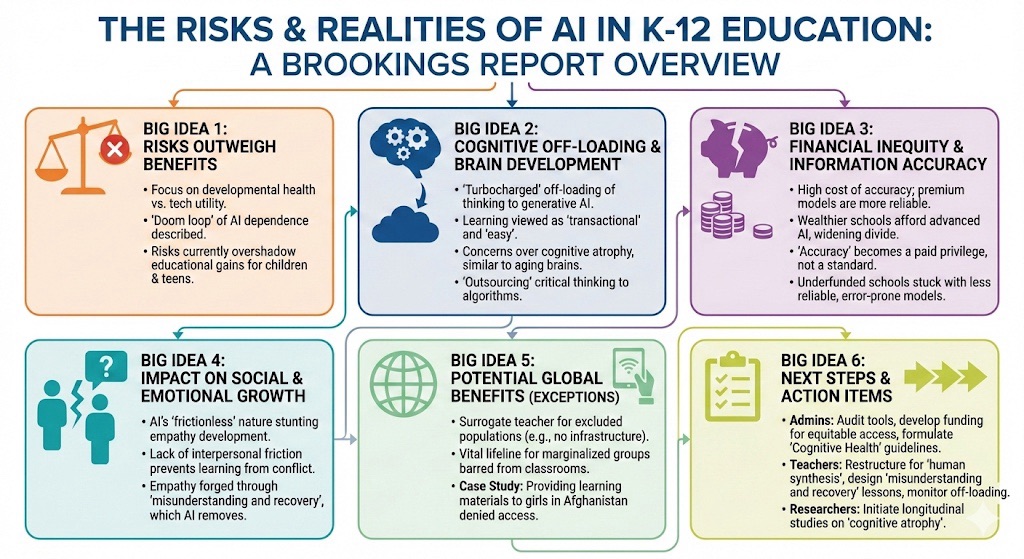
Report: The Risks of AI in Schools Outweigh the Benefits Outline
I. Overview of the Brookings Institution Report on AI in Education
“The risks of using generative artificial intelligence to educate children and teens currently overshadow the benefits.”
A. Background of the Study
- Conducted by the Brookings Institution’s Center for Universal Education
- Involved sweeping research including focus groups and interviews with K-12 students
- Primary focus on the balance between technological utility and developmental health
II. The Phenomenon of Cognitive Off-loading
“The report describes a kind of doom loop of AI dependence, where students increasingly off-load their own thinking onto the technology.”A. Historical Context vs. Modern AI
- Historical precedents of technology reducing manual effort
a. Keyboards and computers reduced the necessity for handwriting mastery
b. Calculators automated basic mathematical calculations and operations- The “Turbocharged” Nature of Generative AI
a. AI accelerates the process of off-loading to an unprecedented degree
b. Learning is increasingly perceived by students as “transactional” and “easy”
B. Impact on Brain Development- Concerns regarding cognitive decline or atrophy similar to aging brains
- Risks associated with “outsourcing” critical thinking and synthesis to algorithms
III. Financial Inequity and Information Accuracy
“This is the first time in ed-tech history that schools will have to pay more for more accurate information.”A. The High Cost of Accuracy
- Wealthier communities and private schools can afford advanced, premium AI models
- Advanced models are demonstrated to be significantly more accurate than free versions
- Underfunded schools are relegated to less reliable models with higher error rates
B. Widening the Educational Divide- Affluent students gain access to higher-quality “truths” and refined data
- Creates a tiered system where “accuracy” becomes a paid privilege rather than a standard
IV. Impact on Social and Emotional Growth
“We learn empathy not when we are perfectly understood, but when we misunderstand and recover.”A. The Stunting Effect of the AI “Echo Chamber”
- AI interactions are often frictionless and designed to perfectly “understand” the user
- Lack of interpersonal friction prevents students from learning how to navigate social conflict
B. The Role of Misunderstanding- Experts argue that human empathy is forged through the process of recovery after a misunderstanding
- AI removes the human struggle necessary for achieving emotional maturity and resilience
V. Potential Global Benefits and Exceptions
“One of the strongest arguments in favor of AI’s educational use… is its ability to reach children who have been excluded from the classroom.”A. Access for Marginalized Populations
- Potential for AI to act as a surrogate teacher in regions with no formal school infrastructure
- Targeted application in areas where specific groups are barred from education
B. Case Study: Afghanistan- Use of AI to provide learning materials to girls and women denied access by the Taliban
- Serving as a vital educational lifeline where traditional classroom settings are prohibited
VI. Next Steps and Action Items
A. Educational Administrators and Policymakers- Conduct immediate audits of AI tools currently being used in K-12 classrooms
- Develop funding strategies to ensure students in lower-income districts have access to the most “accurate” AI models to prevent an information gap
- Formulate “Cognitive Health” guidelines that limit AI use during primary developmental phases
B. Teachers and Educators- Restructure assignments to prioritize “human synthesis” over transactional outputs
- Implement lessons that intentionally incorporate “misunderstanding and recovery” to foster empathy
- Actively monitor students for signs of “cognitive off-loading” in daily coursework
C. The Brookings Institution and Research Groups- Initiate longitudinal studies tracking the specific effects of AI on the brain’s “cognitive atrophy”
- Expand focus groups to determine if certain AI-assisted strategies can be “untethered” from transactional learning behaviors
Discover more from Another Think Coming
Subscribe to get the latest posts sent to your email.
 Another Think Coming