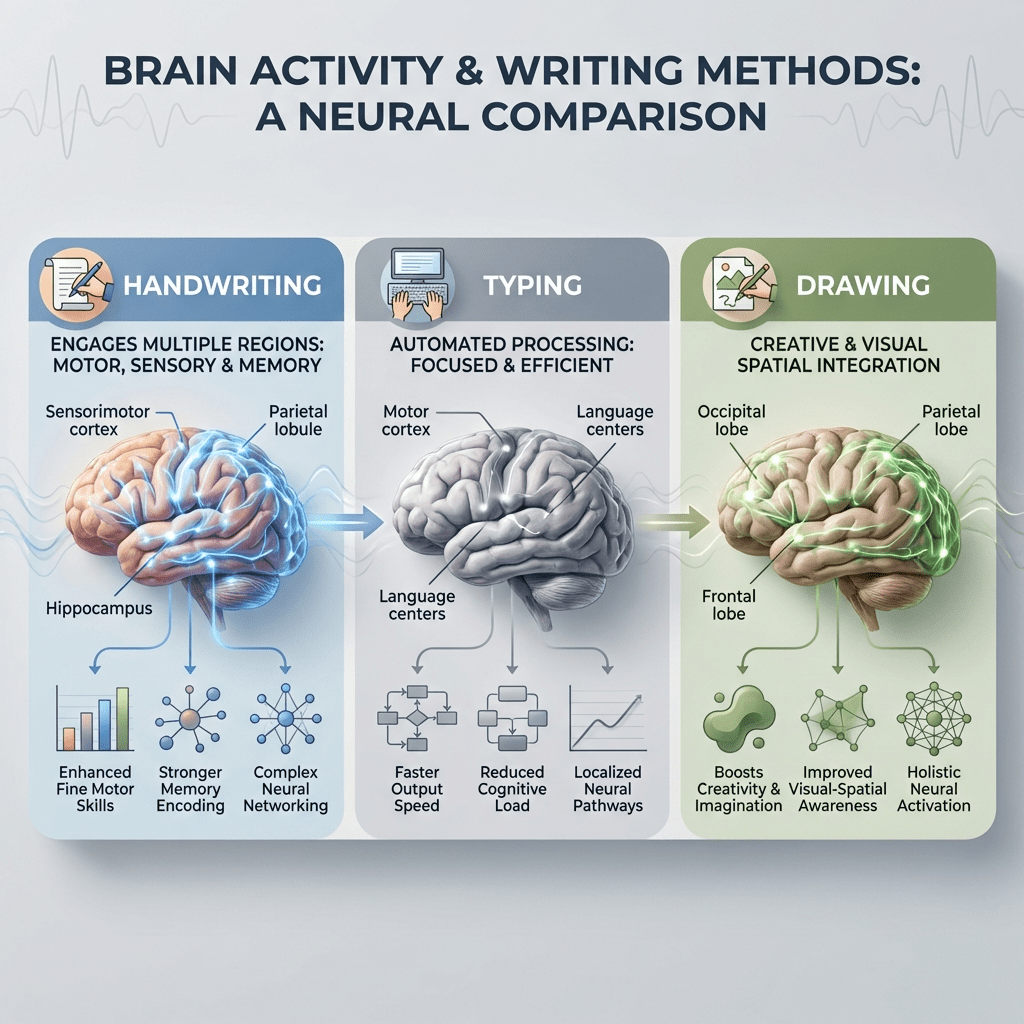
New Jersey students will, as they’ll now be required to learn how to write in cursive by hand…results revealed that cursive handwriting synchronized brain waves within a range primed for learning.
Additionally, it stimulated more electrical activity in the parietal lobe and central regions of the brain, which are associated with memory and encoding of new information (source).
“The use of pen and paper gives the brain more ‘hooks’ to hang your memories on. Writing by hand creates much more activity in the sensorimotor parts of the brain. A lot of senses are activated by pressing the pen on paper, seeing the letters you write, and hearing the sound you make while writing. These sense experiences create contact between different parts of the brain and open the brain up for learning.”
What about digital handwriting?
For learning and memory, digital handwriting is far superior to typing — but for maximum “hooks,” physical paper still has an edge.
As the Tokyo researchers suggest, you can partially bridge this gap by “personalizing digital documents by highlighting, underlining, circling, drawing arrows, handwriting color-coded notes in the margins” to create richer spatial encoding (Source).
So, I guess, all that hard work, the slow process of handwriting, is what makes the difference.
Discover more from Another Think Coming
Subscribe to get the latest posts sent to your email.
 Another Think Coming