Reading Mike Kentz’ blog entry, The AI Will Wait, again this morning, I found this particular section (BOLD) to ring true in my own experience. I bet it does in your experience as well when working with technology. That said, I found it reminded me of something I had learned about centipedes at some point in my life and it’s fun to consider it as an analogy for AI-powered creativity.
One year ago, Caltech researchers Jieyu Zheng and Markus Meister published a paper in Neuron with a title I can’t get out of my head: “The unbearable slowness of being.” Their finding: human cognition — the speed at which we remember, decide, and imagine — operates at a fixed rate of about 10 bits per second. That’s roughly the pace of casual typing. It’s a biological ceiling.
For comparison: A YouTube video streams at 8 million bits per second. The fact that we think at 10 bits per second shows just how massive and unfair the mismatch really is. And AI sits somewhere in between, still orders of magnitude faster than thought.
When we’re in a real-time exchange with something that processes information hundreds of times faster than we think, our nervous system takes notice. Or at least mine does. We adjust, we speed up, we try to “keep up,” even though our true value is precisely in our ability to slow down and think differently.
But, oh, the pressure of thinking and moving faster is ever-present. When I’m working on a project for work, I’m trying to get quality product done as quickly as possible. The faster it’s out there, the sooner it can start earning money (passive income, right?). If it needs fixing down the road, or updating, that’s a bit of a pain because I’m moving too fast to circle back and update content. New projects take precedence over old ones, and the old ones eventually fade away or fall off.
AI Anamorphosis
In fact, I remember reading about something like this in a biology class (weird, huh, what the brain dredges up)…centipede anamorphosis. I imagine we’re creating new stuff all the time, and the old parts get pushed back or something along those lines…for fun, let’s see what Gen AI does with that:
When a centipede grows in a process called anamorphosis (anamorphic development), it doesn’t shove its old body parts backward. Instead, it adds new body segments near the back end each time it molts. The older segments stay where they are—they just get bigger and stronger—while new segments appear at the “tail” side. Working with AI can be similar: you keep adding new tools or mini-projects fast, but your older projects don’t move to the end—they stay in the middle of your work and can get ignored, outdated, and eventually forgotten unless you go back and refresh them.
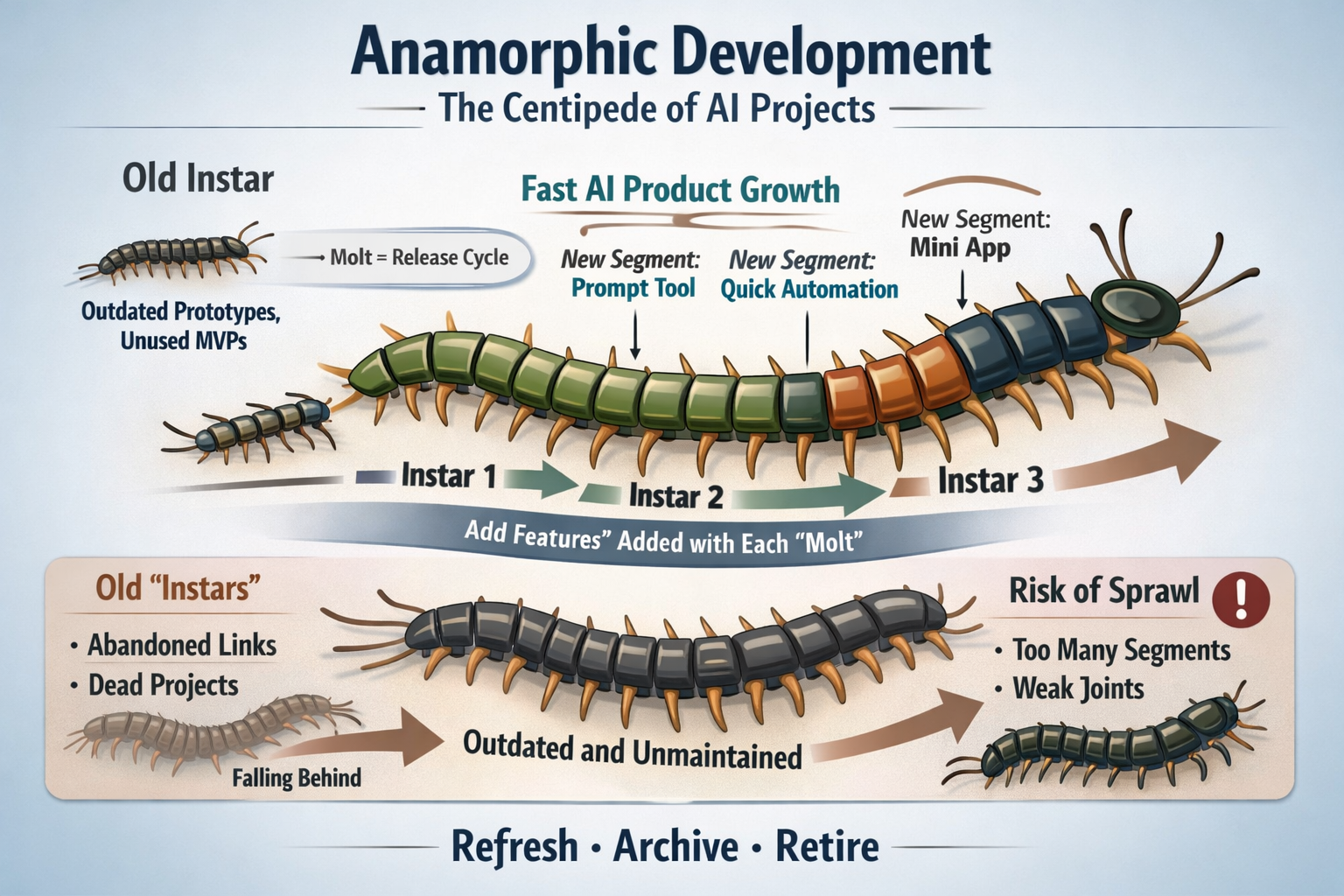
AI work often becomes anamorphic: each sprint adds segments fast, but without a maintenance molt, older instars get left behind and disappear.
Online Content Development
I thought this was fun to consider from an online content development:
Your content ecosystem can grow the same way: every new AI-enabled product (knowledge boosters, educator accelerators, micro-courses) is a new segment you add quickly, while older courses become interior segments—still part of the body of work, but increasingly overlooked. The risk isn’t that the old segments “break,” it’s that the whole system becomes hard to navigate and trust because some segments are stale.
My AI work is anamorphic. Since I keep adding new ‘segments’ fast, so I need a regular molt. That process (aka RAR) looks like this:
- Refresh what still matters. High-traffic or still-relevant courses get a light molt: update examples, links, screenshots, and AI/tool references.
- Archive what still helps. Content that’s still useful but not worth updating becomes a preserved “middle segment”: clearly labeled Archive (Year), frozen, searchable, and not marketed as current.
- Retire what now slows everything down. Content that’s misleading, redundant, or off-mission gets “shed”: redirect, unlist, or remove, with a short note pointing to the replacement.
A Revised Process for Content Creation
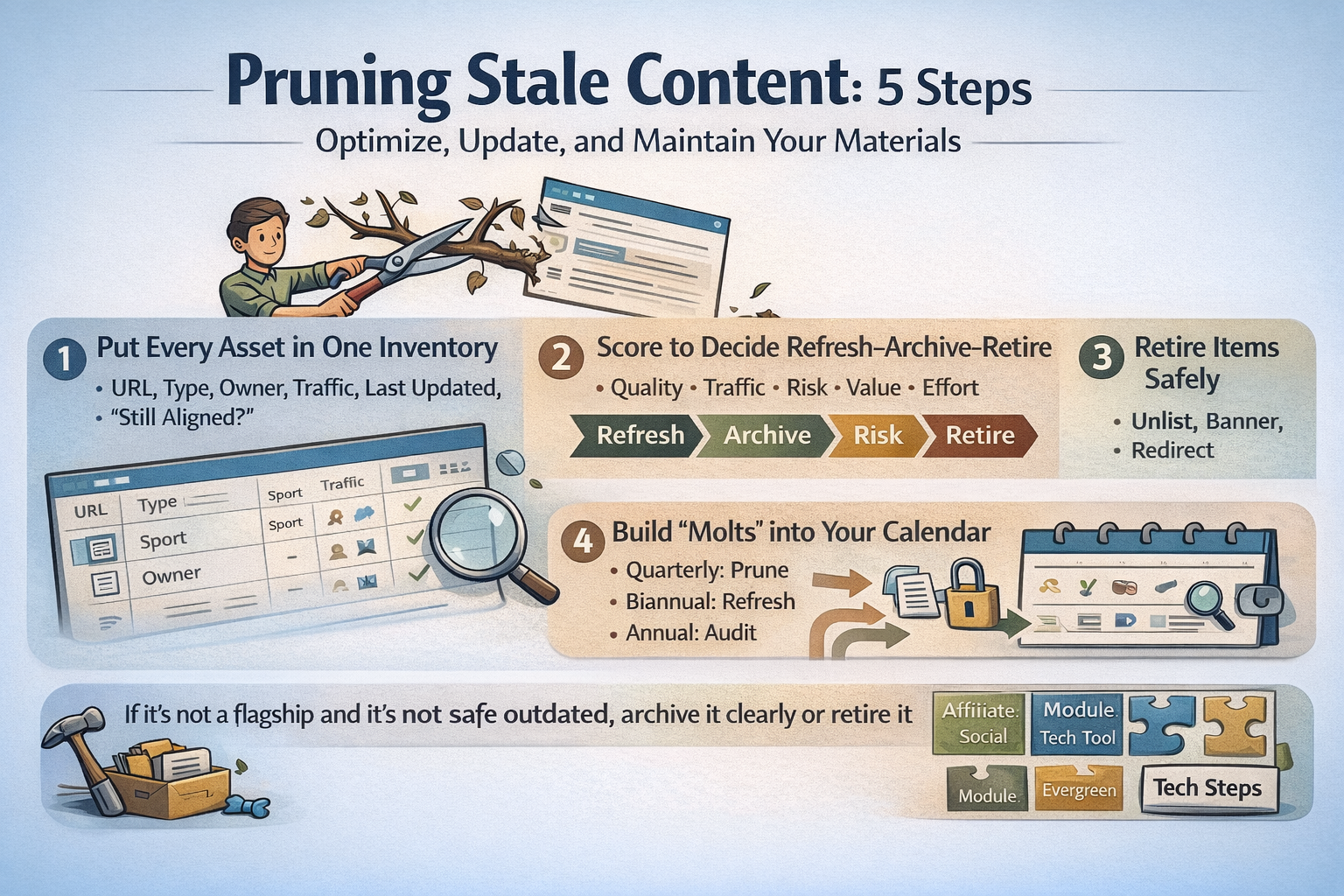
For fun, I asked ChatGPT for a fresh process. This is what it came up with…not surprisingly, it’s what I’m mostly doing already:
Discover more from Another Think Coming
Subscribe to get the latest posts sent to your email.
 Another Think Coming