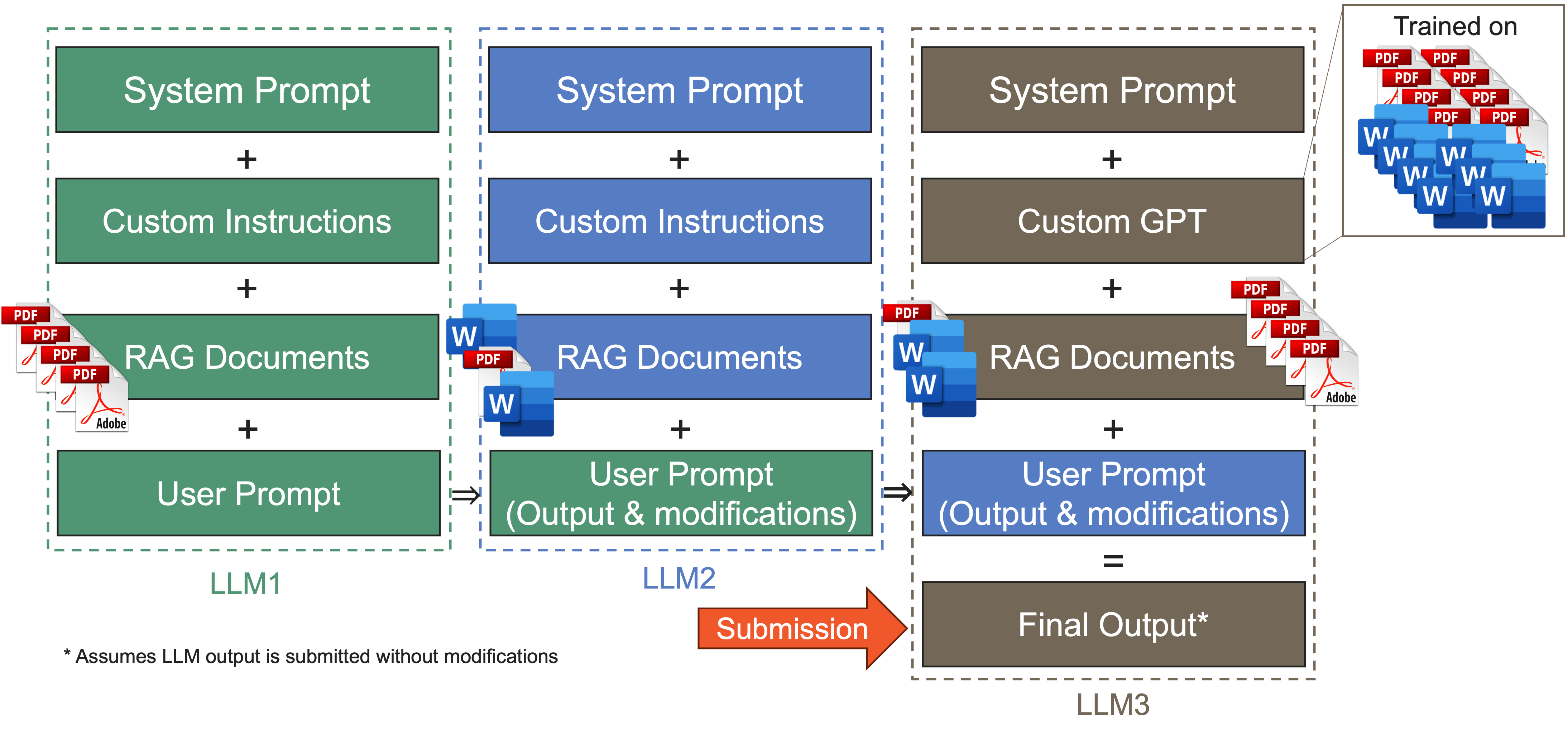
I love this diagram (Bassett, 2024) I stumbled on in the comments while reading and writing about Mike Kentz’ blog entry, You Don’t Have to Keep Up with AI. As a result, I ended up generating a few new diagrams to capture my reflections on Professor Bassett’s original diagram that reflect my situation and, perhaps, a future one where I can depend on one solution more than others. I wonder if we aren’t all going to be “speed juggling,” that is, juggling AI worlds spinning incredibly fast while we stand still?

Note: All images in this post generated by BoodleBox Unlimited’s Nano Banana Pro. Learn more online.
Chasing the AI Train
When a young educator, recently a father and husband living in East Texas, Bill Onley (assistant superintendent) said to me, “Technology is like a train you’re always chasing. You keep hoping you can hop on, but it stays just outside your grasp.” That’s my best paraphrase of what he described in his folksy, wise humor.
When I think about the AI Rat Race today, it’s definitely a competitive marathon with no end for the frontier LLMs like OpenAI, Google, Anthropic, and others. But do we all need to keep up with Gen AI the way these models are doing it?
The pace of competition today in the Gen AI area is breathtaking. I feel like I’m at the Kentucky Derby watching a nail-biter of a race. Consider this observation from Dario Amodei (co-founder and CEO of Anthropic) responding to Demis Hassabis (co-founder and CEO of Google DeepMind), as cited by Paul Roetzer in his SmarterX newsletter:
Demis: “There’s obviously competition between the companies, but also US and China, primarily…It would be good to have a bit of a slightly slower pace than we’re currently predicting, even my timelines, so that we can get this right society. But that would require some coordination.”
Dario: “Why can’t we slow down to Demis’ Timeline? The reason we can’t do that is because we have geopolitical adversaries building the same technology at a similar pace. It’s very hard to have an enforceable agreement where they slow down and we slow down.”
As someone deep into his K-12 education career, now working at a non-profit education association, learning to use Gen AI and share it is imperative. But does it need to be this fast? Some say, “Yes, it does. Essentially, we DO have to keep up with the rapid pace of change, even if that means destroying schools as they are now, and remaking them with Gen AI.”
Others suggest that isn’t necessary, as David Cutler points out:
What I’m pushing back on is the growing expectation — sometimes stated outright, sometimes implied — that teachers should embed AI tools into instruction as proof of modernity, relevance, or “future readiness.”
That expectation rarely originates in classrooms. It more often arrives through initiatives, policy language, and people fluent in phrasing that travels well online and to the right ears. Those systems stay tidy. Classrooms are not.
I hear polished phrases like “intentional integration,” “ethical use,” and “future readiness.” They sound good. They fit neatly on slides. They perform well in posts and professional development meetings. But classrooms don’t operate on slogans. They run on time, attention, skill-building, and constant tradeoffs.
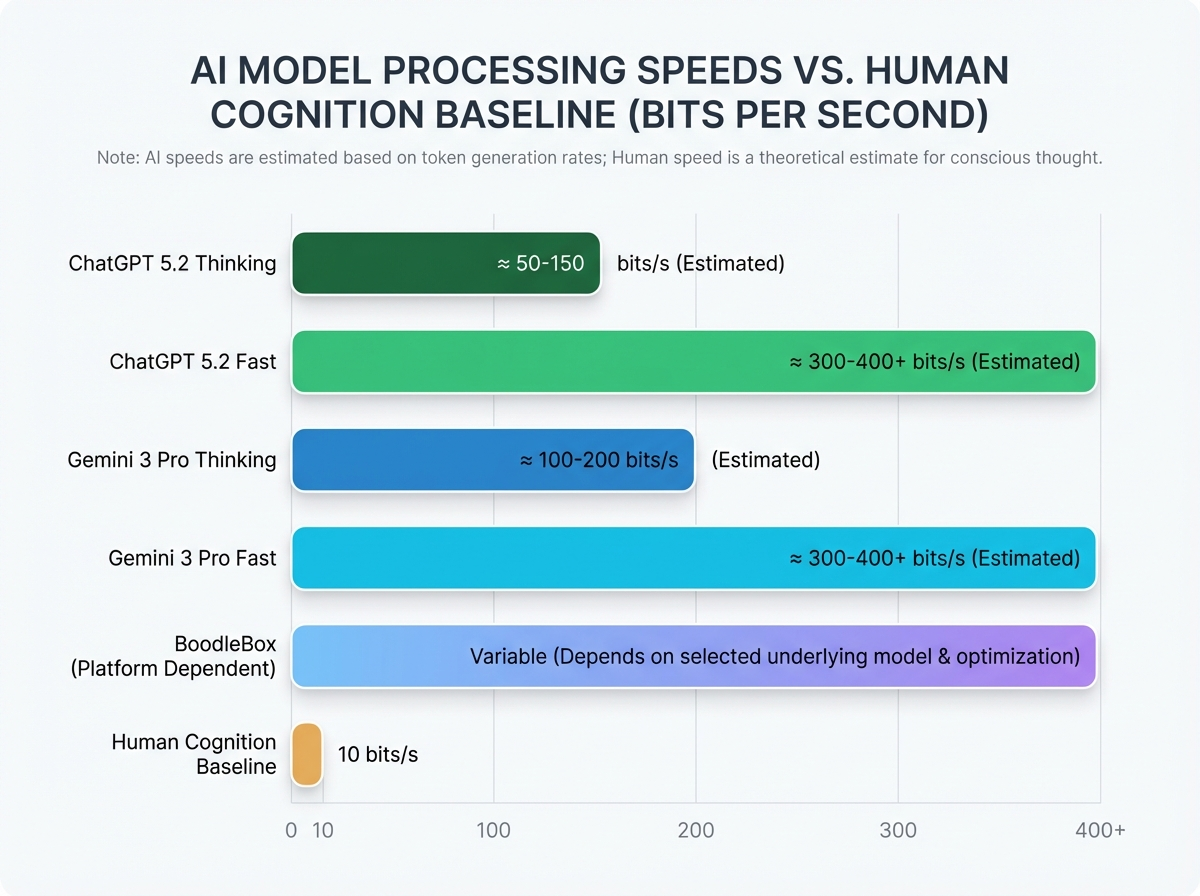
The whole train analogy is broken. When Ed Tech was slow, maybe it wasn’t. Now, Gen AI makes it impossible to keep up…or does it? The main limitation is what Mike Kentz referred to in his blog entry. That limitation is human, the 10 bits per second processing. Perhaps this diagram I asked BoodleBox to generate puts it into perspective:
Keeping Up
With that diagram in mind, is “keeping up” even do-able? We need a different way to process this.

I suspect that given the prevalence of free Gen AI tools for higher education students, this image of a “speed juggler” is an apt description of learners in the future. The balls may change, but the act of juggling does not. I regret all I know about juggling is what I learned in Joel Rosenberg’s D’Shai series. A bit from the book, which any writer may recognize as being “in the zone.”
A kazuh runner can, once kazuh is raised, run for hours; his only limitation is the endurance of his body, and while in the state of kazuh that doesn’t matter to him: he can and might and will run until his bones break and his muscles snap and he dies.
What if using Gen AI is a bit like raising kazuh, of being in the zone, while juggling impossibly fast spinning worlds of understanding and creation?
Less Fantasy, More Reality
Associate Professor Mark A. Bassett’s Dangerous AIdeas blog entry, On Keeping Up with AI, has a more realistic picture of how students use Gen AI. Check out both diagrams…what we think is happening and what is actually happening. Go check it out.
Aside: By the way, Professor Bassett covers a lot of heavy-duty topics in a video on Institutional Responses to GenAI. It’s worth a watch.
Professor Bassett’s perspective is that our current explanation of how students use AI is simple (and he offers a diagram that captures that). Instead, he proposes a second diagram that reflects the use of three different LLMs, and I found it to be quite reflective of my own processes in using LLMs. I love the simplicity of Bassett’s diagram and how it captures the multiple LLMs that someone might employ.
After reflecting on it a bit, I wondered, how could I represent my own collaboration efforts with multiple LLMs?
Aside: I keep a ChatGPT, Gemini, and BoodleBox account. Over time, that’s going to become unsustainable. So, I’m trying to find a multi-purpose tool that will do the best work for me. For now, BoodleBox (as my base tool) plus ChatGPT or Gemini get the job done. I keep hoping BoodleBox will improve even more (e.g. voice chats, a better mobile app, support for video) since I don’t want to keep paying for three every month. Right now, I subscribe to ChatGPT or Gemini depending on which one works best for my needs. But in time, I hope to shed one or two of these LLMs and keep BoodleBox as my go-to.
Harnessing AI Collaboration
When preparing for workshops, etc. this process is what I often follow. The first LLM is usually ChatGPT Project, where it’s easy to gather a wide variety of documents. The next is Gemini Pro (v3), then I take the remainder and drop it into BoodleBox where I can use a variety of models a la bot stacking.
That might look like this, which I think is a fairly similar to what Professor Bassett’s image. In this diagram below, the person is at the center, doing all the coordinating (at 10 bits per second), while the AI collaborators (e.g. BoodleBox, Gemini, ChatGPT) are moving a LOT faster.
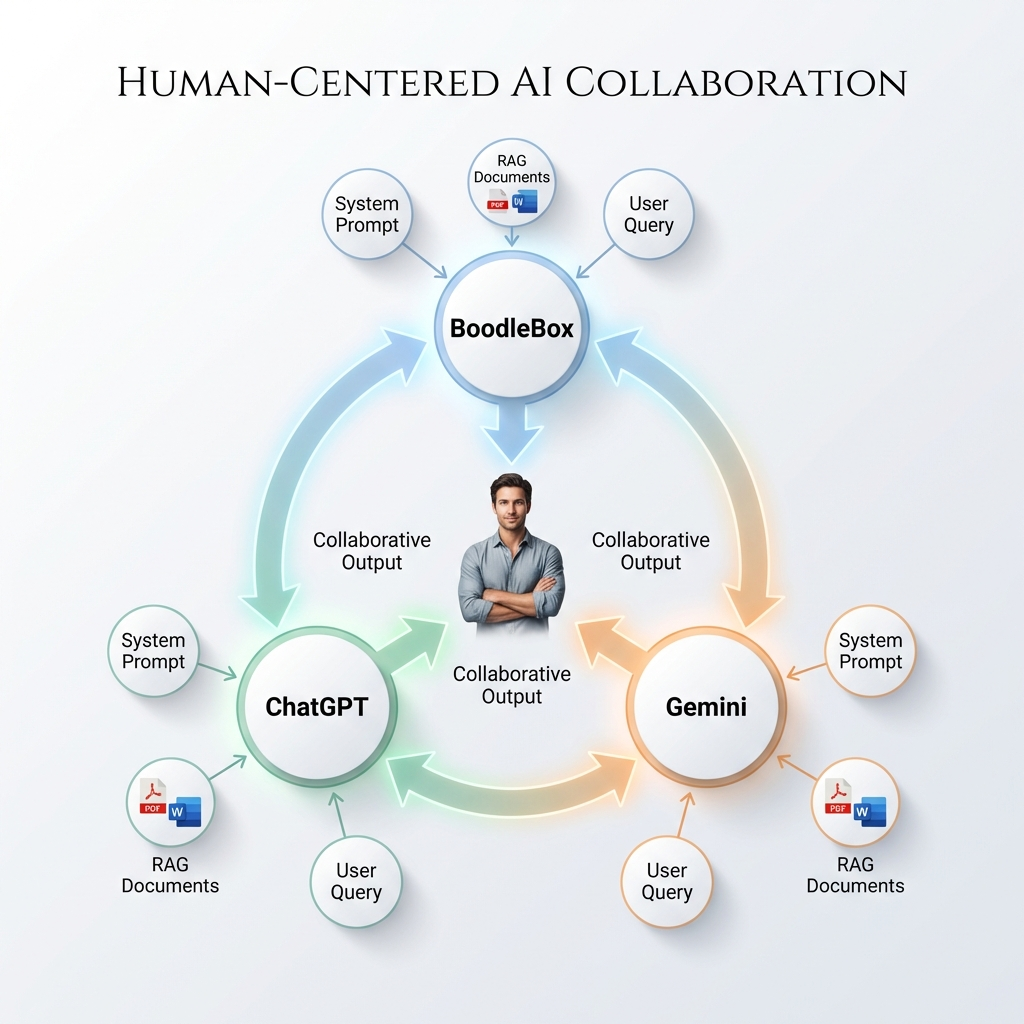
As you can probably imagine, I’m shuffling content increasingly between these various tools. And, the BoodleBox aspect includes multiple models, depending on which is most appropriate for the task or that gets me the desired result.
Adding Local AI
In time, I want the process to look like this, if it needs to…a way of incorporating local AI tools (e.g. Ollama with Page Assist or whatever is the latest and greatest) in ways that work.
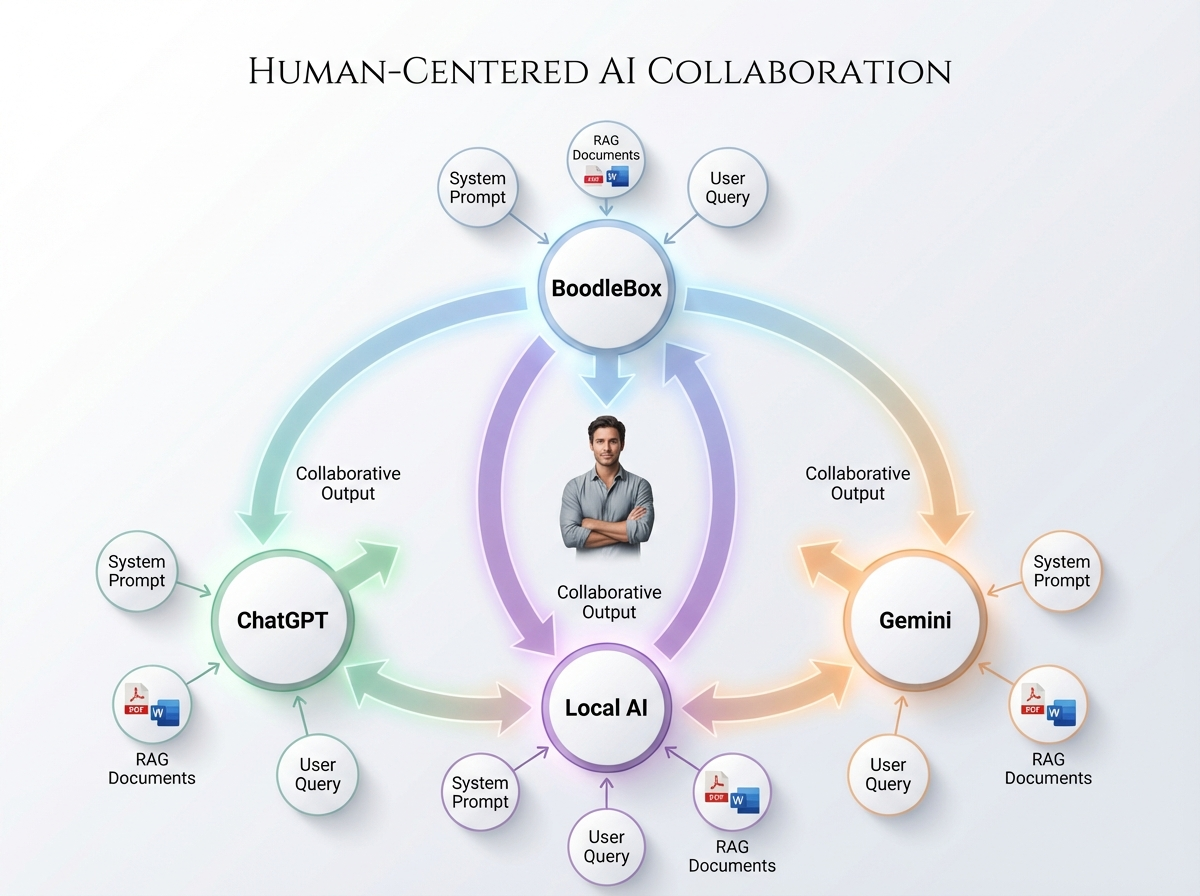
Of course, in terms of privacy and safeguarding information, I’m probably going to end up with something like this:
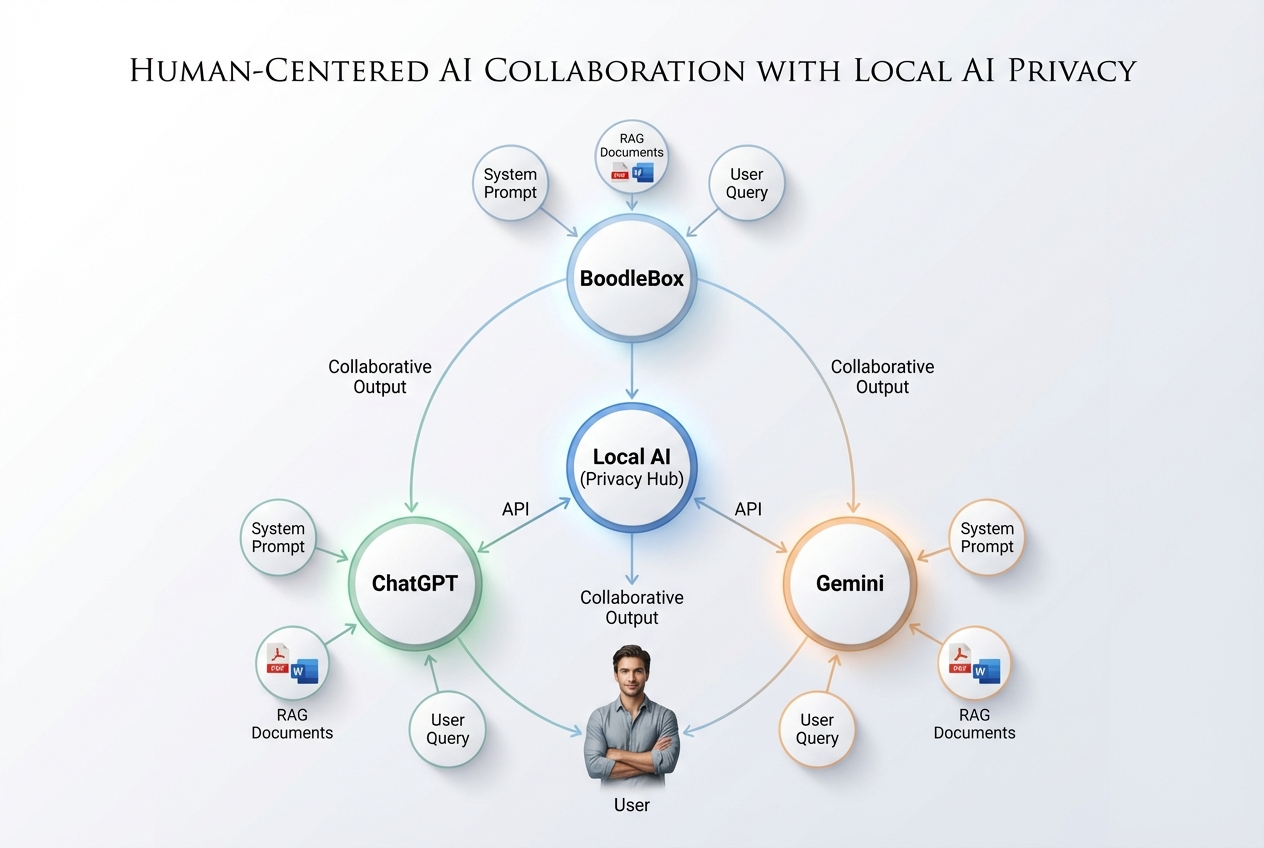
In this last diagram, I have the option of ChatGPT and Gemini, if I choose to pay for them via API. The benefit? My data is safeguarded and all the work happens on my device. If I need it, BoodleBox is available. The truth is that BoodleBox provides the value of all the LLMs for $20 a month. It’s worth the subscription, so long as I don’t need to use Gen AI on my smartphone for voice chat (which I really prefer but seldom use).
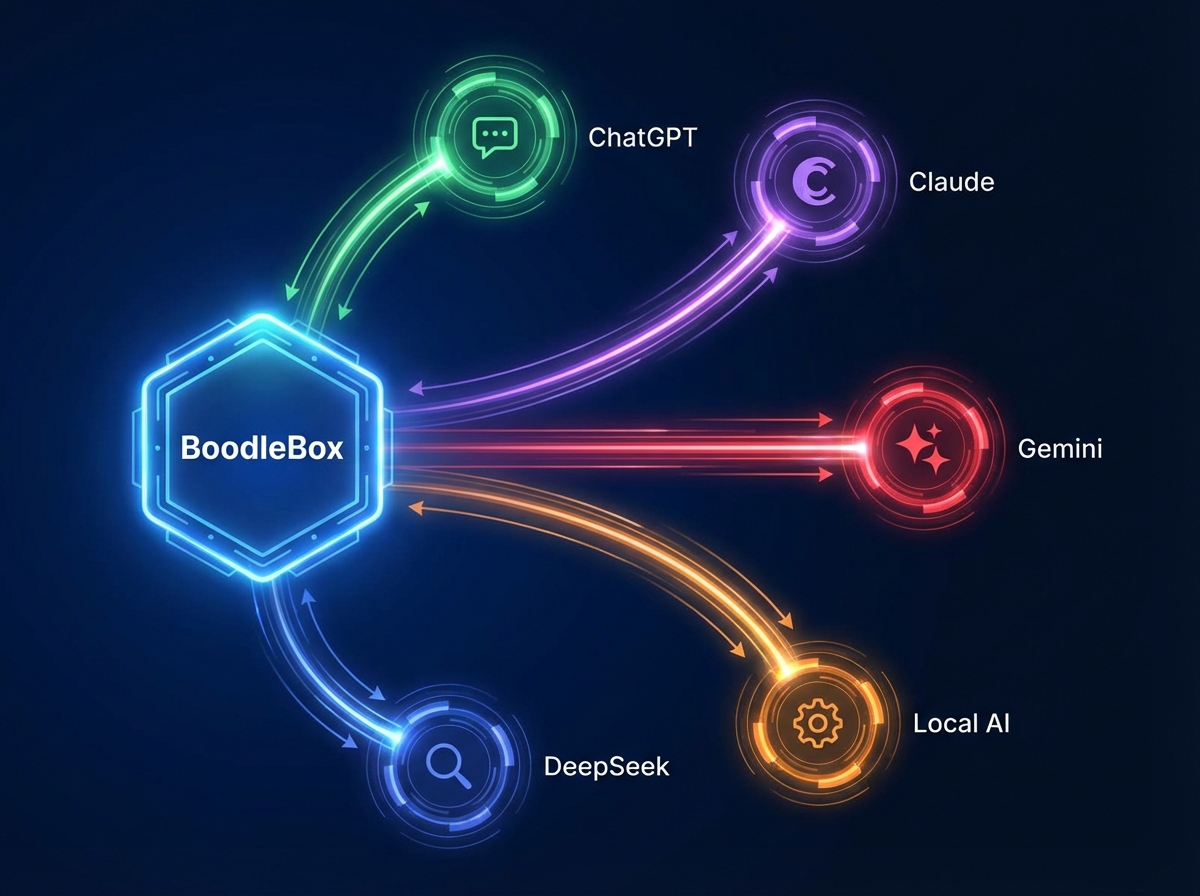
Ok, one final generated image. I was hoping for a juggler but use your imagination.
Discover more from Another Think Coming
Subscribe to get the latest posts sent to your email.
 Another Think Coming