Wow, it’s the last day of TCEA 2026 Convention and Exposition. I thought I’d share some of the artifacts for my last session of the event. These items below were generated anew from my original session resources for the presentation. Enjoy!
View the Slide deck as a PDF | Watch Video |
Listen to Podcast
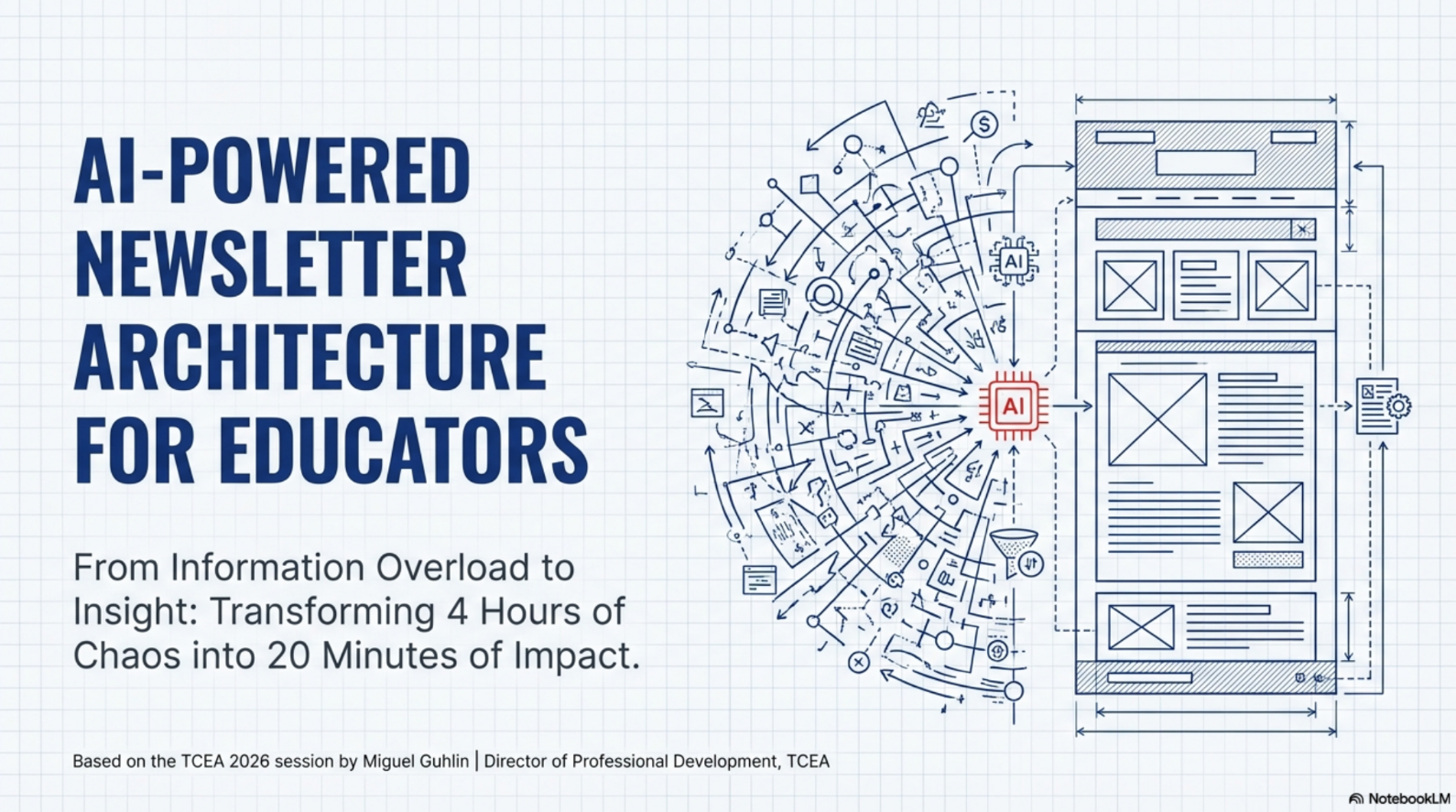
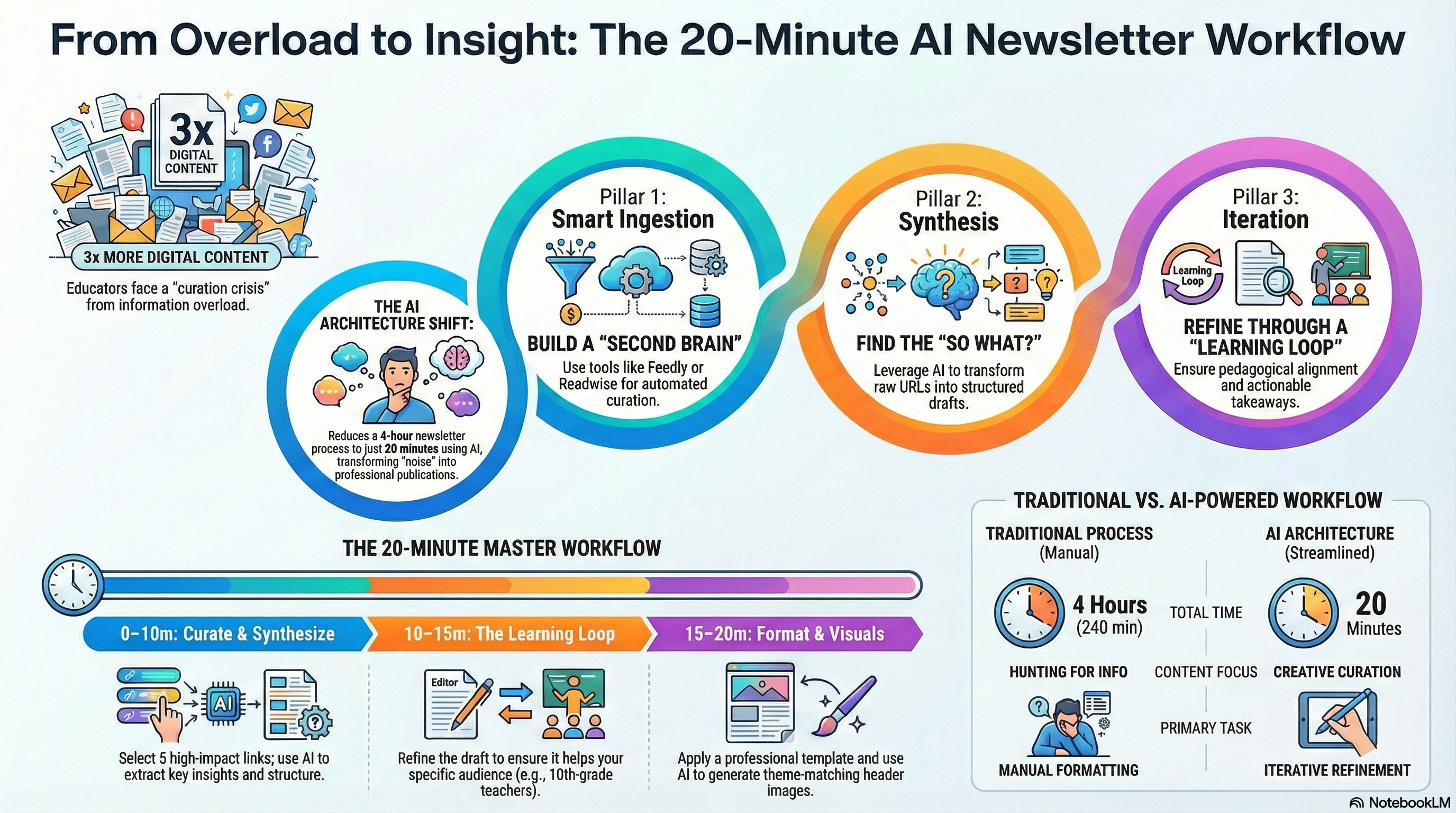
Infographic
Slide Deck (Animated GIF)
The 20-Minute Architect: How AI is Rescuing Educators from the “Curation Crisis”
1. Introduction: The Digital Squeeze
Educators today are operating under a “digital squeeze,” consuming three times more content than they did just five years ago. We are drowning in a chaotic sea of tangled wires—social feeds, endless podcasts, and a barrage of articles that often lead to more noise than insight. The central problem isn’t a lack of resources; it’s that this information overload creates cognitive friction, preventing raw data from transforming into meaningful learning. To bridge the gap between noise and student impact, we must shift from being overwhelmed consumers to becoming “Learning Loop Architects.”
2. Takeaway 1: From Content Curator to Learning Loop Architect
The transition to an Architect requires a fundamental mindset shift. You are no longer just gathering links in a digital bucket; you are building a deliberate system—an architecture standing on three pillars: Ingestion, Synthesis, and Iteration. A professional newsletter is not a list; it is an intentional learning experience. As an Architect, your job is to find the “So What?” for your specific audience, ensuring that every piece of content is curated with a 10th-grade teacher or a campus counselor in mind.
“Today isn’t about adding another ‘to-do’ to your list. It’s about building an architecture—a system that moves you from being a person who is overwhelmed by information to a ‘Learning Loop Architect’ who masters it.”
3. Takeaway 2: The 20-Minute Master Workflow
The most significant barrier to professional sharing is the “4-hour grind” of manual curation and formatting. By leveraging a streamlined AI workflow, we can reduce that labor to 20 minutes of creative curation. The process is broken into four precise 5-minute stages:
- 0–5 Minutes: Curate – Select five high-impact “seeds” from your pre-saved “Second Brain.”
- 5–10 Minutes: Synthesis – Run links through an AI “Architect” to extract the core value and draft the structure.
- 10–15 Minutes: Iteration – Refine the draft for pedagogical alignment and actionable takeaways.
- 15–20 Minutes: Format – Drop text into a template and generate clean, professional visuals.
Strategist’s Tip: When it comes to visual design, if it takes more than five minutes, you’re overthinking it. Keep it simple: professional colors, no distorted lettering, and clear text.
4. Takeaway 3: Building a “Second Brain” for Smart Ingestion
The secret to speed is Smart Ingestion. Stop “hunting” for content; that is where the four hours go. Instead, build a “Second Brain” using tools like Feedly, Readwise, or Raindrop.io. This strategy allows you to collect “seeds” during low-stakes moments—like your morning coffee—simply by “liking” or “saving” the best bits.
“Stop ‘hunting’ for content. That’s where the 4 hours go. Instead, use tools… to let the content come to you.”
By the time you sit down to create, your raw materials are already waiting for you in your digital archive.
5. Takeaway 4: The “Role-Context-Task” Prompting Formula
Professional results require professional prompts. To move the AI from generic reporting to specialized teaching, you must use the “Role-Context-Task” formula. This provides the AI with the necessary constraints to produce high-leverage content.
- Role: Define the persona (e.g., Classroom Teacher, Instructional Coach, Campus Administrator, or Counselor).
- Context: Provide the lens (e.g., “Our district’s overall school vision” or “Focusing on Universal Design for Learning (UDL)”).
- Task: Define the output (e.g., “Summarize these links into actionable takeaways”).
This formula forces the AI—and you—to move beyond “what happened” to “how we grow.”
6. Takeaway 5: The “Instructional Playbook” vs. The “Community Pulse”
Having a pre-defined structure is critical for synthesis speed because it creates predictable, repeatable issues that save cognitive load for your readers. Contrast these two high-impact models:
- The Instructional Playbook: Built for the “Science of Teaching,” this model focuses on pedagogical themes. It includes a “Quick Win” Strategy (under 5 minutes to implement), a “Peer Spotlight” to celebrate classroom wins and sharing culture, and the “Evidence Corner” which summarizes the research behind the practice.
- The K-12 Community Pulse: Focused on the “Home-School Bridge” and district branding. It features a “Leadership Note” on weekly values, a “Need to Know” Grid for upcoming deadlines, and campus spotlights.
7. Takeaway 6: The “Silent Thirst” – The Physical Cost of Digital Efficiency
Digital efficiency is a powerful tool, but we must acknowledge its environmental metacognition. There is a “physical cost” to our automation. It likely took about two standard bottles of water to research, draft, and visualize a single issue of a professional newsletter. When multiplied by one billion daily prompts, we are building a literal “Empire of Water.”
In water-stressed regions, a single 1MW data center can consume as much water as 400 people. As strategists, we should advocate for transparency and look for models like Mistral Large 2, which is setting standards by publishing full-lifecycle environmental impact reports.
“Digital efficiency is a powerful tool, but it doesn’t come for free.”
8. Takeaway 7: The “3-2-1 Summary” for High Retention
To truly “close the loop” and ensure your curation moves the needle on practice, every issue should end with a 3-2-1 Summary:
- 3 Big Ideas: The core conceptual takeaways.
- 2 Insights or Quotes: Perspectives specifically chosen to encourage “unlearning and relearning.”
- 1 Actionable Challenge: A specific “homework” task for the reader.
Without that final challenge, the loop remains open, and the curation remains mere information rather than a catalyst for transformation.
9. Conclusion: Start Small, Close the Loop
The shift from the four-hour grind to a 20-minute architecture is a choice. You can move from being overwhelmed to becoming an empowered Learning Loop Architect today. Do not attempt to build a masterpiece on day one. Start small: pick one topic, utilize a Prompt Cheat Sheet, and send a curated insight to just three colleagues this week.
Once you close that first loop and see the impact on your community, you’ll never go back to the manual grind. What will you start with?
Discover more from Another Think Coming
Subscribe to get the latest posts sent to your email.
 Another Think Coming