Note: I set up a Claude Project that combines StoryMaker, SlideMaker, and BlogAssembler (sets of custom instructions) to help me decipher the Anthropic labor research report in terms of a story I am familiar with. This is what it came up with. My question is, “Is it compelling?”
What Anthropic’s labor research means if you work in marketing — and you’re already using Gen AI.
You’re good at your job. You know your market. You’ve already got BoodleBox, Claude, or Gemini open in a tab, drafting copy or pulling competitive data while your colleagues are still figuring out what prompt engineering means.
That’s not nothing. That instinct put you ahead.
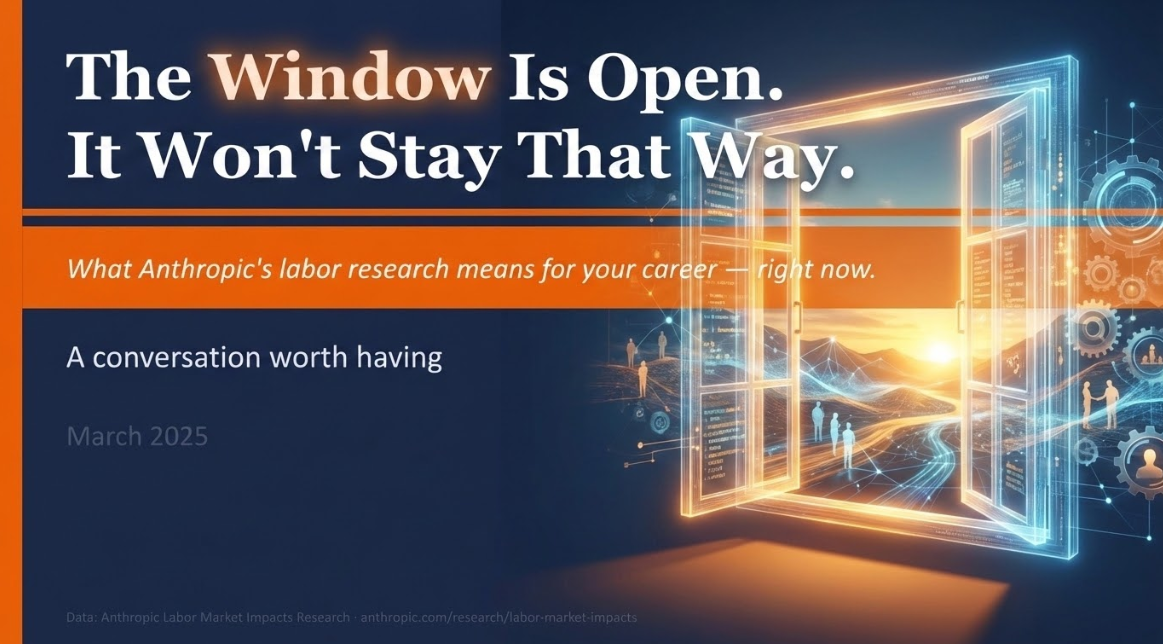
But here’s the thing I keep thinking about after reading Anthropic’s labor market research: being ahead right now is not the same as being safe.
Sound familiar? That gap between “I use AI tools” and “AI does my job” is smaller than most people realize — and it’s closing faster at the director level than anywhere else.
The Numbers Aren’t Theoretical
Anthropic didn’t publish predictions. They published usage data — what Claude is actually doing in the real world, measured from real interactions. Here’s what that looks like for five areas:
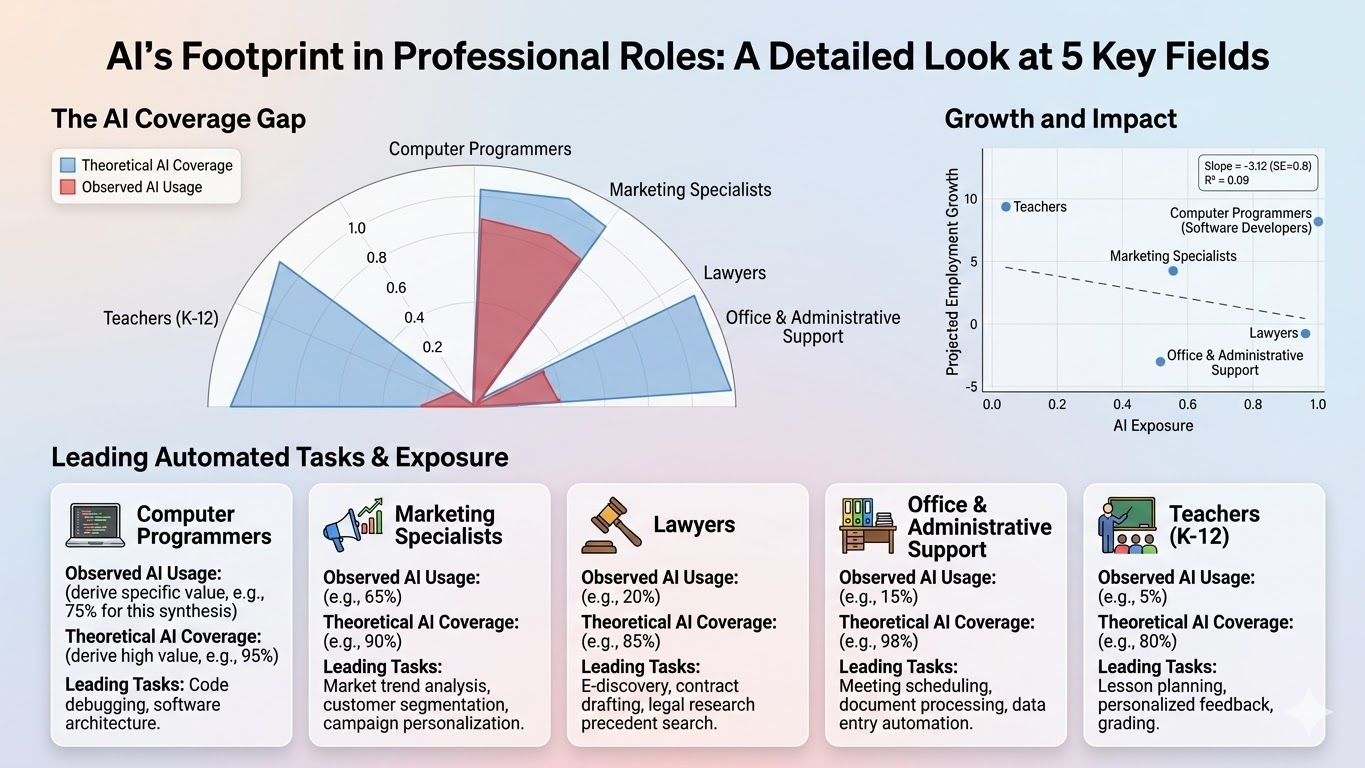
The results for marketing, sales, and management roles are not subtle.
| Occupational Category | Observed AI Exposure |
|---|---|
| Business and Finance | 94% |
| Management | 92% |
| Sales | 72% |
| Education and Library | 68% |
That 94% figure for Business and Finance doesn’t mean 94% of those jobs are gone. It means 94% of the measurable tasks in that category are ones Gen AI is already performing for someone, somewhere, today.
When I first looked at this data, I had to sit with it for a minute. Because the categories most exposed aren’t warehouse workers or truck drivers. They’re the knowledge workers who spent the last decade assuming education and credentials were their protection.
The most exposed individual roles tell the same story:
- Computer programmers: 74.5% observed exposure
- Customer service representatives: 70.1%
- Market research analysts: 64.8%
- Sales representatives: 62.8%
- Financial analysts: 57.2%
If your job involves writing, analyzing, reporting, or customer communication — and most marketing director roles involve all four — you are in the high-exposure zone.
What “Exposure” Actually Threatens
Here’s what I don’t think gets said clearly enough: the threat isn’t that you lose your job tomorrow.
The threat is quieter. Your role gets restructured. The title stays. The salary shrinks. Autonomy disappears. A junior person with the right tools does 80% of what you do today — at a fraction of the cost — and suddenly the director position looks very different from the inside.
This is already happening in marketing departments. Not as a rumor. As a reorganization pattern.
The people who come through this intact are not the ones who used AI tools the most. They’re the ones who positioned themselves around what Gen AI genuinely cannot do: local knowledge, strategic judgment, relationships, and the ability to recognize when the AI is wrong about their specific market.
If you work in internet marketing for a car dealership in a specific city, you know things Claude doesn’t. You know which inventory sits and why. You know what messaging lands with your buyers and what falls flat. You know the competitive landscape on your stretch of highway. That’s not data in a model. That’s earned knowledge.
The question is whether you’ve made that knowledge visible — and indispensable.
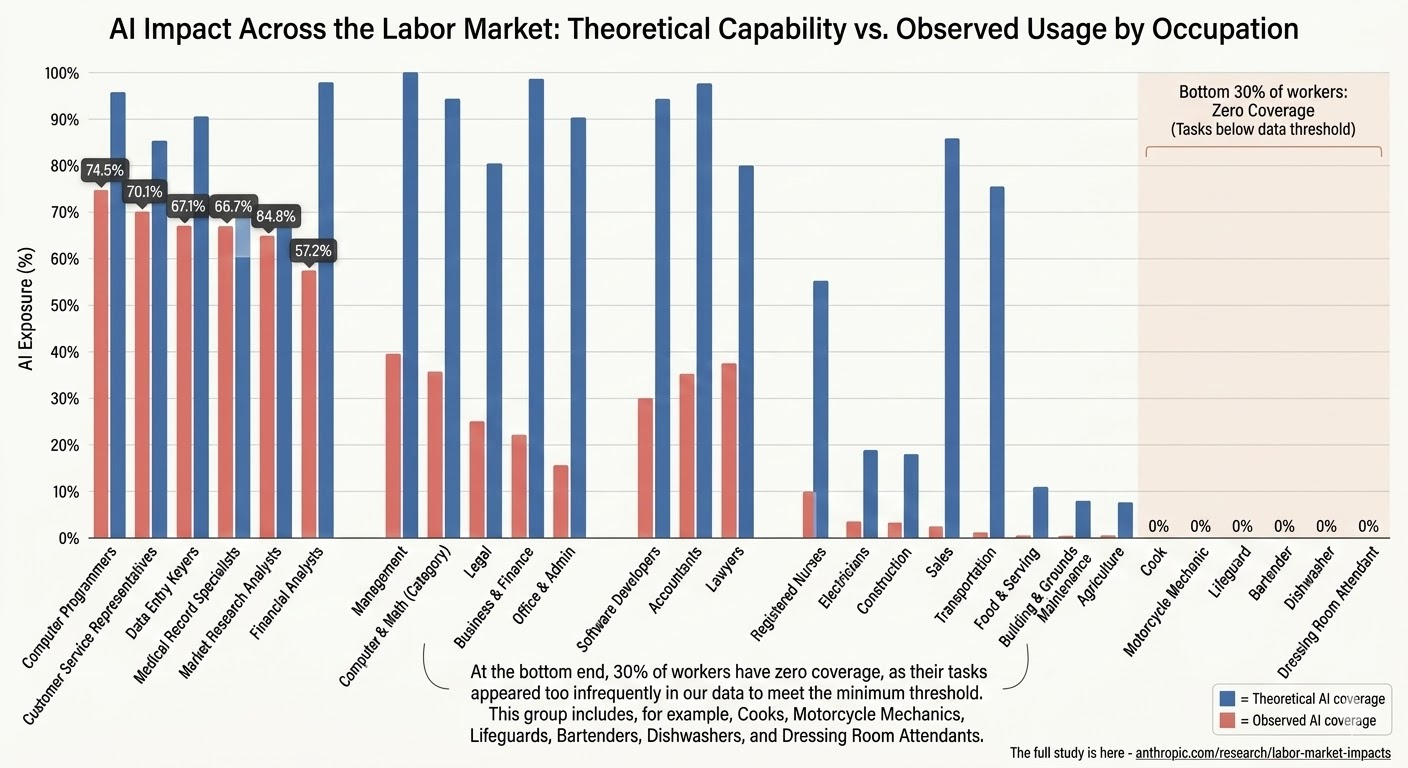
The gap is smallest for tech-centric and specific analyst roles (far left), where observed usage (annotated in black boxes) aligns more closely with theoretical potential. In contrast, physical and service labor occupations (far right) show minimal AI impact in both metrics. Notably, a shaded section highlights the “bottom 30% of workers” (including service roles like cooks and bartenders) who currently have zero measured AI exposure because their specific job tasks fell below the study’s data threshold.
Two Directors. Same Title.
I’ve started thinking about this in terms of two versions of the same role.
Director A uses Gen AI to go faster. More copy, faster turnaround, better-looking reports. The work product improves. The director feels efficient. From the outside, this looks like an asset.
Until the dealership realizes a junior hire with the same tools can produce the same output.
Director B does something different. They use Gen AI to amplify judgment, not replace it. They audit their own task list, identify which pieces of their role are execution versus strategy, and deliberately push their value into the strategy layer. They get publicly certified — not because they need a credential, but because visible learning signals intentionality to an employer. They make themselves the person who knows when the AI is wrong, not the person the AI makes redundant.
Director B is harder to replace. More importantly, Director B becomes more valuable as Gen AI gets more capable — because the judgment layer gets more critical, not less, as the execution layer gets automated.
Which director are you building toward?
Four Moves. Start This Week.
I’m not going to tell you to “stay curious” or “embrace change.” You’ve heard that. Here’s what actually moves the needle:
1. Audit your task list. Spend 20 minutes writing down everything you did last week. Then ask, honestly: which of these could Gen AI do without my specific knowledge of this market and these customers? Those tasks are your vulnerability map. Don’t ignore them.
2. Get publicly certified. Google’s Generative AI courses are free. HubSpot’s AI Marketing certification takes a few hours. The credential matters less than the signal: you’re not waiting for someone to tell you this is important. You already know.
3. Own the judgment layer. Your local market knowledge is your moat. Document it, articulate it, and make sure your employer understands that this is the part of your job that Gen AI cannot replicate. You know things about your buyers that aren’t in any training dataset.
4. Position yourself for strategy, not execution. Director-level roles are being restructured everywhere. Your job security lives in decisions, relationships, and the ability to see around corners — not in deliverables that a well-prompted model can produce in minutes.
None of this requires a career change or a dramatic pivot. It requires a clear-eyed look at where you’re spending your energy — and a deliberate choice to shift toward the parts of your role that compound over time.
The Window Is Still Open
I’ve been in education technology long enough to watch several waves of “this changes everything” come and go. Most of them didn’t change as much as the hype suggested.
This one is different. Not because of the hype — because of the usage data. Anthropic isn’t telling us what Gen AI could do to knowledge work. They’re showing us what it’s already doing.
The professionals who come out of this period well are the ones who saw the data, took it seriously, and made a move before someone else made it for them.
You’ve figured out harder things than this.
Start with the audit.
Interested in looking at the research yourself? Anthropic’s labor market impacts study is worth reading in full — not just for the numbers, but for what they’re measuring and how.
Discover more from Another Think Coming
Subscribe to get the latest posts sent to your email.
 Another Think Coming