AI Adoption Readiness Checklist for Nonprofit Organizations
Thought this might be fun to cook up given interest in Ai from nonprofit organizations. I love how it’s not about the tech or the innovation, but the change management process. If you are an organization that hasn’t managed change successfully before, AI implementation will find a hard road ahead to success.
Based on research by Dr. Priyanka Dave — adapted for nonprofit organizations
“80% of AI adoption efforts fail — not because of employee motivation, but because of broken organizational systems. Use this checklist before spending another dollar on AI training.”
— Dr. Priyanka Dave, Inc. (March 2026)
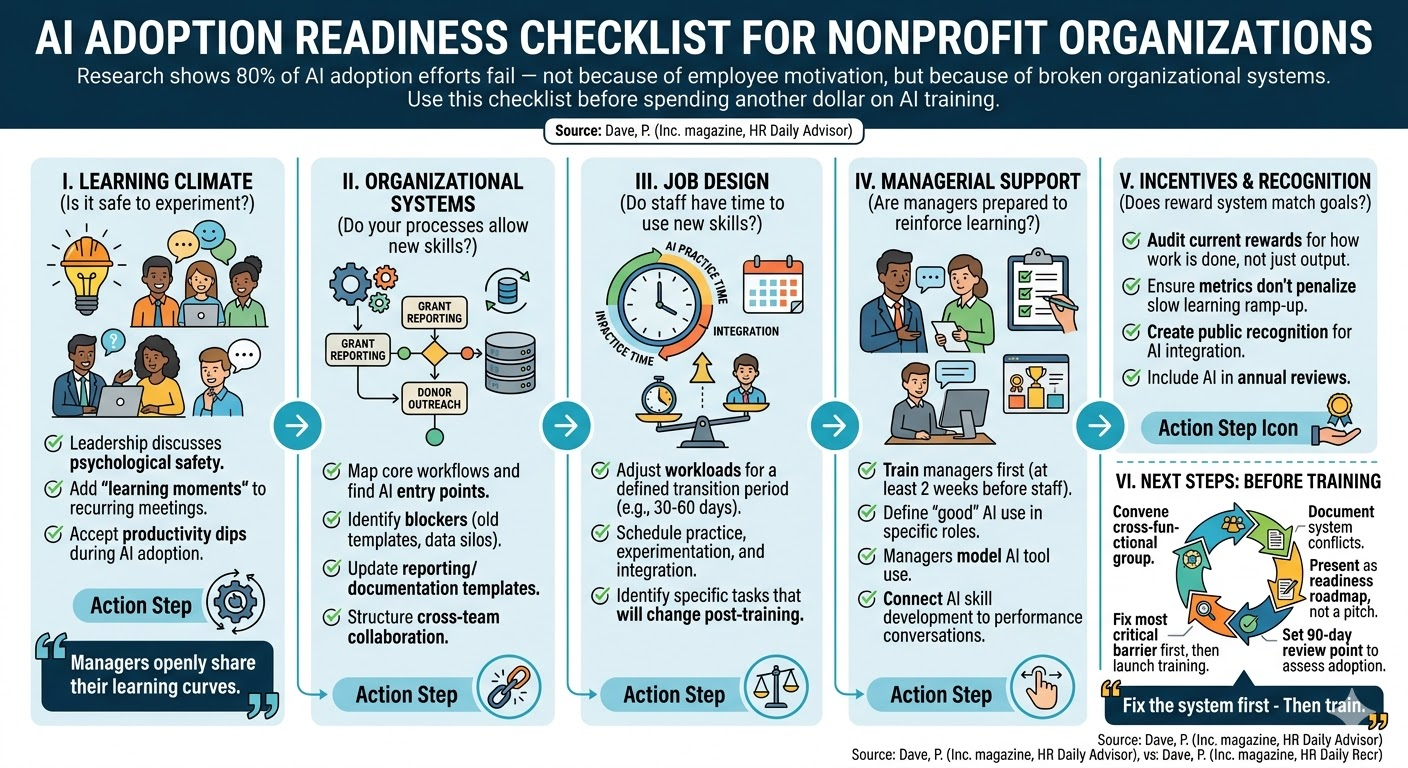
AI ADOPTION READINESS CHECKLIST
For Nonprofit Organizations
Research shows 80% of AI adoption efforts fail — not because of employee motivation, but because of broken organizational systems. Use this checklist before spending another dollar on AI training.
Source: Dave, P. (2026, March). “80 Percent of AI Adoption Efforts Fail—It Has Nothing to Do With Motivation.” Inc. magazine. Secondary source: Dave, P. (2025, December 22). “Why Your AI Upskilling Will Fail (Unless You Fix These 5 Things First).” HR Daily Advisor.
I. LEARNING CLIMATE — Is it safe to experiment?
“Leadership talks about innovation but punishes any deviation from established processes. Employees complete AI training but stick to the old way because ‘that’s how we’ve always done it’ is the safer choice.” — Dave (HR Daily Advisor, 2025)
Before launching AI training, ask your staff:
[ ] When someone tries a new approach and it fails, what typically happens? (If the answer is “nothing good,” fix culture first.)
[ ] Do team meetings include space for “what I tried this week”?
[ ] Do managers openly share their own learning curves with new tools?
[ ] Are staff rewarded for experimentation, or only for error-free execution?
Action steps:
[ ] Hold a leadership conversation about psychological safety and AI experimentation.
[ ] Add “learning moments” to a recurring all-staff or team meeting.
[ ] Explicitly state that productivity dips during AI adoption are expected and acceptable.
II. ORGANIZATIONAL SYSTEMS — Do your processes allow new skills to take root?
“Your company trains people on AI data analysis tools, but the monthly reporting template hasn’t changed in five years and doesn’t accommodate new insights. Employees either force new learnings into old formats or abandon them entirely.” — Dave (HR Daily Advisor, 2025)
Audit your workflows:
[ ] Map 2–3 core workflows (e.g., grant reporting, donor outreach, program data) and identify where AI could fit.
[ ] For each workflow, ask: “If staff wanted to use AI here, what would stop them?” (Old templates, approval chains, and data silos are common blockers.)
[ ] Identify whether reporting or documentation templates need updating to reflect AI-assisted work.
[ ] Determine whether cross-team collaboration is structurally supported, not just encouraged in theory.
Action steps:
[ ] Remove at least one structural barrier before training launches.
[ ] Designate a shared space (doc, Slack channel, etc.) to capture what works — build organizational memory.
III. JOB DESIGN — Do staff have time and space to actually use new skills?
“An employee completes prompt engineering training but still has the same deliverable deadlines and the same workload. They don’t have time to use new AI tools or integrate them into their daily work.” — Dave (HR Daily Advisor, 2025)
Check for these common blockers:
[ ] Staff are being asked to add AI tools on top of already full workloads.
[ ] No time has been built into schedules for practice, experimentation, or integration.
[ ] Deliverable deadlines and expectations haven’t changed to reflect a transition period.
Action steps:
[ ] Before training, identify which specific tasks will be done differently afterward.
[ ] Adjust workload expectations for a defined transition window (e.g., 30–60 days post-training).
[ ] Add “AI application time” as a line item in relevant job roles or weekly planning.
IV. MANAGERIAL SUPPORT — Are managers prepared to reinforce what staff learn?
“Employees are excited about what they have learned and the opportunity to experiment with AI — but are quickly frustrated when they find their supervisors and managers aren’t quite sold on the new tools. They quickly revert to the old ways of doing things.” — Dave (HR Daily Advisor, 2025)
Manager readiness check:
[ ] Managers have been trained on AI tools before their direct reports.
[ ] Managers can clearly describe what “good” AI adoption looks like in specific roles.
[ ] Managers are comfortable modeling the use of AI tools, not just endorsing them verbally.
[ ] AI skill development is part of, or connected to, performance conversations.
Action steps:
[ ] Train managers first — at minimum two weeks before staff training begins.
[ ] Provide managers with a simple checklist of what AI-enabled work should look like per role.
[ ] Coach managers on how to give feedback on AI skill application, not just task output.
V. INCENTIVES & RECOGNITION — Does your reward system match your training goals?
“Here is the brutal reality: people do what gets rewarded, not what gets trained. If your incentive systems still reward speed over quality, volume over insight, or individual heroics over collaborative problem-solving, no amount of training will change behavior.” — Dave (HR Daily Advisor, 2025)
Audit your current reward signals:
[ ] Review how promotions, recognition, and merit increases are currently awarded. (Do they reward how work gets done, or only what gets done?)
[ ] Identify whether any current metrics actively discourage AI experimentation. (E.g., speed-based metrics that penalize the slower ramp-up of learning a new tool.)
[ ] Check whether informal peer recognition aligns with adopting new approaches.
Action steps:
[ ] Before training, adjust at least one formal metric to reward AI skill application — not just output volume.
[ ] Create visible, public recognition for staff who integrate AI into their work.
[ ] Ensure annual reviews or check-ins include a question about AI adoption progress.
VI. NEXT STEPS — Before you spend another dollar on AI training
“Training programs shouldn’t be the starting point when you’re upskilling employees to build competencies in the use of AI tools. To be effective, training should follow a thorough analysis of the learning and work environment.” — Dave (HR Daily Advisor, 2025)
[ ] Convene a cross-functional group (program, ops, comms, leadership) to work through this checklist together.
[ ] Document where your current systems conflict with desired AI behaviors.
[ ] Present findings to leadership as a readiness roadmap — not as a training pitch.
[ ] Fix the most critical systemic barrier first, then launch training.
[ ] Set a 90-day review point to assess adoption and adjust.
“The goal is not to train staff on AI. The goal is to build an organization where new skills can take root. Fix the system first — then train.” — Dave (HR Daily Advisor, 2025)
 Another Think Coming