Here’s a little story via Claude about AI in education. How much of it rings true for educators in Texas? None of the characters are real.
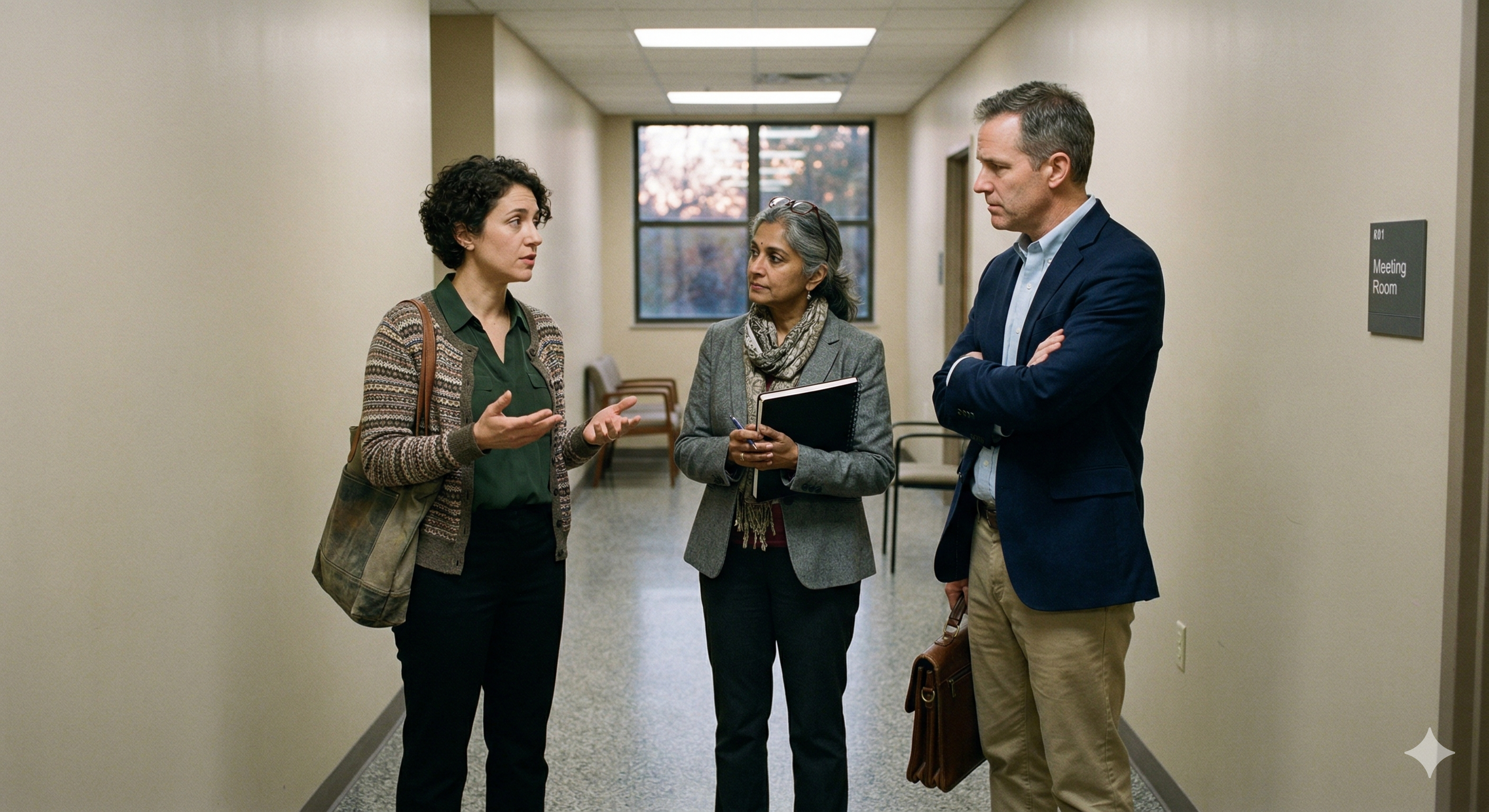
A Conversation in the Hallway
Three educators talk after a long day at an educators’ meeting about Gen AI.
Characters:
- Maya — middle school CS teacher, 12 years in the classroom
- Robert — assistant superintendent, mid-sized Texas district
- Dr. Priya Nair — professor of education policy, state university
Maya: I’ve been turning this over in my head all day. We spent hours talking about AI in education, and the thing that keeps nagging at me is — we don’t even have a starting point. No state vision. No strategy. No one at the agency who’s actually empowered to do anything about it. I kept waiting for someone to say, “Here’s what Texas is building toward,” and it never came.
Robert: That’s the part that keeps me up at night, honestly. I went back and looked at our district policy after we got that survey data. We updated our acceptable use policy, threw in a paragraph about AI, and called it done. And apparently that puts us ahead of seventy percent of districts in the state. That’s not a compliment to us — that’s an indictment of where we are collectively.
Dr. Nair: And the states that have moved — they didn’t wait for a perfect framework. They issued something. Even rough guidance gave districts a place to stand. Texas is sitting on yellow on that map while other states are already green and iterating. The legislature just dropped interim charges on AI in classrooms today, which is actually an opening. But if we don’t walk something through that door, it’ll close.
Maya: What got me, though — and I don’t think we talked about this enough today — is the stuff that ranked at the bottom of administrator concerns. The psychological stuff. The social-emotional piece. We had one person in the room who put it pretty starkly: we completely failed to imagine what social media would do to kids, and we’re walking into AI the same way. Eyes wide open and still not looking.
Robert: That’s fair. And I’ll own it from the district side. When you’re drowning in cheating complaints and data privacy questions and parent emails, you’re not thinking about what AI does to a kid’s sense of identity or their ability to struggle productively. You’re in triage. I’m not proud of that, but it’s real.
Dr. Nair: The counselor piece someone raised was the one that stuck with me. The idea that school counselors are going to be sitting across from students dealing with emotional fallout from AI relationships — and we have no preparation for that. It’s not in counselor prep programs. It’s not in administrator programs. We’re training people for a school that no longer exists.
Maya: And then there’s the professional development problem, which is its own disaster. Every time someone says “PD” in education, teachers brace themselves for a Saturday workshop about a new app that’ll be gone in two years. That’s not preparation. That’s performance. What I kept hearing today — and what I believe — is that teachers need a framework for thinking about AI, not a tutorial for a specific tool.
Robert: The feedback from our own survey basically confirmed that. When administrators were asked what they need most, the number one answer was help writing policies — not tools, not curriculum, not apps. They need to understand the thinking behind this well enough to lead their own communities through it. We’re not giving them that.
Dr. Nair: And we can’t add it as a new layer on top of everything else. That’s the thing. If this shows up as a new standard teachers have to hit on their appraisal, a new checkbox in the evaluation rubric, a new required training on top of everything already required — people will check the box and move on. The recommendation I’d push hardest for is weaving this into what already exists. Teacher certification. Principal certification. Superintendent standards. School board training. If it’s in those pipelines, it actually moves.
Maya: Which means it has to start with the legislature telling the agency to act. Because none of this happens otherwise.
Robert: And that’s the window that just opened today.
Dr. Nair: Then we’d better have something worth handing them when they look our way.
[A long pause. Someone’s phone buzzes. Nobody looks at it.]
Maya: I just keep thinking about my kids. They’re already using this stuff. Every day. And we’re still arguing about whether it’s cheating. We’ve got to get ahead of that conversation — for their sake, not ours.
Robert: Agreed. The question is whether we move fast enough to matter.
Dr. Nair: We’ve done it before. It takes the right people in the same room at the right moment. Today might’ve been that moment. We’ll see what we do with it.
End of scene.
Discover more from Another Think Coming
Subscribe to get the latest posts sent to your email.
 Another Think Coming