Listening to the SmarterX podcast, I found myself reflecting on a meeting I attended last week on Gen AI. The meeting, not work related, was fascinating because it brought together a lot of different folks and perspectives. I relished the differences of opinion, the various modes of expression because, while I have been learning how to use Gen AI, explaining why AI in education remains a tough sell. I’m not even sold on the idea. That’s OK since being skeptical is something I value. I can learn as much as I can about Gen AI without agreeing with the wholesale adoption of Gen AI in schools for use by students. I definitely see use cases and problems being solvable from a staff perspective with Gen AI.
Two Paths Diverged, or Rather, Converged
While at the meeting last week, I had the idea of two paths. On the one hand, a personal journey of growth and discovery. This is the journey each of us has to take to build comfort and confidence in using Gen AI. Without it, it’s difficult to use it in professional settings. Rather than being only about using it for personal reasons (e.g. like a search engine replacement), you are focused on competence in learning how to better use Gen AI to get things done.
On the other, a professional application of Gen AI. This is when you start to use Gen AI in the workplace, in collaboration with other people to get things done. To assist in the development of the idea in my head, I drew two parallel roadmaps:
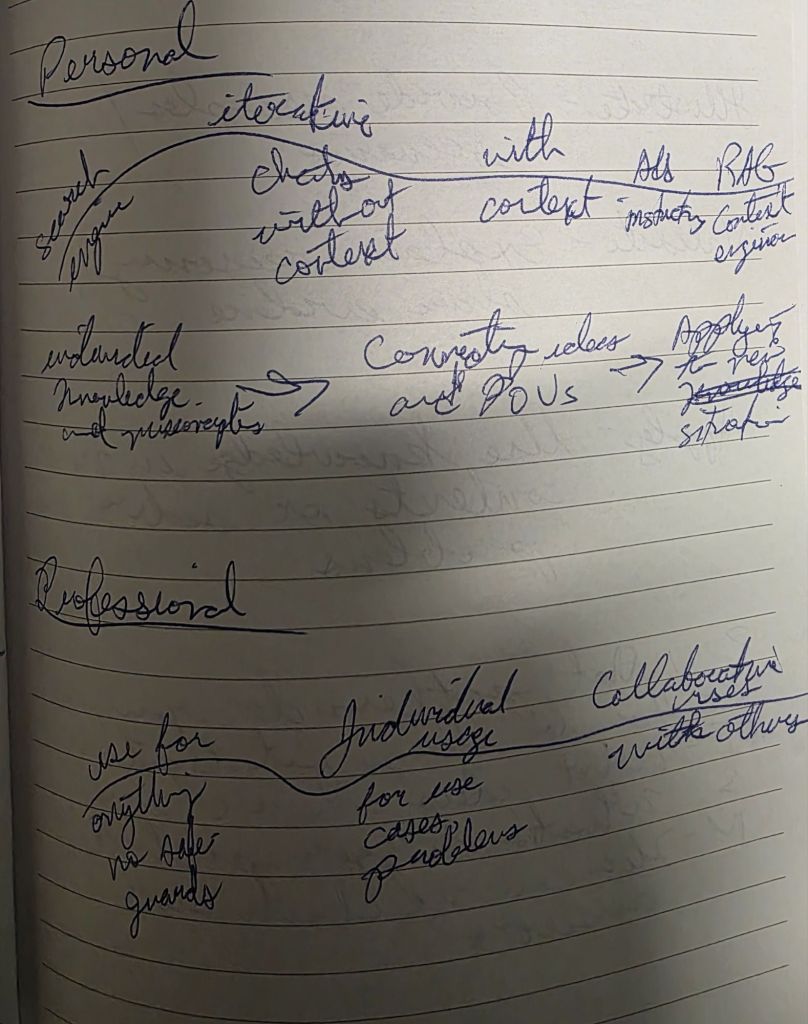
Working at a nonprofit organization, and having had the opportunity to introduce Gen AI to others, I find myself at the point that I clearly see the benefits of Gen AI. But so many of those I work with are still slogging through the mud. They never develop the competencies and knowledge of Gen AI to improve their own practice and work.
Observing others struggle through the process, and who are trying to explain their concerns and misgivings about Gen AI, gives me access to a bigger picture view of AI adoption at nonprofits. That’s different from those who may still be figuring out the value of prompting approaches/acronyms and sorting through vocabulary.
With the handwritten roadmap in hand, I asked Gen AI to adapt my image and its thinking:
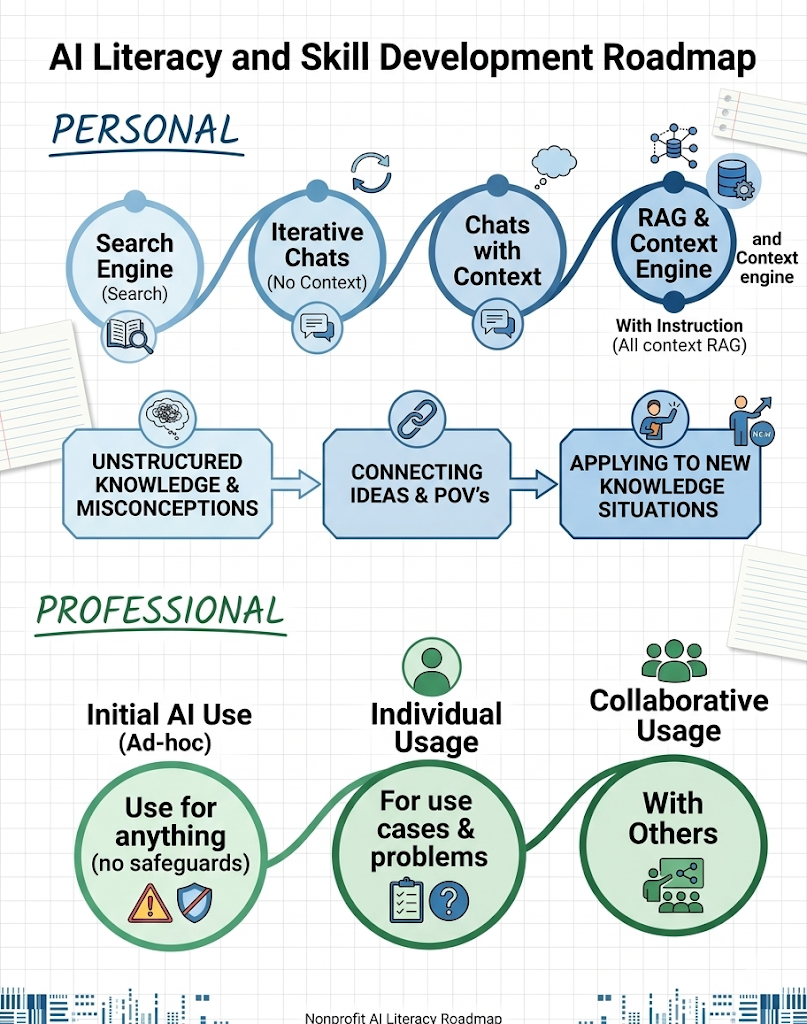
It’s not a perfect adaptation but good enough for the back of a napkin.
Roadmap Chart
To be honest, I am frustrated by the slowness of AI adoption in some nonprofits. Finding a way forward can be a bit difficult. This literacy roadmap is intended for nonprofit organizations. What’s crazy funny is how often Phase 0 never even gets off the ground
AI Literacy Roadmap for Nonprofit Organizations
View the website or explore the table
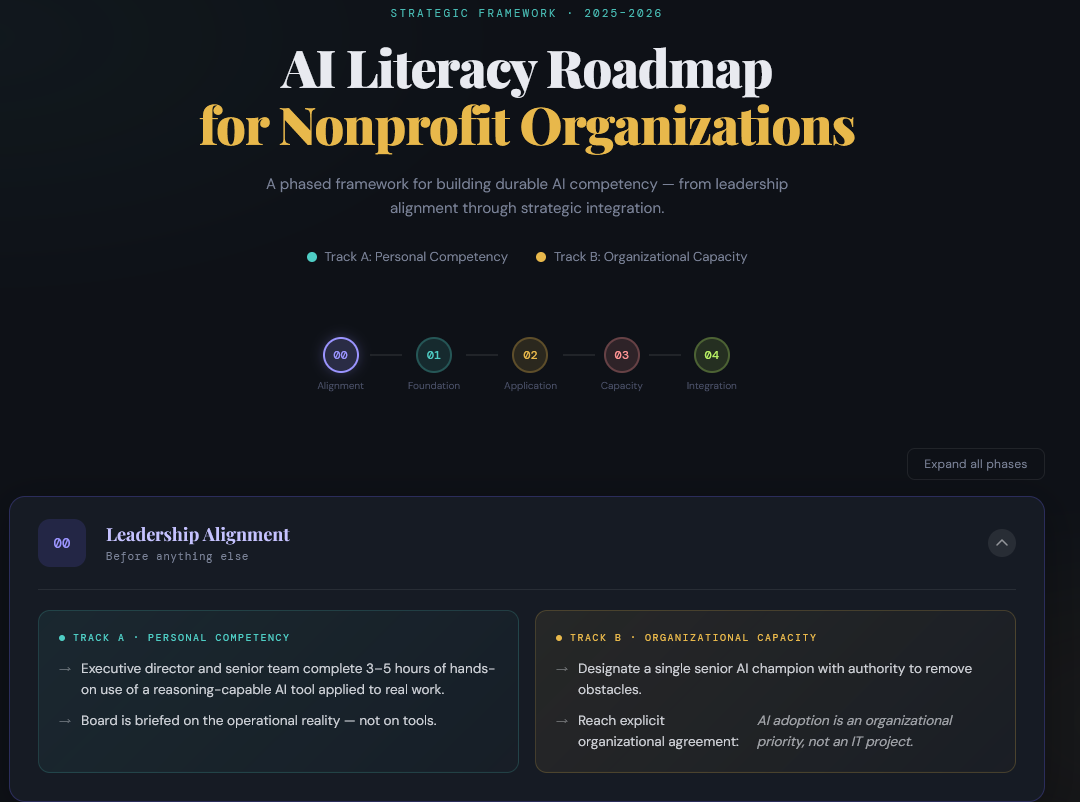
| Phase | Timeline | Track A: Personal Competency | Track B: Organizational Capacity |
|---|---|---|---|
| Phase 0: Leadership Alignment | Before anything else | Executive director and senior team complete 3–5 hours of hands-on use of a reasoning-capable AI tool applied to real work. Board is briefed on the operational reality — not on tools. | Designate a single senior AI champion with authority to remove obstacles. Reach explicit organizational agreement: AI adoption is an organizational priority, not an IT project. |
| Phase 1: Foundation | Months 1–3 | Every staff member learns what AI is and isn’t, how to prompt effectively, 3–5 role-specific use cases, how to catch AI errors, and basic org policy. Every session ends with a real work task completed — not a practice exercise. Differentiate by adopter type from the start: give power users room to go further, move the middle group past surface use, and let a pain point solution do the convincing for resistant staff. | Write an AI use policy (not a technology policy). Publish a short approved tool list with guidance on which tool fits which task. Create a frictionless staff sharing mechanism. Conduct an informal baseline assessment of current AI use — not punitive, just informational. |
| Phase 2: Application | Months 3–6 | Staff build repeatable, department-specific AI workflows. Develop prompt libraries for common tasks by function. Practice using AI as a thought partner — not just a drafting tool. Build evaluation skills: quality, accuracy, bias, brand alignment. Invest in paid/Pro tiers; the gap between free and paid reasoning models is significant and this is not the place to cut costs. | Build a structured peer learning model — monthly working sessions by function, sharing real outputs. Maintain an internal living prompt library. Integrate AI into existing workflows rather than running it as a parallel track. Update job descriptions to reflect specific, observable AI competency expectations. Define a named escalation path for staff who encounter problems. |
| Phase 3: Organizational Capacity | Months 6–12 | Staff develop advanced use of reasoning models, ability to evaluate and select tools independently, and basic understanding of agents and automation. Identify 3–5 internal power users across functions — invest in them specifically. By this phase, a portion of training delivery should be peer-led. | Stand up a formal AI governance working group with a mandate to evaluate tools, update policies, and actively support adoption. Clarify data governance: what organizational data can go into AI tools and under what conditions. Build a standard vendor/tool evaluation framework. Conduct the first structured AI use audit — not cost-cutting, but mission-effectiveness. Establish a staff feedback mechanism with a commitment from leadership to act on it. |
| Phase 4: Strategic Integration | Year 2 and ongoing | Continuous learning is built into the work rhythm — short-form updates, tool reviews, peer sharing. Staff own their learning paths. AI competency is a real factor in hiring, onboarding, and performance reviews. The organization can onboard new staff into AI literacy without starting from scratch. | AI is embedded in annual planning — used actively in strategic analysis, scenario planning, and resource decisions. The organization can articulate its AI posture — including ethical boundaries — to funders, partners, board, and community. Governance policies are reviewed at minimum twice per year. Senior leadership is personally and visibly competent. The organization contributes what it has learned back to the field. |
Discover more from Another Think Coming
Subscribe to get the latest posts sent to your email.
 Another Think Coming