Try this online tool
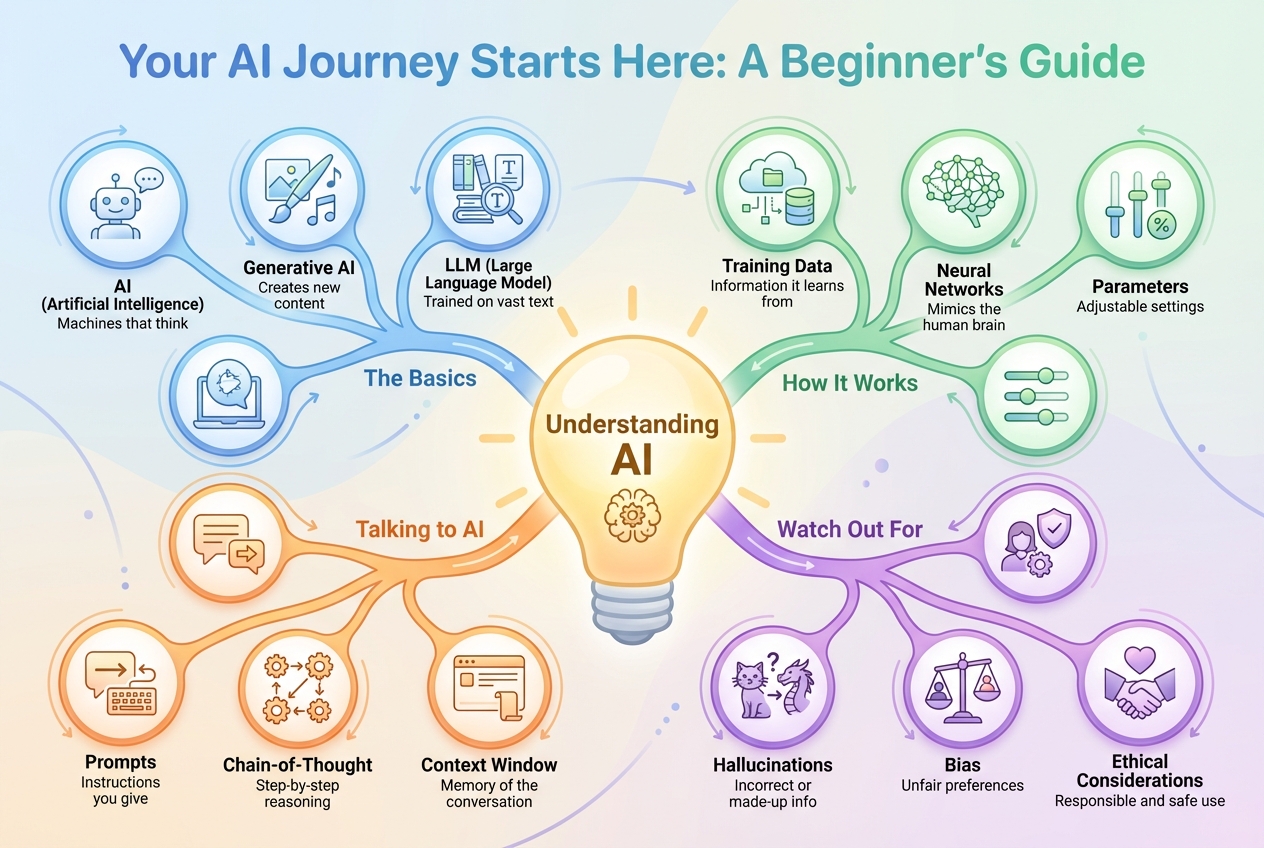
🧠 Core AI Concepts
| Term | Definition |
|---|---|
| Generative AI | A category of AI that creates new content (text, images, code) in response to user inputs |
| Large Language Model (LLM) | The underlying technology (like GPT-5, Claude, Gemini) trained on massive datasets to understand and generate human-like language |
| Hallucination | When an AI confidently generates incorrect or fabricated information |
| Stochastic Parrot | A term describing how AI assembles statistically probable sequences of words without true underlying understanding |
| Bias | Systematic prejudice in AI outputs resulting from the data used to train the model |
🔧 Prompting & Context Engineering
| Term | Definition |
|---|---|
| Prompt Engineering | The practice of refining inputs to get the most accurate and useful outputs |
| Context Engineering | Creating the specific environment or background instructions (like a “Knowledge Stack”) that allow the AI to deliver consistent results |
| Persona (Role-Playing) | Instructing the AI to adopt a specific role (e.g., “Act as an expert editor”) to influence tone and expertise |
| Zero-Shot Prompting | Asking for a task with no examples provided |
| Few-Shot Prompting | Providing a few examples to guide the AI’s style or format |
| Chain-of-Thought (CoT) | Asking the AI to “think step-by-step” to improve reasoning on complex tasks |
| Negative Prompting | Explicitly telling the AI what not to include (e.g., “–no jargon”) |
📐 Technical Frameworks & Features
| Term | Definition |
|---|---|
| CORE Framework | A structured prompting approach: Clarity, Objectives, Relevance, Examples |
| RAG (Retrieval-Augmented Generation) | Providing the AI with specific documents to reference, grounding answers in facts and reducing hallucinations |
| Custom Instructions | Persistent guidelines telling the AI who you are and how you want it to respond across all conversations |
| Knowledge Stack | A personalized system of tools, prompts, and reference files that work together for a specific workflow |
| Bot Stacking | Using multiple AI models in one conversation where each builds on the others’ outputs |
🔬 Advanced Analysis Terms
| Term | Definition |
|---|---|
| Lexical Density | A measure of content word concentration used to analyze how formal or conversational a text is |
| Voice Drift | The tendency for AI to gradually strip away a human’s unique writing style during revision |
| Thematic Clustering | How AI groups unstructured data into related categories based on mathematical similarity |
🍌 BoodleBox-Specific Terms
| Term | Definition |
|---|---|
| Nano Banana | Google’s Gemini Flash Image generator—fast, no watermarks, great for educational visuals |
| Knowledge Bank | Your personal AI library where uploaded files are stored and can be referenced |
| Star Docs | Documents you “star” to auto-attach to every new chat |
| Coach Mode | Built-in feature that teaches you to prompt better as you work |
| Memory Mode | AI remembers previous conversations for continuity |
🚀 Quick Reference: Prompting Best Practices
1. Be SPECIFIC - "Write a 3-paragraph summary" beats "summarize this"2. Assign a ROLE - "You are an expert curriculum designer..."3. Provide CONTEXT - Include grade level, audience, purpose4. Give EXAMPLES - Show the format or style you want5. Set CONSTRAINTS - Word count, tone, what to avoid6. Request STRUCTURE - "Use bullet points and headers"
 Another Think Coming