Paul Roetzer (SmarterX.ai) suggests there are two approaches many take to Generative AI. The following is based on my notes of his podcast presentation adapted for K-16 and non-profit organization use as processed through BoodleBox-Gemini 3 Pro model.
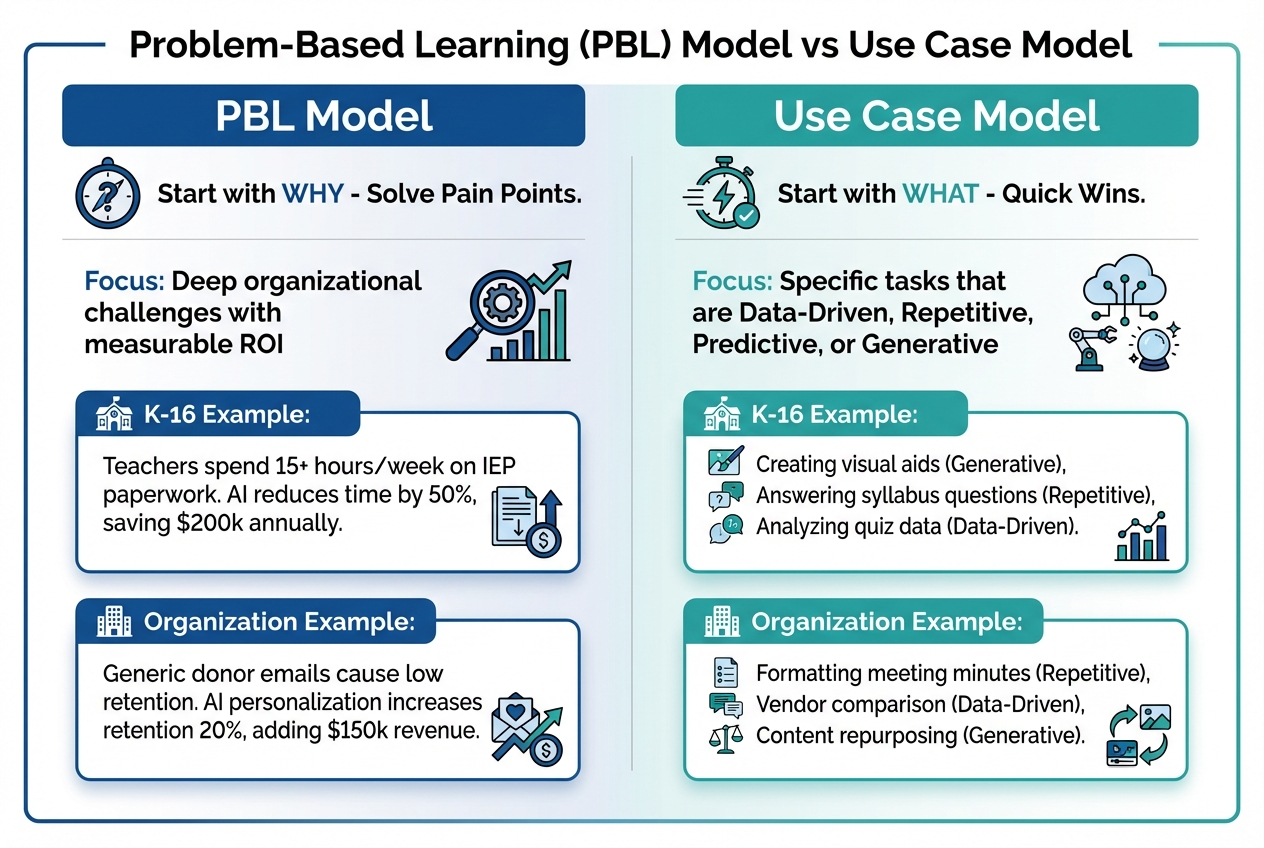
Problem-Based Learning (PBL) Model
The Problem-Based Learning (PBL) model approaches AI adoption by starting with the “Why.” It focuses on identifying deep-seated organizational pain points—inefficiencies, bottlenecks, or resource drains—that traditional methods haven’t solved. In this model, AI is not just a tool but a strategic intervention designed to deliver measurable value. The goal is to move from a specific problem statement to a quantifiable value proposition (time saved, money saved, or quality improved).
Examples of Problem Statements and Value
K-16 Education
- Problem: Special Education teachers spend 15+ hours per week on paperwork and IEP goal tracking, leading to high burnout rates and less time for direct student support.
- Value: Reducing administrative drafting time by 50% using secure, compliant AI assistants could save the district $200k in turnover costs annually and increase student contact time by 300 hours per teacher/year.
- Problem: Students receive feedback on writing assignments 2 weeks after submission due to teacher workload, by which time the learning moment has passed.
- Value: Implementing AI-assisted feedback loops (human-in-the-loop) provides instant, formative feedback, improving student writing proficiency scores by 15% and reducing grading time by 60%.
Non-Profit Organizations
- Problem: Our donor retention rate is dropping because we send generic “blast” emails rather than personalized impact reports to our 5,000+ small-dollar donors.
- Value: Using AI to segment data and generate personalized impact narratives for each donor segment could increase retention by 20% and annual giving by $150,000.
- Problem: Highly skilled program directors spend 40% of their time formatting reports and creating slide decks for the board, rather than executing the mission.
- Value: Automating the “raw data to presentation” workflow recovers 15 hours per week per director, equivalent to adding one full-time employee to the mission team without increasing headcount.
Use Case Model
The Use Case model focuses on the “What” and “How.” It identifies specific, manageable tasks (“quick wins”) where AI excels. Instead of trying to solve a massive systemic issue immediately, this approach looks for jobs that are Data-Driven, Repetitive, Predictive, or Generative. By unbundling a job into its component tasks, organizations can insert AI into specific workflows to augment human capability immediately.
Examples of Identifying Characteristics of Use Case Model
K-16 Education
- Is it Generative? (Content Creation)
- Task: Creating copyright-free, distraction-free visual aids for lessons.
- AI Application: Using tools like Nano Banana to generate specific diagrams (e.g., “a coloring page of a plant cell”) or slide backgrounds instantly.
- Is it Repetitive? (Routine Admin)
- Task: Answering the same questions about the student handbook or syllabus.
- AI Application: Creating a Custom Bot loaded with the handbook (Knowledge Bank) to answer parent/student queries 24/7.
- Is it Data-Driven? (Analysis)
- Task: Analyzing student quiz scores to group them for differentiated instruction.
- AI Application: Uploading CSV data to a Code Interpreter to instantly visualize learning gaps and suggest grouping strategies.
Non-Profit Organizations
- Is it Repetitive? (Workflow Automation)
- Task: Converting meeting notes into formal minutes and action items.
- AI Application: Using Star Docs (with a style guide attached) to automatically format rough notes into official board minutes after every meeting.
- Is it Generative? (Marketing/Comms)
- Task: Repurposing one grant report into social media content, newsletters, and blog posts.
- AI Application: Bot Stacking (using a reasoning bot to extract insights, then a creative bot to write the posts) to turn one document into a month’s worth of content.
- Is it Predictive? (Strategic Planning)
- Task: Identifying which past donors are most likely to give to a new specific campaign.
- AI Application: Analyzing historical donor data to predict engagement and draft targeted outreach scripts.
Sample Use Cases
These provide a wide variety of use cases you can try with any Gen AI tool in K-16. More for non-profit organizations, universities, and business appear below.
Organization Examples
| Use Case Type | Specific Scenario | BoodleBox Feature | Quick-Win Prompt |
|---|---|---|---|
| Repetitive (Standardization) | Meeting Minutes Automation Transforming rough notes into official records using a consistent format. | Star Docs (Auto-attach Style Guide) | (Star your “Meeting Minutes Template” first)Take these rough notes and format them into our official meeting minutes structure. Identify key decisions and tabled items. |
| Repetitive (Compliance) | Policy-Compliant HR Comms Drafting responses that strictly adhere to the employee handbook. | Custom Bots (Knowledge Bank) | You are the HR Assistant. Using the uploaded Employee Handbook, draft a reply to an employee asking about the procedure for requesting FMLA leave. |
| Generative (Content Creation) | Meeting to Presentation Turning text-based reports into visual presentations for the board. | Slide Deck Gen | Take these meeting notes and create a 5-slide PowerPoint presentation with speaker notes highlighting the key decisions. Make it downloadable. |
| Generative (Repurposing) | Content Engine Turning one whitepaper or grant report into a month of social content. | Bot Stacking (Claude -> Nano Banana) | 1. Summarize this PDF into 5 LinkedIn posts.<br>2. @nano-banana Create a professional, watermark-free header image for the first post featuring a modern office setting. |
| Data-Driven (Analysis) | Vendor/Grant Comparison Analyzing multiple PDFs to create a decision matrix. | Document Analysis (Multi-file upload) | (Upload 3 vendor PDF proposals)Create a comparison table for these three vendors based on: Total Cost, Timeline, and Service Level Agreement (SLA). |
| Predictive (Project Mgmt) | Project Timeline Creation Breaking down a complex goal into a scheduled plan. | Bot Stacking (Reasoning Model) | Break down the attached grant application requirements into a 4-week project timeline. List specific tasks for the "Research," "Drafting," and "Budget" teams. |
K-16 Examples
| Use Case Type | Specific Scenario | BoodleBox Feature | Quick-Win Prompt |
|---|---|---|---|
| Generative (Creating New Content) | Watermark-Free Visuals Generate specific diagrams or coloring pages for lessons without copyright issues or logos. | Nano Banana (Gemini Flash Image) | @nano-banana Create a black and white coloring page outline of a plant cell with clear labels for 5th graders. |
| Generative (Adaptive Content) | Instant Differentiation Rewrite a complex text for multiple reading levels in a single pass. | Bot Stacking (Claude + GPT) | @claude45-opus Rewrite this text for a 3rd grade reading level.(Then) @chatgpt-4o-mini Now rewrite the original text for an ESL student. |
| Data-Driven (Analysis) | Quiz/Assessment Analysis Upload CSV test scores to identify learning gaps without using Excel formulas. | Code Interpreter (Data Wizard) | (Upload CSV file)Analyze this data. Create a bar chart showing the distribution of grades and identify the top 3 concepts where students struggled. |
| Data-Driven (Research) | Literature Review Synthesis Find real-time academic sources and synthesize them immediately. | Bot Stacking (Perplexity + Claude) | @perplexity Find 5 recent peer-reviewed articles on AI in nursing education.(Then) @claude45-opus Synthesize these articles into a 2-paragraph literature review. |
| Repetitive (Routine Admin) | Syllabus/Handbook FAQ Answering the same student/parent questions repeatedly. | Custom Bots (Knowledge Bank) | (Create a bot named “Course Assistant” with your Syllabus attached)Draft a polite response to a student asking about the late work policy. Cite the specific section from the syllabus. |
| Predictive (Planning) | IEP Goal Drafting Drafting measurable goals based on unstructured observation notes. | Custom Bots (Privacy Focused) | Based on these observation notes (anonymized), suggest 3 SMART goals for an IEP focused on reading fluency and social interaction. |
 Another Think Coming