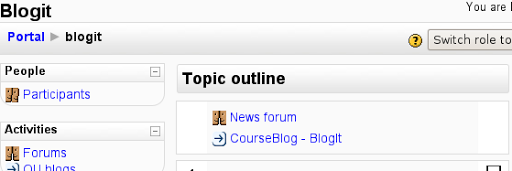
Later this week, one of my team has the opportunity to discuss using blogs in Moodle. However, as most know, the built-in blogs feature (please, don’t yell at me ;->) in Moodle is not as robust as other blog platforms (e.g. b2Evolution). So, I was pleasantly surprised to stumble across this module for Moodle–OU Blog. (this forum is helpful on the subject of OU Blog Module)
A little background on it from the module page:
An alternative blog system for Moodle. Can be used in place of, or in addition to, the standard Moodle blog system.
- Provides user blogs (similar to Moodle ones; everyone has their own blog) and course blogs (add an instance of the module to a course, and students in the course can all contribute to a shared blog).
- Full support for comments. Comments can be turned off for a particular blog or post, but otherwise people can leave comments in both user and course blogs. In order to avoid spam, you currently have to be a logged-in user in order to leave comments, even if the post itself is open to the public.
- Access control levels: private (user only), course members, logged-in users, or worldwide.
- Group support for course blogs (so you can have per-group blogs).
- Blog-specific tags. Tags are not connected to the Moodle tag system but apply only within the blog. You click on a tag to see all posts in the current blog with that tag.
- User display options – change the name of your blog (from My Name’s Blog to whatever you like) and add a description.
- Standard Moodle 1.9 role/permission support (eg if you want to make it so students can’t post to course blogs, etc).
- Post and comment management. You can edit or delete posts and delete comments, but deleted or previous text remains available to administrator users. (This is necessary in various circumstances.)
- RSS and Atom feeds.
- Automatically integrates with the OU search system (if that is installed) to provide fulltext search of blog posts.
I’ve just finished installing it on my test Moodle at home–running on XAMPP for Linux–and it works pretty well. I’m not sure I understand all the components but this certainly seems like a great start in providing students with their own blogs, including a course blog they can all contribute to. Has anyone else used OU Blog with K-12 students?
Here’s what it looks like (click the image to see larger view):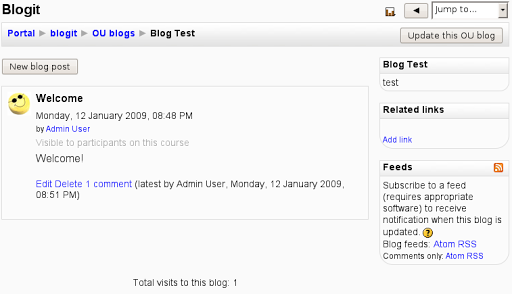
This is a vanilla Moodle install, so no themes applied. However, my hope is that I’ll be able to use this to provide students with blogs with a Moodle environment that can allow guests (like parents or other visitors).
Here’s what a new blog post entry form looks like: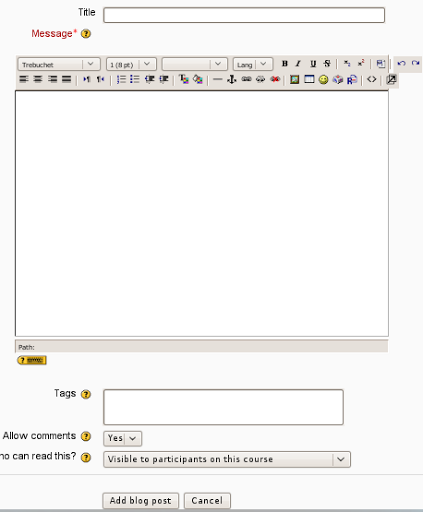
Reservations/Questions on use of this module for Moodle?
- RSS feeds are present but how can I feed the content through the front page (I know, use the Remote RSS feeds block but what if I wanted that content to appear in the middle of the page? Hmm…)
- If I post to an individual blog, does that end up in the course blog? Need to try that.
- More to add…..
WHY NOT USE WORDPRESS OR SOMETHING ELSE?
The reason for not using WordPress, b2Evolution, or one of those other solutions is that Moodle is already gaining in popularity in schools…and supporting it is quickly going to become the 800-pound gorilla in the room. Who wants to introduce yet another system–no matter how wonderful–into the equation? After fierce discussion, I was convinced not to introduce another tool. Some other limitations:
- Don’t want to incur another expense for a service that may not be used in all classrooms (e.g. use Moodle OU Blog in lieu of ad-supported edublogs.org…consider what advertising does to this DuckDiaries blog).
- No need to create another series of folders and organizational system to manage classroom blogs. In fact, just create a Moodle per teacher and use that for online lit circles, blogs, etc.
- Ok, that’s all I can come up with this late at night. You?
So, I’m hoping that adding this OU Blog module will make it possible for students to blog within already created Moodle classrooms.
Whether this actually works or not, only time will tell. Here’s a list of already existing systems being supported:
- Joomla for 250 sites
- Moodle for 50-100 courses and growing quickly
- Apple Blog Server for teacher classroom web pages
Supporting each of these is getting to be a full-time job for one or two people.
If this works, the more difficult work begins…exploring best practices on using blogs with students and communicating that to teachers.
Anyone made a list of all the different ways that teachers are using blogs with their students?

 Subscribe to Around the Corner-MGuhlin.org
Be sure to visit the ShareMore! Wiki.
Discover more from Another Think Coming
Subscribe to get the latest posts sent to your email.
 Another Think Coming
I think I’ll post more on this later, but I just can’t personally fathom that much control/moderation/setup/maintenance over a blog system. Would you expect a tech coordinator to maintain all of this, or a tech teacher? My tech coordinator talked about possibly using one of our secretaries to moderate some blog content because with all the students blogging or commenting on content, the sheer amount of moderation involved is becoming enormous. DR
I think I’ll post more on this later, but I just can’t personally fathom that much control/moderation/setup/maintenance over a blog system. Would you expect a tech coordinator to maintain all of this, or a tech teacher? My tech coordinator talked about possibly using one of our secretaries to moderate some blog content because with all the students blogging or commenting on content, the sheer amount of moderation involved is becoming enormous. DR
DR, look forward to the longer post. It’s less the moderation and more the updating of one blog system or another. I have 3000 teachers. Even if only a few hundred decide to implement blogs in their classrooms, supporting that many blogs will be incredibly time-consuming…and the hackers are out there.Hence, the focus on using Moodle which is fairly easy to upgrade and maintain.miguel
DR, look forward to the longer post. It’s less the moderation and more the updating of one blog system or another. I have 3000 teachers. Even if only a few hundred decide to implement blogs in their classrooms, supporting that many blogs will be incredibly time-consuming…and the hackers are out there.Hence, the focus on using Moodle which is fairly easy to upgrade and maintain.miguel
thanks for sharing your ideas i really appreciate it!keep it going and more power!
thanks for sharing your ideas i really appreciate it!keep it going and more power!
Great find, Miguel. Thanks!
Great find, Miguel. Thanks!
Sweet find, Miguel. We have moodle 1.9++ and also have been struggling with trying to find a suitable blog platform. fyi…moodle 2, which is supposed to be available in June of 09, will include comment support. It looks like OU only allows comments from those who have accounts in the moodle network, which is kind of a bummer. Not sure what the standard blogging tool in moodle 2 will allow as far as commenting from the outside world goes, but we’ll see.Thanks for sharing once again…this is great!
Sweet find, Miguel. We have moodle 1.9++ and also have been struggling with trying to find a suitable blog platform. fyi…moodle 2, which is supposed to be available in June of 09, will include comment support. It looks like OU only allows comments from those who have accounts in the moodle network, which is kind of a bummer. Not sure what the standard blogging tool in moodle 2 will allow as far as commenting from the outside world goes, but we’ll see.Thanks for sharing once again…this is great!
@Matt, Moodle 2, huh? Do you know if they’ve improved the wiki at all? Worthless the way it is now!i hope Moodle 2 is an upgrade not a migration!!!Suffering through Joomla migration,Miguel
@Matt, Moodle 2, huh? Do you know if they’ve improved the wiki at all? Worthless the way it is now!i hope Moodle 2 is an upgrade not a migration!!!Suffering through Joomla migration,Miguel
@miguel…yeah, it could end up being a migration…I haven’t a clue about that one. And I don’t want to get to far ahead of myself and excited about something that doesn’t exist yet.The standard wiki module that the community decided upon is Nwiki, which is supposed to be a big improvement over the existing standard wiki (Nwiki can be installed under moodle 1.9 and previous versions I believe, but we haven’t done this).I am also looking forward to the natural Mahara integration as well, which will give create some interesting portfolio possibilities. I’ve been playing around with the moodleman’s moodle 2.0 playpen a bit, but the mahara piece seems to bonk out when I try it.http://playpen.riverview.nsw.edu.au/moodle20/~matt
@miguel…yeah, it could end up being a migration…I haven’t a clue about that one. And I don’t want to get to far ahead of myself and excited about something that doesn’t exist yet.The standard wiki module that the community decided upon is Nwiki, which is supposed to be a big improvement over the existing standard wiki (Nwiki can be installed under moodle 1.9 and previous versions I believe, but we haven’t done this).I am also looking forward to the natural Mahara integration as well, which will give create some interesting portfolio possibilities. I’ve been playing around with the moodleman’s moodle 2.0 playpen a bit, but the mahara piece seems to bonk out when I try it.http://playpen.riverview.nsw.edu.au/moodle20/~matt
@Matt, unfortunately, my NWiki install attempt didn’t go well. I’ll have to try again. Thanks for the heads-up on it!!For fun, I’ll try doing a Moodle 1.93+ to 2.0 and see what happens.Take care,Miguel
@Matt, unfortunately, my NWiki install attempt didn’t go well. I’ll have to try again. Thanks for the heads-up on it!!For fun, I’ll try doing a Moodle 1.93+ to 2.0 and see what happens.Take care,Miguel