UPDATE 10/13/2009 – This past weekend, I played around with XAMPP for Mac and it runs great! I retract all the mean things (“clunky”) I said about it below. MAMP is already OFF my Macbook and I’m using XAMPP. Setup was a breeze, customized the PHP.INI file, and off we go!
ORIGINAL ENTRY:
Two colleagues of mine setup a Mac OS X Leopard server with Apache/MySQL/PHP running on it but then left…leaving me with a server I wasn’t sure how to administer. The problem is a simple one. While I’m familiar with how to do the upgrade of PHP/MySQL on different platforms, I haven’t a clue how to do it on Mac OS X.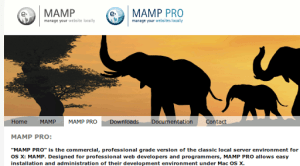
As such, I started looking for an easy way to set up a working environment. Past experience had introduced me to MAMP, which I use to backup my WordPress and Moodle environments on my Mac…think of it as a XAMPP for Mac (careful, there is a XAMPP for Mac) but easier and less clunky than XAMPP for Mac (although I think XAMPP for Linux and Windows is just great!).
My first thought was to rely on MAMP PRO, where M=Mac, A=Apache, M=MySQL, and P=PHP. But in various places I’d read, there were always always reservations about using such a system…apparently, it’s for development not production due to security issues. The MAMP Pro version comes with this software:
I decided to write to MAMP PRO folks and ask them what they thought…here was their response:
First of all: MAMP PRO isn’t a production server. It can be used as a web server but there are at least the following points to consider:

1. The web server is as secure or less as the system that it is running on.
2. Don’t run your web server on a machine containing sensible data.
3. Backup your important data on regular basis.
4. Take care that your system is up to date.
5. Control logs on regular basis.
6. Run Apache/MySQL servers as user www/mysql.
7. Change the MySQL root password to something else than “root”.
8. Activate “Allow local access only” in the MySQL tab.
9. Set permissions as restricted as possible.
System security isn’t a simple task. You have to calculate the risk and handle appropriately.
On that note, $55 doesn’t seem like too high a price to pay to get Apache, MySQL/PHP working on a Mac server. Now, how do I convince folks to buy software where the vendor is based out of Germany?!?
A follow-up question I have for the MAMP PRO support folks is this one:
If I run MAMP PRO on my Mac OS X Leopard server, will it still be able to serve up Apple Blogs/Wikis, or will that disappear?

 Subscribe to Around the Corner-MGuhlin.org
Be sure to visit the ShareMore! Wiki.
Everything posted on Miguel Guhlin’s blogs/wikis are his personal opinion and do not necessarily represent the views of his employer(s) or its clients. Read Full Disclosure
Discover more from Another Think Coming
Subscribe to get the latest posts sent to your email.
 Another Think Coming
Leopard’s wiki/blog server relies on a number of additions to Apache’s configuration, so I’m pretty sure you’d lose those services by running MAMP. That said, if you set up MAMP’s Apache to listen on a port that’s not being used by Apple’s services, you could be OK. (I know that 80, 8087, and 8008 are off limits and there may be others.)An alternative is that you *can* run many web apps on Leopard server without changing a thing. We currently have our main district site running Joomla and I have installed Drupal on the box as well. Both are perfectly happy with the installed MySQL and PHP that come with 10.5 server. You can either install them in subdirectories of /Library/WebServer/Documents and have them appear at http://www.yourdomain.org/myapp/ or else use Server Admin to create additional sites (virtual hosts) and install the files elsewhere. (The latter obviously requires additional DNS entries, while the former does not.)The biggest limitation of Apple’s PHP is that is doesn’t include compiled-in support for some of the more commonly needed modules (GD library being one), which might be a deal-breaker. In the past, I have installed Marc Liyanage’s PHP package (http://www.entropy.ch/software/macosx/php/), which nicely substitutes itself for the built-in PHP. I have not yet tried this on my current Leopard server, so I can’t vouch for the latest version specifically, but I’d definitely look into it.As for MySQL, in the past, I have installed the package from MySQL.org in place of Apple’s supplied version so I know that’s possible. However, I did that as part of the initial set up the server. I’m not sure how well it would work as a “retrofit”. That said, I have added two things to help administer our current server: First, I downloaded the MySQL Community Server installer package and installed the System Preference pane for starting and stopping the server (you don’t have to install the MySQL package itself–the pref pane is included in the disk image). Second, I installed PHPMyAdmin for managing the databases. (And Sequel Pro is a nice free GUI app for querying your databases and makes a handy companion to PHPMyAdmin.) Finally, another option for drop-in application stacks is Bitnami (bitnami.org). I have tried several of them for testing purposes only, so I can’t speak to their appropriateness for production systems, but they seemed decent.
Leopard’s wiki/blog server relies on a number of additions to Apache’s configuration, so I’m pretty sure you’d lose those services by running MAMP. That said, if you set up MAMP’s Apache to listen on a port that’s not being used by Apple’s services, you could be OK. (I know that 80, 8087, and 8008 are off limits and there may be others.)An alternative is that you can run many web apps on Leopard server without changing a thing. We currently have our main district site running Joomla and I have installed Drupal on the box as well. Both are perfectly happy with the installed MySQL and PHP that come with 10.5 server. You can either install them in subdirectories of /Library/WebServer/Documents and have them appear at http://www.yourdomain.org/myapp/ or else use Server Admin to create additional sites (virtual hosts) and install the files elsewhere. (The latter obviously requires additional DNS entries, while the former does not.)The biggest limitation of Apple’s PHP is that is doesn’t include compiled-in support for some of the more commonly needed modules (GD library being one), which might be a deal-breaker. In the past, I have installed Marc Liyanage’s PHP package (http://www.entropy.ch/software/macosx/php/), which nicely substitutes itself for the built-in PHP. I have not yet tried this on my current Leopard server, so I can’t vouch for the latest version specifically, but I’d definitely look into it.As for MySQL, in the past, I have installed the package from MySQL.org in place of Apple’s supplied version so I know that’s possible. However, I did that as part of the initial set up the server. I’m not sure how well it would work as a “retrofit”. That said, I have added two things to help administer our current server: First, I downloaded the MySQL Community Server installer package and installed the System Preference pane for starting and stopping the server (you don’t have to install the MySQL package itself–the pref pane is included in the disk image). Second, I installed PHPMyAdmin for managing the databases. (And Sequel Pro is a nice free GUI app for querying your databases and makes a handy companion to PHPMyAdmin.) Finally, another option for drop-in application stacks is Bitnami (bitnami.org). I have tried several of them for testing purposes only, so I can’t speak to their appropriateness for production systems, but they seemed decent.
Tom, thanks for the feedback. We’re trying out your suggestions and you’ve answered questions.With appreciation,Miguel
Tom, thanks for the feedback. We’re trying out your suggestions and you’ve answered questions.With appreciation,Miguel