
A short time ago, I shared an article for publication–which appeared in TCEA’s TechEdge magazine–entitled Social Media Tools: Gathering the Loose Threads. Apparently, Tim Holt hasn’t read it! (sigh). In a simple way, if you use Google Reader, you can subscribe to everything Miguel Guhlin shares online…and that’s by design!
In a blog entry recently, Tim Holt (Intended Consequences) shares that he’s been rethinking the whole blogging thing….
So I have been rethinking the whole blogging thing. How many people are reading them? How many people are writing them? How many people are becoming new readers? Unfortunately, with my little iWeb program, I don’t have any idea how many people actually read this blog or listen to my podcasts. I know, for instance, that I am not nearly as popular as say, Will Richardson, but I also know that there are a lot of you guys out there that do read it. I don’t have Google analytics., I don’t have time.
Before moving on to the main points of this blog entry, Tim (and Apple iWeb bloggers), I encourage you to read about these iWeb tools and tips:
These should slay the complaint that you can’t do certain things in iWeb…but don’t get me wrong. I’d rather use Google’s Blogger, WordPress.com (although there are limits), Edublogs.org (pay for it), or something else besides iWeb. I know…remember that I used Thingamablog–view the old version of Around the Corner with 7000+ blog entries–that works in much the same way.
TRACKING THE FLOW OF IDEAS
Truth is not only violated by falsehood; it may be equally outraged by silence.
-Henri F Amiel
In his post, Tim uses me as an example–incorrectly–that suggests I run around and post my information to multiple social networking sites (e.g. Plurk, Twitter, Facebook, My Blog, etc.). If I did that, I wouldn’t have time for anything else! I suspect (ok, I know) others think I spend massive amounts of time managing my networks.
Tim writes the following:
Even more difficult to track is posts. For instance, I track a bunch of people, Miguel Guhlin, Will Richardson, David Warlick and a few more. So here is what happens:
Say Miguel posts something on Twitter. I have to be on Twitter when he posts or close to when he posts, or I have to purposely track his Tweets. He may or may not Tweet something that he posts on his blog. But maybe he posts something on Facebook. Or MySpace. Or his Blog.
All of these have to be tracked. Every single one of them. And there simply is no program or site that I know of that tracks every single place that Miguel, or Will, or David or anyone posts to.
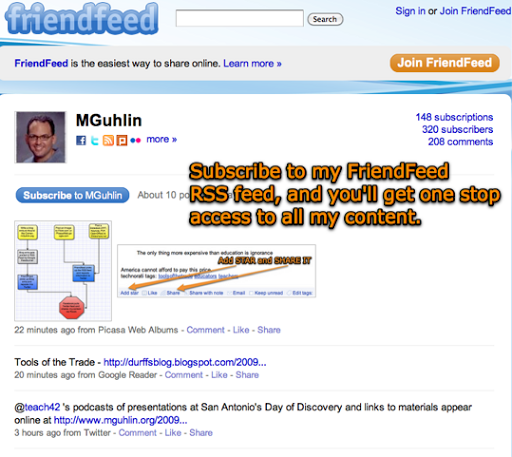
In actuality, Tim could just subscribe to my FriendFeed RSS feed and get ALL my content sharing across various networks via his RSS reader. To better understand the flow of ideas and information, here’s a crude diagram:

(click image to enlarge)

Source: Tools of the Trade from Durff


 Subscribe to Around the Corner-MGuhlin.org
Everything posted on Miguel Guhlin’s blogs/wikis are his personal opinion and do not necessarily represent the views of his employer(s) or its clients. Read Full Disclosure
Discover more from Another Think Coming
Subscribe to get the latest posts sent to your email.
 Another Think Coming
Miguel, Miguel,You make my point exactly! Thanks! It should not be a e-paper chase to follow anyone. A new teacher, or someone new to the whole world of edublogging, would have no idea about all of these things that you mention, unless they a) read your article, or b) read a mention of them somewhere, or c) knew a friend, or D) …you get the idea. If I am a newbie, and I start following you on say, Twitter, or Will, or David, or anyone, there is probably NO WAY to figure out about all of the things you mention above. If I start following you on Facebook, there is no way to know about them based on the messages that show up there. None. You have to stumble upon them, or have a friend set you up. Both of which are iffy propositions. "Consider your most recent post on my homepage on Facebook: Miguel Guhlin Tools of the Trade http://ff.im/-cwZXi 58 minutes ago · Comment · Like"Google? RSS? Miguel is on You know about these things because you do these things.You know about these things because you have been involved in the conversation for years. In order to use Friendfeed, you have to know about Friendfeed. (BTW, when I posted about you posting to Twitter, that is exactly what you do when a Tweet appears, whether you posted somewhere else or not. If it shows up on Twitter, it is posting to Twitter.)You yourself called the setup you have as "elaborate." I agree, And following is just as elaborate. The point of the article I wrote, was that it is not easy to follow a single person, and it is even harder to follow multiple people. Miguel has Miguel's set up, David has his, Will has his, and so on. And while you don't see it yourself as complicated, teachers with limited time, whom we are trying to "convert" would indeed see it as too complicated.(If you don't believe it, just look at the ways you could sign this entry: I count at least 8.)
Miguel, Miguel,You make my point exactly! Thanks! It should not be a e-paper chase to follow anyone. A new teacher, or someone new to the whole world of edublogging, would have no idea about all of these things that you mention, unless they a) read your article, or b) read a mention of them somewhere, or c) knew a friend, or D) …you get the idea. If I am a newbie, and I start following you on say, Twitter, or Will, or David, or anyone, there is probably NO WAY to figure out about all of the things you mention above. If I start following you on Facebook, there is no way to know about them based on the messages that show up there. None. You have to stumble upon them, or have a friend set you up. Both of which are iffy propositions. “Consider your most recent post on my homepage on Facebook: Miguel Guhlin Tools of the Trade http://ff.im/-cwZXi 58 minutes ago · Comment · Like”Google? RSS? Miguel is on You know about these things because you do these things.You know about these things because you have been involved in the conversation for years. In order to use Friendfeed, you have to know about Friendfeed. (BTW, when I posted about you posting to Twitter, that is exactly what you do when a Tweet appears, whether you posted somewhere else or not. If it shows up on Twitter, it is posting to Twitter.)You yourself called the setup you have as “elaborate.” I agree, And following is just as elaborate. The point of the article I wrote, was that it is not easy to follow a single person, and it is even harder to follow multiple people. Miguel has Miguel's set up, David has his, Will has his, and so on. And while you don't see it yourself as complicated, teachers with limited time, whom we are trying to “convert” would indeed see it as too complicated.(If you don't believe it, just look at the ways you could sign this entry: I count at least 8.)
@Tim – Social networking tool use evolves over time…I didn't know all this when I started, and who knows, tomorrow, the tools might be different.I choose to learn them because I present on these topics and want to simplify my life. Whether others choose to is entirely up to them…however, if folks start blogging, they are embracing constant learning experiences.If a teacher isn't willing to be a constant learner in communication/collaboration tools of the age, are they going to remain worthy of students who are?
@Tim – Social networking tool use evolves over time…I didn't know all this when I started, and who knows, tomorrow, the tools might be different.I choose to learn them because I present on these topics and want to simplify my life. Whether others choose to is entirely up to them…however, if folks start blogging, they are embracing constant learning experiences.If a teacher isn't willing to be a constant learner in communication/collaboration tools of the age, are they going to remain worthy of students who are?
"If a teacher isn't willing to be a constant learner in communication/collaboration tools of the age, are they going to remain worthy of students who are?"The answer to that question is very clearly, 'NO.'
“If a teacher isn't willing to be a constant learner in communication/collaboration tools of the age, are they going to remain worthy of students who are?”The answer to that question is very clearly, 'NO.'
Great post and share. Thanks.I like how you are using a Friendfeed widget on your homepage as well now.
Great post and share. Thanks.I like how you are using a Friendfeed widget on your homepage as well now.
"If a teacher isn't willing to be a constant learner in communication/collaboration tools of the age, are they going to remain worthy of students who are?"I think you overestimate the time and willpower of most educators. Most teachers are "constant learners." I would say a much smaller percentage are "constant implementers" that actually practice what they learn. From my own experience, it is one thing to teach, it is another to implement. I stand by my original blog post: Following you, or me, or Wes or anyone takes a great deal of effort and it is not intuitively obvious.Because there is such difficulty, the opportunity to learn, to be a "constant learner" is often lost. I appreciate you keeping the conversation going.
“If a teacher isn't willing to be a constant learner in communication/collaboration tools of the age, are they going to remain worthy of students who are?”I think you overestimate the time and willpower of most educators. Most teachers are “constant learners.” I would say a much smaller percentage are “constant implementers” that actually practice what they learn. From my own experience, it is one thing to teach, it is another to implement. I stand by my original blog post: Following you, or me, or Wes or anyone takes a great deal of effort and it is not intuitively obvious.Because there is such difficulty, the opportunity to learn, to be a “constant learner” is often lost. I appreciate you keeping the conversation going.
"If a teacher isn't willing to be a constant learner in communication/collaboration tools of the age, are they going to remain worthy of students who are?"No! But they will still be given students because the fact of the matter is that students will learn most of what they need CONTENT wise regardless of the methods employed.RE: how easy it is to stay abreast via implementation of all the various social network dissemination techniques and connections, it all comes down to choice. I use Google Reader to keep up with my subscriptions, Twitter (which I selective connect to FB) to converse, and Delicious to keep track of my faves. However, I have to make a conscious choice about how much time I'm going to spend following every link or responding to every post that comes across. It's easy to get lost in the convo and realize 2 – 3 hours have passed. But some teachers just refuse to implement and therefore refuse to learn as a result. It's not rocket science and it's not hard.
“If a teacher isn't willing to be a constant learner in communication/collaboration tools of the age, are they going to remain worthy of students who are?”No! But they will still be given students because the fact of the matter is that students will learn most of what they need CONTENT wise regardless of the methods employed.RE: how easy it is to stay abreast via implementation of all the various social network dissemination techniques and connections, it all comes down to choice. I use Google Reader to keep up with my subscriptions, Twitter (which I selective connect to FB) to converse, and Delicious to keep track of my faves. However, I have to make a conscious choice about how much time I'm going to spend following every link or responding to every post that comes across. It's easy to get lost in the convo and realize 2 – 3 hours have passed. But some teachers just refuse to implement and therefore refuse to learn as a result. It's not rocket science and it's not hard.
Thanks for this post. I wondered how to link my blog, facebook, twitter, flickr together, and now I know how!(I found this article via a post on Stephen Downes newsletter.) (I think lol)
Thanks for this post. I wondered how to link my blog, facebook, twitter, flickr together, and now I know how!(I found this article via a post on Stephen Downes newsletter.) (I think lol)