 |
| Source: http://www.ipadngravy.com/ wp-content/uploads/ 2010/10/ipad-theft.png |
The question about whether iPad apps purchased using volume purchase pricing (VPP), issued to teachers using their own iTunes account–rather than a school account–for redeeming those apps purchased with District funds has been going around in my head all week. The question first arose when Chris Nilsson suggested (“iOS Headaches“) in passing that this practice that some Tx districts have embraced might be illegal.
Response via Google+ from Gordon Dahlby:

Are they rationalizing because an app might be $.99 instead of software at $100? I don’t think per unit cost changes the laws for public ownership. I’m not sure when an employee can take anything with them, except maybe their notes. Buying consumables for the classroom is not a transfer of ownership, even if the teacher is the one making the purchases via school credit or PO or even a “gift” from a PTA. One could not buy a laser toner cartridge for a home printer just for the convenience of printing class sets at home, nor take home reams of paper where they need to track “school use” and swap out paper for “personal use.”
Question: How can the District use vouchers for iTunes purchases?
Not actually being involved in an iPad deployment at this specific time, I composed a response based on my best intel (why not, it’s fun to use that language). I’m not sure if it’s the best response, or more complete, but…that’s why I’m sharing it here. If you read it and see a way to improve it, I hope you’ll speak up in the comments!
The process is outlined here:
http://www.apple.com/education/volume-purchase-program/faq.html#vouchers
Districts describe it in this way:
1) Apply to be a Program Manager – http://edu-vpp.apple.com/asvpp.html2) Setup Program Facilitators (NEISD does them by campus) – http://edu-vpp.apple.com/asvpp_manager/For new Program Facilitator accounts, it is recommended that you create generic email addresses for use only with this program (example: PF1@institution.edu or PF2@institution.edu)
3) The Program Manager/Facilitator obtains the vouchers online at http://volume.itunes.apple.com/us/storeThis Volume Purchase Program allows educational institutions to purchase multiple copies of the same app or book at once. Developers and publishers may also offer a discount for these multiple purchases. To use this program you must have a Program Facilitator account, which can be obtained by any Program Manager from your institution. To get started, sign in or redeem a Volume Voucher.
4) Campus/Dept Program Facilitators are issued volume vouchers which they can use to start purchasing.
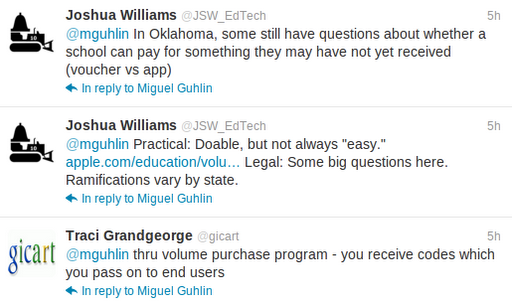
POTENTIAL ISSUESOne of the potential issues which isn’t mentioned is that Program Facilitators can assign apps purchased to individual iPads. When the end-user redeems those, they darn well better be using a school district email account. If they are NOT, and instead use their personal iTunes account, then the apps are assigned to that person…when that person leaves the District, so do your apps, even if they were purchased with school funding. In Texas, some still have questions about whether a school can pay for something for staff they may have not yet received (voucher vs app). Is it illegal to purchase apps for teachers/students to use that they then take with them when they leave the District?
One District’s approach has been to use GoogleApps for Education generic emails for every iPad they issued to students and staff. In that case, it doesn’t matter if the apps are assigned to that iPad/email because it then still belongs to the District and iTunes accounts for each device are under District control.
The other issue is that it may be illegal to treat apps as consumables. That is, you can’t just issue apps to individuals (under the scenario where they login with their personal iTunes account) and let them keep the value of the Apps. For Special Ed that could result in gifting staff with $100 apps.
In our district, we treat the apps much like you would a workbook that students write in. If they do carry the apps with them in their iTunes after they leave the district, we don’t consider it any different than reams of paper packets their teachers might have run off on school paper, or workbooks, lab manuals, etc that they might have used and kept…I don’t see how it could be considered illegal, since every district buys paper, xeroxes packets, and provides workbooks that students use, and are considered consumables. Not to mention kleenex, pens, pencils, etc. We’ve saved $30,000 on paper costs so far this year just at one campus not running off worksheets, packets, tests, etc. So that does seem a better use of funds because at least apps are able to be used more than one time. 😉
My response:
I’m familiar with that perspective (“App as consumable”). However, others have suggested that treating apps as consumables–especially when those may cost up to $100 or more, esp in the case of Special Education–is illegal use of District funds. The other concern is that you can’t know how many apps you have in your district…essentially, you keep having to pay for expensive apps over and over again. This is costly for districts with high mobility among staff (and students).
While I appreciate the convenience the app as consumable perspective enables in terms of management, I have to be able to respond to the critique that it is 1) Illegal; 2) Costly over time; and 3) Reflects poor management of district funding/resources.
Read more about iPad stuff in schools….
Enter your email address:
Delivered by FeedBurner



Discover more from Another Think Coming
Subscribe to get the latest posts sent to your email.
 Another Think Coming
My response is here: http://holtthink.tumblr.com/post/17830418295
My response is here: http://holtthink.tumblr.com/post/17830418295
Hey Miguel,Have you seen this: Appe ios5 deployment guide?I am intrigued by the Layered Ownership Model described on page 33. What are your thoughts?
Hey Miguel,Have you seen this: Appe ios5 deployment guide?I am intrigued by the Layered Ownership Model described on page 33. What are your thoughts?