 |
| Source: http://www.mobypicture.com/user/dim/view/11705905/sizes/full |
the future of learning lies in a student-centered, web 2.0 empowered,networked connectivism. This is the New Culture of Learning, and we owe it to our own life-long learning and to our students to study this mode closely and exploit every opportunity to advance it. (Source: http://21k12blog.net/2012/09/07/networked-learning-at-the-core-of-a-new-report-on-innovating-pedagogy/)
In a twitter exchange with EdTechSandyK, as well as in reading an article entitled The iPad will not save your school, and considering the best approach to put technology in schools, I’ve found myself engaging in “soul-searching” about these solutions.
Allow me a moment to reflect on the following perspectives:
- Discard the Antiquated: Folly or Genius?
- 5 Temptations of a CEO
Before we begin, my biases are offered up for consideration:
- Courage of convictions: If we’re going to invest in iPads because they ARE the magic bullet, then let’s go whole hog. Let’s throw out antiquated Dell computers, old laptops and get rid of the enterprise approach to technology management in schools. Let’s use the iPads for assessment (Pearson’s TestNav is due out on iPad soon), for creation and rework our daily schedules so that computer labs are non-existent. This will cost at least $21,000 per classroom to get started.
- Note: To clarify, “whole hog” is…wireless everywhere, curriculum alignment for every learning activity, eliminating labs as the tech learning space, teaching online and in the cloud.
- The Classroom is the Portal to safe, Virtual Learning Spaces. Children don’t have to go anywhere else inside the building to develop 21st Century Skills a la P21.org if they have one to one mobile devices.
- The level of separation between Curriculum/assessment initiatives and iPads in schools determines the success or failure of said expensive technology. If you bring iPads in, then you better match your curriculum to iPads or you are just WASTING MONEY AND TIME.
- For the first time in history–given GNU/Linux, free open source software–we have everything we need to make yesterday’s computing solutions the most cost-effective.
- If your teaching doesn’t involve real life problem-solving with technology that engages and extends beyond the classroom walls, then “it ain’t worth squat.”
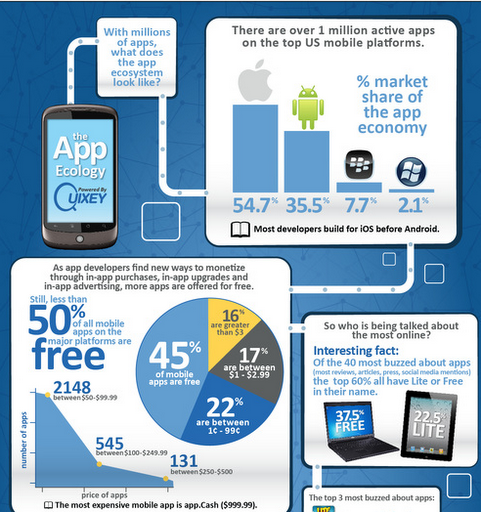
(Source for iPad Infographic shown right)

TWITTER CONVERSATION – Discarding the Antiquated: Folly or Genius?
In a short exchange with EdTechSandyK, she responds to my sharing of an Edudemic blog entry, The Sad Reality of Education Technology, that points out the following:
In case you haven’t noticed yet, we are in the midst of the largest technological revolution in decades. The proliferation of wireless computing and personal technological devices capable of accessing the world has created a new landscape that schools must be aware of now. This isn’t like the other waves that have come across the proverbial bow of education.
Whole language, phonics, “new” math, you name it. Most of the proposed solutions to education’s woes have simply been a twist on the old way of doing things. This technological revolution is different; it has the potential to fundamentally change the way we teach and the way students learn. If done correctly, it can re-define the old way of teaching and provide the means for teachers to truly look at all we have done before through a new student centered lens. At the root of this change for schools is the idea of a 1:1 program.
A 3-Part Series
I would take that one step further and state that if any school considers a 1:1 program the iPad should be the device of choice. This is the first article in a 3-part series discussing the importance of a 1:1 iPad initiative. The argument for why the iPad over other personal devices will be saved for the second article in this series.
As you can see, the key ideas expressed in this excerpt of the blog entry are as follows:
- We are facing changes that are unlike anything we’ve seen before.
- The biggest change is personal technological devices that connect us wirelessly and what those make possible.
- The iPad should be the 1:1 program device of choice.
EdTechSandyK: I don’t agree that 1:1 has to be an iPad, but rest of article is spot on: The Sad Reality of #EdTech t.co/FPbj5XnA HT @mguhlin
mguhlin: @edtechsandyk ha, that’s exactly why I thought the article was spot on…that assertion of one device to rule them all. 😉
EdTechSandyK: @mguhlin Awesome! I’ve seen different folks do so much w/ different tech over the years that I don’t believe in one answer for all. 🙂
mguhlin: @EdTechSandyK diversity is a gift, however, standardization on a base device in orgs with limited resources/funding is necessary.
EdTechSandyK: @mguhlin I agree to an extent. We tried standardizing on IWBs for that reason, but more desirable options came along.
EdTechSandyK: @mguhlin It’s a big risk to decide on a standard today when something better can come along at any moment. Limited resources…
EdTechSandyK: @mguhlin …could leave you stuck with less flexibility. I still think iPads are difficult to manage in an enterprise environment, too.
EdTechSandyK: @mguhlin If all we had to worry about was teaching with them, that might change my thinking. But I’m still learning, too…
mguhlin: @EdTechSandyK my apologies, 5 Temptations of a CEO (not a leader). t.co/eBouT0w5 #3 is relevant with waiting for perfect device.
Today, it is less about content and more about thinking. It is less about whatyou know and more about how you know and who you know to get it from.
Once you know, you must do. I do not mean knowing facts and doing exams. You cannot simply consume; you must contribute and create. (Source: Barking Up the Wrong Tree)
- LibreOffice.org – An Office suite that is completely compatible with MS Office, is well-supported by GoogleDocs, and relatively easy to use. Not only that, you can give it away to everyone in your school community. It works on Mac, Windows, and Linux operating systems, so it runs practically on all the “old” technologies.
- InkScape – a vector drawing tool that could easily fill the hole the role of Adobe Illustrator, and I’ve used it often.
- THE GIMP – This image editing tool–not unlike Adobe Photoshop–offers incredible uses and is part of my daily kit.
- Scribus – A desktop publishing tool, if you find LibreOffice unequal to the task or your past workflows.
- Dia – Graphic organizer software that offers similar functionality to Inspiration and other web-based graphic organizers. I just used it yesterday and was amazed at the maturity of this program.
- OpenShot Video Editor: Although there are plenty of tools available, with a Linux machine, you could have a powerful video editor that works better than Windows-based MovieMaker.
- And the list goes on….
Administrators around the globe are looking for the ‘next big thing’ to save students from a mediocre or irrelevant education and it seems that many have decided that Apple’s iPad is the catalyst to an answer.1
Assuming a classroom set of 30 iPads (for 30 students) that have a product life of 3 years, how else might a teacher choose to spend $20,000-$24,000 to better their ability to teach? Add in training and support costs and that number quickly moves towards $40,000 per classroom. Extrapolate that to an entire school or district and the purchasing power is enormous – what if that investment was put into any other tool – curriculum training, on-site health care for students, library science, financial literacy, reading specialists, after-school care, teacher salaries, paid professional development, or arts programs?
Temptation #1: Being more interested in protecting your career status than you are in making sure your company achieves results.
Advice: Make results the most important measure of personal success.
Temptation #2: Wanting to be popular with your direct reports instead of holding them accountable.
Advice: Work for the long-term respect of your direct reports, not for their affection. View them as key employees who must deliver on their commitments if the company is to produce predictable results.
Temptation #3: Ensure that your decisions are correct.
Advice: Make clarity more important than accuracy…your people will learn more if you take decisive action than if you always wait for more info. It is your job (as CEO) to risk being wrong.
Temptation #4: The desire for harmony.
Advice: Tolerate discord.
Temptation #5: The desire for invulnerability.
Advice: Actively encourage your people to challenge your ideas…don’t be afraid to be vulnerable and trust them with your career/reputation and ego.
Enter your email address:
Delivered by FeedBurner



Discover more from Another Think Coming
Subscribe to get the latest posts sent to your email.
 Another Think Coming
What is the "cost per classroom" in textbooks?
Hmm…for elementary or secondary? Need to clarify that response (good question!). Whatever it is, we're paying extra.