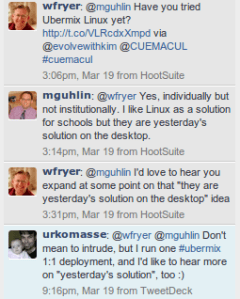
 Earlier today, Wes Fryer (Moving at the Speed of Creativity) sent me a tweet and I quickly responded. In my response, I assert that Linux is a solution for schools but that it is yesterday’s solution on the desktop. Some of the problems our children face CAN be solved with Linux netbooks, but those kinds of questions are old ones. If Linux is the answer to old questions, what are the new ones? Same questions, different answers appropriate for now rather than yesterday.
To be blunt, no one wants computer labs, netbook carts anymore. They’d rather have an iPad. That’s not to say other technologies aren’t necessary, useful, worth having. Only that they are a solution to yesterday’s computing problems. New problems, new solutions. You know…you don’t pour new wine into old wineskins.
Let me be up front about a few things:
- I automatically load GNU/Linux on all my laptops, desktops, netbooks. If it doesn’t have Linux on it, then it soon will have. When friends bring me their computer and complain that it has a problem, I load Linux on it to give them an oasis of stability.
- Linux is a great, no cost operating system with a suite of phenomenal software maintained by a global community of developers and supporters.
- I love Android and the Nexus 7 is a wonderful tablet, albeit no where near as robust as the iPad or iPad Mini. Given the choice between an Android and an iPad, I’d recommend iPad because it enables you to do more. For schools, it’s a no-brainer.
- Although Apple, Microsoft, Google will undoubtedly sell you down the river because they want you to buy their product or what they’re selling, the Linux community will continue to innovate because they enjoy a level of freedom.
Scenario #1 – Total iPad Cost: $13,000,340.00Scenario #2 – Total Computer+Netbook Cost with Windows: $8,965,750.00Scenario #3 – Total Computer+Netbook Cost with Linux: $7,663,750.00
One should always use the best tool for the task at hand.Our tasks, in terms of computing needs, however, have changed. Legacy application suites are getting replaced by a seemingly never-ending stream of smartphone and tablet applications. Cloud services for productivity and storage are the new Microsoft Office and hard drive. Touch computing is becoming the norm, not the exception, and mobile operating systems are optimized for it. Simply put: Netbooks are just another example of old-school computing, and world is moving on. Farewell, netbooks; it was fun while it lasted.
“Any government that tells people to teach proprietary software is essentially delivering the country into the hands of a company.”
The only sane choice IS Linux.
Other stuff worth reading in this vein:
- The March of the Penguins on the Student Desktop
- Linux in Texas Schools
- The Mark of the Apple iPad
- Sabrina Joy Stevens Writes it So I Don’t Have To
Update: Jim Klein responds in the comments. Read those in a guest blog post here along with my response.


var _gaq = _gaq || []; _gaq.push([‘_setAccount’, ‘UA-3445626-5’]); _gaq.push([‘_setDomainName’, ‘mguhlin.org’]); _gaq.push([‘_trackPageview’]); (function() { var ga = document.createElement(‘script’); ga.type = ‘text/javascript’; ga.async = true; ga.src = (‘https:’ == document.location.protocol ? ‘https://ssl’ : ‘http://www’) + ‘.google-analytics.com/ga.js’; var s = document.getElementsByTagName(‘script’)[0]; s.parentNode.insertBefore(ga, s); })();
Discover more from Another Think Coming
Subscribe to get the latest posts sent to your email.
 Another Think Coming
Hey Miguel, thanks for your thoughts here. To sum them up, it seems like your argument is "the iPad is going to win, so we should give up" with a heavy emphasis on "the way we do things now", however I'm not sure that this reflects reality, partially because you seem to be focusing on netbooks alone in your comparisons, and partially because I know for a fact that an iPad is not your (or anyone else's) primary computing device. So let's break those two down:On the netbook front, while the category "netbook" as it is understood to mean a 10" laptop is dead, they have simply been replaced by more powerful and slightly larger 11.6 inch notebooks at the same price points (See Acer V5, Asus X201E, etc.) But even with that knowledge, let's be fair and compare Apples to Apples with an equally priced notebook running ubermix. That Core i3+ notebook will process your aforementioned video and audio at least twice as fast as your iPad, and the applications will bring with them greater capabilities and sophistication than the overly simplistic, touch-based interfaces of the iPad allow. But beyond that, the real computing device also offers far greater potential in terms of complex, sophisticated applications for making, like Blender, Alice, Scratch, LibreCAD, and Eclipse, as well as access to the wide array of web apps that simply don't work or work poorly on an iPad (Flash, Java, and other plugins are still quite prominent, despite what Apple fans might like you to believe). I could go on here, but I think you know what I'm getting at. Choosing to do less in the name of simplicity, opting for an activity-centric approach that emphasizes "doing" rather than "making" in the name of fitting technology in without disrupting outdated structures and practices, and submitting yourself to a degree of vendor lock-in never before experienced in computing is, quite simply, a terrible idea that will ultimately hurt everyone involved.On the primary computing device front, let's get real here: no one you know or I know uses an iPad as their primary device, for many of the reasons I listed above – and more. Knowing that, why on earth would we then think it's OK to give students iPads and only iPads to compute on? The answer is simple: because we make all of our decisions based on what we perceive the capacities of our teachers to be, rather than on what we believe the potential of students to be. This, perhaps, is the saddest trend of all. What will it take for us to believe in kids? To honor their expertise? To accept that we don't have to know everything about technology for our students to use it effectively? When will we understand that our students don't need a list of steps, a stupid template, a wizard, or someone else's idea of design to build something great? I, for one, don't want to see 30 copies of the same (perfect, by someone else's standards) thing as evidence of mastery. I'm not impressed by the beatifully designed whatever that a student used a canned app to create. I'm far more impressed by the ugly thing that mostly works, but was created from scratch with a healthy dose of critical thinking and problem solving. (continued…)
(…continued from prior comment) I fear that giving in to the Borg (Apple and similar corporations), building dependency on other people's software and "ecosystems", and limiting our kids in the name of not being disruptive is leading us down the same path we have gone with skilled labor. We barely think about plumbing, carpentry, metalworking, and shop in schools today, finding ourselves content to simply leave a check for the plumber/carpenter/mechanic when we need something done. And yet we are facing a shortage of skilled labor the likes of which we have never experienced in this country, which is driving costs of some of the most basic needs higher and higher. The same will soon be true with computing. The number of computer science students continues to decline, yet demand for computing resources continues to increase. If current trends are any indication, we are building a generation of takers, rather than makers, who rely on someone else to provide them with the tools they need to get things done, placing their future in the hands of profiteers who wish to control something that was meant to be free. Programs are like math, and if you have to go to the math store to purchase ever more math when you want to design something, then what you design is based entirely on how much math you can afford. Let's not set our kids up to succeed or fail based on how much they can afford. Let's give them the world and anticipate the amazing things they might do with it.
Miguel and Jim, thanks for the comments and your insight to a problem that most schools are facing at this time. As the current push by the Federal and State Governments to move to digital textbooks continues many schools must choose. At my district we currently have Ubermix on all student machines and it has been great. However, when we move to a 1:1 I want to make the best choice for my staff and students. We have been going to schools that use IPads. The portability and some of the apps like eBackpack and Notability work very well in their environment. We are also investigating Chromebooks, and Android, Windows 8 tablets as possible solutions. I am eagerly awaiting an Ubuntu or Ubermix tablet to me this would be the perfect tablet for students and staff.