After reading this study on critical thinking and AI, I found myself scratching my head. I wanted some way to capture ideas reading the study stimulated. Before I share those images, let’s take a quick look at what the study was about.
Confidence Effects From a Survey of Knowledge Workers. In CHI Conference
on Human Factors in Computing Systems (CHI ’25), April 26–May 01, 2025,
Yokohama, Japan. ACM, New York, NY, USA, 23 pages. https://doi.org/10.
1145/3706598.3713778
About the Study
Here are five key takeaways:
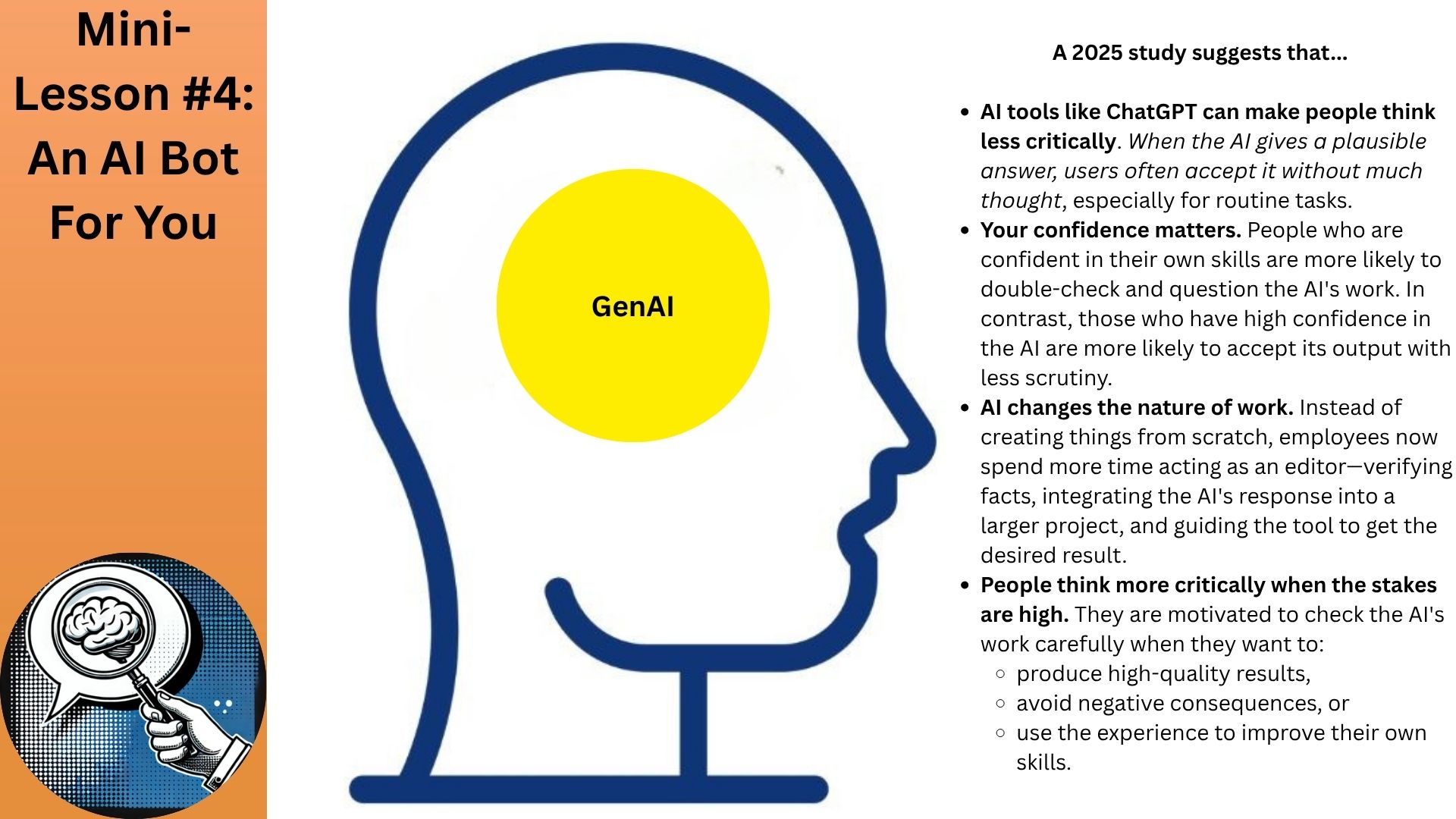
- AI tools like ChatGPT can make people think less critically. When the AI gives a plausible answer, users often accept it without much thought, especially for routine tasks.
- Your confidence matters. People who are confident in their own skills are more likely to double-check and question the AI’s work. In contrast, those who have high confidence in the AI are more likely to accept its output with less scrutiny.
- AI changes the nature of work. Instead of creating things from scratch, employees now spend more time acting as an editor—verifying facts, integrating the AI’s response into a larger project, and guiding the tool to get the desired result.
- People think more critically when the stakes are high. They are motivated to check the AI’s work carefully when they want to produce high-quality results, avoid negative consequences, or use the experience to improve their own skills.
- This research can help developers build better AI. The findings suggest that future AI tools could be designed to encourage critical thinking by helping users spot potential issues, learn from the process, and better understand when to trust the AI and when to rely on their own judgment.
A Visual for Critical Thinking
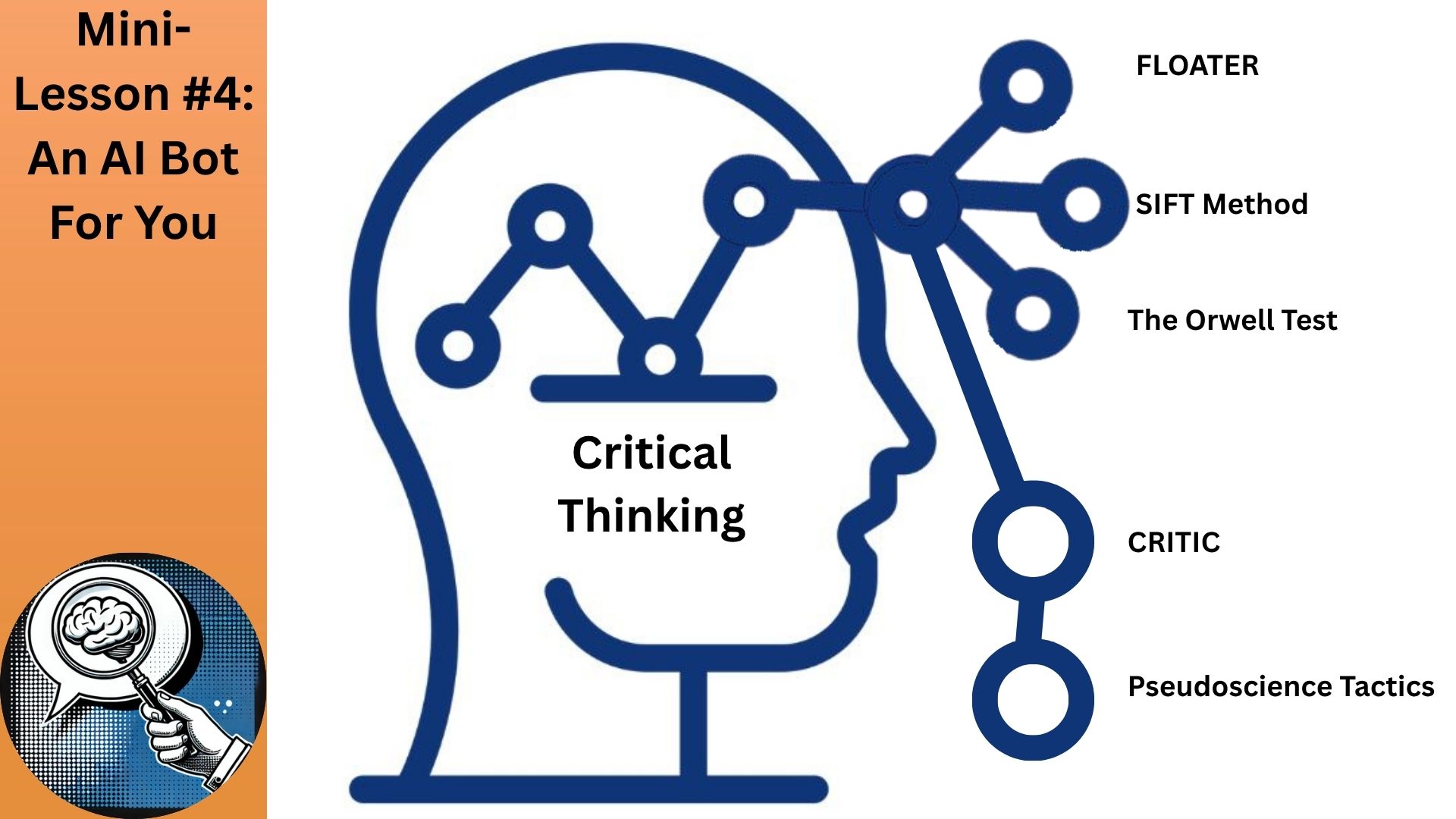
After reviewing the takeaways, I’m tempted to revise the two slides that appear below. In the first picture, students develop competency in critical thinking frameworks. If not all of them, at least in one or two of them:
In the second image below, using GenAI replaces the critical thinking…AI takes on the whole burden:
But that’s not really reflective of the research, is it?
Refining the Images
I may simply cut these two slides out of my slide deck. I asked Gemini to analyze my current images and make suggestions. Then, I dropped those suggestions into ChatGPT to see if would create a new version:


While I like these new images, I realize that while I started in one place with the research, my brain’s ruminations resulted in a visual represntation closer to my thinking, perhaps incorrect.
The idea I had is that if someone understands and can apply critical thinking frameworks, then they won’t have the GenAI doing all their thinking. I suspect I need a third graphic that show the person thinking WITH GenAI. That might be more accurate to my thoughts, but not necessarily as accurate.
Another Study: Cognitive Debt
This study has some fascinating findings that confirm the worst fears:
- Takeaway 1: Brain Power Goes Down with AI: When you use AI like ChatGPT to write essays, your brain doesn’t work as hard or connect as much as it would if you used a search engine or wrote it all yourself.
- Impact on Teaching and Learning: This means schools might need to teach students when it’s okay to use AI and when it’s better to do the deep thinking themselves to truly learn.
- Takeaway 2: AI Essays Don’t Feel Like Yours: If you use AI to write an essay, you might not feel like it’s really “your” work, and you might have trouble remembering or even quoting what you wrote.
- Impact on Teaching and Learning: Teachers might need to help students understand the importance of their own voice and original thought, even when using new tools.
- Takeaway 3: Relying on AI Can Make You Learn Less Over Time: People who always used AI for essays didn’t do as well in brain activity, writing style, or even grades over several months compared to those who wrote without AI.
- Impact on Teaching and Learning: This suggests that always depending on AI could slow down a student’s learning, so teachers should encourage balanced tool use.
- Takeaway 4: AI Can Be a Good Helper (Sometimes): If you first try to write an essay on your own and then use AI to help, your brain might actually work harder to combine its own ideas with the AI’s suggestions.
- Impact on Teaching and Learning: This shows that AI can be a useful tool for revising or improving work after initial effort, rather than a replacement for thinking from scratch.
- Takeaway 5: AI Habits Can Stick with Your Brain: If you get accustomed to writing with AI, even when you try to write without it later, your brain might still be less organized, and you might use words that sound like they came from AI.
- Impact on Teaching and Learning: Educators might need to teach strategies to help students break away from over-reliance on AI so they can develop strong independent writing and thinking skills.
Yikes. 😱
With the MIT study in hand, I wonder if I quoted the wrong study. My original slides match the MIT study more than the other one. I may adjust my slides to reflect the MIT takeaways.
Cognitive debt makes being super careful about when to use AI with K-12 learners very important. But it also has implications for anyone who doesn’t want to suffer decline in their writing and thinking. AI really is your brain on crack.
Here’s an update to the STEER AI Use for Better Critical Thinking resource, although from most people’s perspective, it will be the first time they run into it! 🙂

Of course, it is only one study, one data point on a graph. How many more before we get to scientific consensus level? And what will that mean for those using AI in the meantime?
Discover more from Another Think Coming
Subscribe to get the latest posts sent to your email.
 Another Think Coming
[…] Critical Thinking Made Simple and Critical Thinking Frameworks […]