
In This Issue: Critical thinking with AI requires more than tool bans. Students meet a media world thick with AI slop, which raises the bar for source checks and platform sense making. New research links heavy social and screen time with small but real dips in language and achievement, while a cultural debate asks what is lost as long form reading fades. Across it all, you will find quick routines that help students slow down, test claims, and restore attention.
Jump to: Article 1 | Article 2 | Article 3 | Article 4 | Article 5 | Tech Alert | Must Read Articles | Notable Gen AI Tools

📗 How to Teach Critical Thinking When AI Does the Thinking
🔥 The Big Idea:
A Deloitte team paid back $291k after shipping a ChatGPT authored report riddled with fake citations. Even experts can outsource thinking when they do not interrogate AI. The remedy is not banning tools. Teach dialogic engagement so students and faculty question, test, and own the reasoning behind AI outputs.
✅ Putting It into Practice:
- Make AI plus critique the assignment. Have students generate an AI draft, then annotate what is missing, what is unsupported, and where assumptions creep in.
- Require evidence checks. For any AI claim, students must trace sources and flag hallucinations or dead links.
- Model transparency. Show your own AI prompts, rejected outputs, and the human judgment you applied.
- Use dialogic prompts in class such as “Where could this be wrong?” and “What would X expert argue instead?” to build habits of interrogation.
Source: Psychology Today
Author: Timothy Cook, M.Ed.
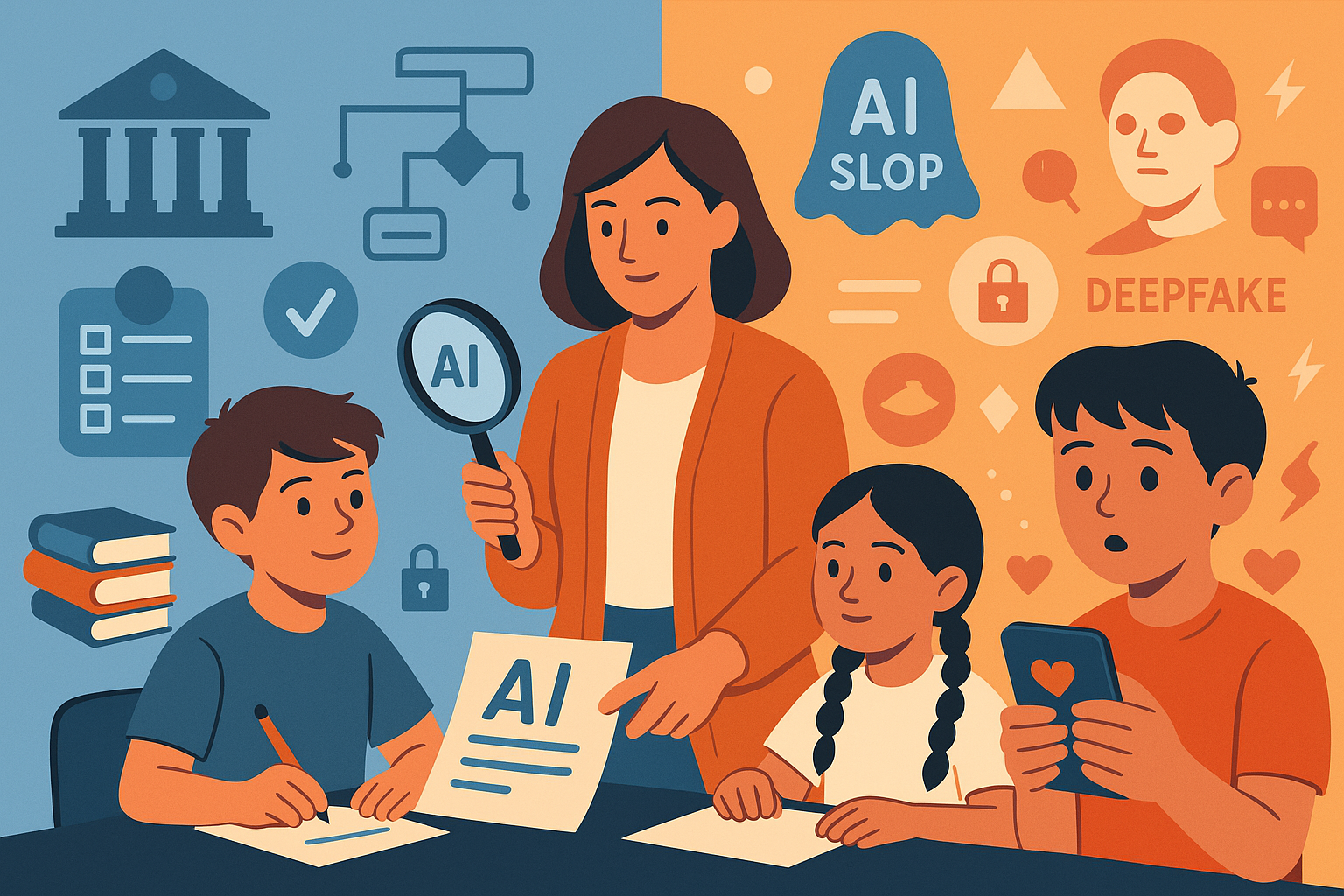
🧭 You Probably Already Saw AI Slop Today: What Educators Need to Know
🔥 The Big Idea:
AI slop, low quality or fake AI generated text, images, and video, now floods feeds and even seeps into search overviews, making it harder for students to tell real from fabricated. The fix starts with human skepticism, transparent workflows, and putting librarians and media specialists on point for schoolwide literacy.

✅ Putting It into Practice:
- Run trust the source drills. Trace a viral claim back to its origin. Label what is missing, who benefits, and how bots might be amplifying it.
- Add a quality gate before publishing student work. Require source checks and a short rationale for credibility.
- Teach platform sense making. Compare how the same topic appears on a moderated forum vs AI generated overviews.
- Partner with the library and media center to lead AI and media literacy mini lessons across content areas.
Source: Tech and Learning
Author: Ray Bendici
🧠 Social Media Use Trajectories and Cognitive Performance in Adolescents
🔥 The Big Idea:
In a national cohort from the ABCD Study with 6,554 participants, both low increasing and high increasing social media trajectories from ages 9 to 13 were linked to slightly lower scores two years later on language heavy tasks such as reading recognition, vocabulary, and memory. Effects were small but consistent and observational. Teach context, not panic.
✅ Putting It into Practice:
- Shift from blanket bans to language first guardrails. Protect reading and vocabulary time windows such as the last 30 minutes before bed for phone free reading.
- Add reflective logs. Students record daily social media time and note trade offs such as what learning time it displaced.
- Teach content over minutes. Discuss how interactive social feeds differ from passive screen time and why that matters for cognition.
- Name the limits with students. Self report bias plus correlation does not equal causation. Invite them to design a classroom mini study.
Source: JAMA
Authors: Nagata et al.
📊 Screen Time and Standardized Achievement in Elementary School
🔥 The Big Idea:
In a Canadian cohort that linked early childhood screen time reports to later grade 3 and grade 6 test performance with samples of 3,322 and 2,084, each additional hour of total screen time was associated with lower odds of higher achievement, especially in reading and math, with TV and digital media driving much of the effect. Associations vary by sex and remain correlational.
✅ Putting It into Practice:
- Prioritize reading and math protected blocks at school and home. Coach families on replacing TV or video with audiobooks or shared reading.
- Track type, not just time. Distinguish TV or digital media vs games and set different boundaries accordingly.
- Build family media plans early in K to 2 with concrete swaps such as a 15 minute math gameboard in place of one episode.
- Communicate nuance. Limits help, but content and context matter, so avoid one size fits all rules.
Source: JAMA Network Open
Authors: Li et al.
📚 The Dawn of the Post Literate Society
🔥 The Big Idea:
Print culture trained us to follow lines of reasoning such as classifying, inferring, and arguing, and that habit powered the Enlightenment, science, and democratic ideals. Today a counter revolution driven by smartphones and hyper addictive feeds coincides with steep declines in reading for pleasure and a struggling book market. The core claim is that as long form reading withers, the cognitive muscles for reasoned argument risk atrophy in public life.
✅ Putting It into Practice:
- Build protected, device free reading blocks of 10 to 20 minutes to re normalize sustained attention and long form comprehension.
- Assign argument maps of book chapters. Students outline claims, evidence, and counterclaims to practice linear reasoning.
- Pair short form with long form. Start with a viral clip, then require a book or article chapter that tackles the same topic in depth.
- Launch reading miles challenges with family opt ins. Track pages or minutes and celebrate streaks rather than speed.
- Teach attention hygiene. Turn notifications off by default during class and model how to batch check messages between periods.
Source: James Marriott column
🔍 Tech Alert
Most users miss AI bias even when the data is right in front of them. A new Penn State study finds most people cannot spot bias in AI training data, even when the skew is obvious, like happy faces labeled with one race and unhappy faces with another. Quick takeaway for class: have students inspect a tiny labeled dataset before using any model, then ask who is missing, how labels were assigned, and what harm a skew could cause. Build the habit of distribution checks first, model outputs second.
Link: Penn State news release
🚀Get a Boost with High-Impact Learning.
TCEA Knowledge Boosters are short, self-paced professional learning experiences designed to fit your schedule and amplify your expertise. Each Booster costs just $29 and varies in total CPE credit hours based on its length and content depth. This gives you flexible, high-impact learning at an affordable price. Explore Perplexity AI and AI as Personal Tutor boosters now.
📚 Must Read Articles
Fresh and practical reads that help you map risks, sharpen instruction, and keep privacy top of mind.
- Shadow AI in Schools, Strategic AI Part One — Short brief on how unapproved AI use shows up in districts plus a starter frame for moving from ad hoc tools to strategy.
- TCEA Instructional Coach Certification and Teaching Edtech — What coaches gain from a structured certification and how that translates to classroom impact.
- Old Problems, New Clothes — Classic classroom challenges reappear in AI wrapped form and why the old playbook still matters.
- Data Privacy Alarm Bells Ringing for GenAI Users — Concrete privacy risks with generative tools and the habits that reduce exposure.
- Struggle is Crucial to Learning in AI Education — Why productive struggle still drives deep learning even with AI at hand.
- Visual Learning Free Tools — A quick set of no cost visual tools you can drop into lessons this week.
- The Death of Windows 10 Led to Record Growth for Zorin OS Linux — A look at OS shifts that may change what students and labs run next year.
🛠️ Notable Gen AI Tools
- 🌀 BoodleBox AI — A browser based AI workspace for educators who want multiple tools in one place.
- 🪄 HeyGen — Create talking avatar videos and language dubs from a script or recording.
- 🧰 Descript — Edit audio or video by editing text, with transcript, overdub, and filler word cleanup.
- 🌀 FastHeadshot — Generate professional headshots from a small photo set for staff pages and badges.
- 🪄 TL;DW — Record meetings and get searchable transcripts and summaries you can share.
- 🧰 Mockup Labs — Turn screenshots or designs into clean mockups for slides, parent docs, and portfolios.
- 🌀 Tapybl — Build a simple link hub to share class resources and student work in one spot.
Another Think Coming by MGuhlin.org
Discover more from Another Think Coming
Subscribe to get the latest posts sent to your email.
 Another Think Coming
Hiya Miguel…. the ‘Jump to’ links at the top of this page link to chatgpt addresses, which in turn are not accessible to readers.
Stephen, thanks for catching that! I’ve fixed the anchor links so they should work properly now. Mucho appreciated!
-Miguel