What fun it was to go over my presentation for Coaching the Heavy Hitters of Instructional Strategy. I managed to hit voice record on my phone to see how it would work. The outline is right on target. I had to laugh because the slide deck from the NotebookLM is amazingly better than my Canva-based creation.
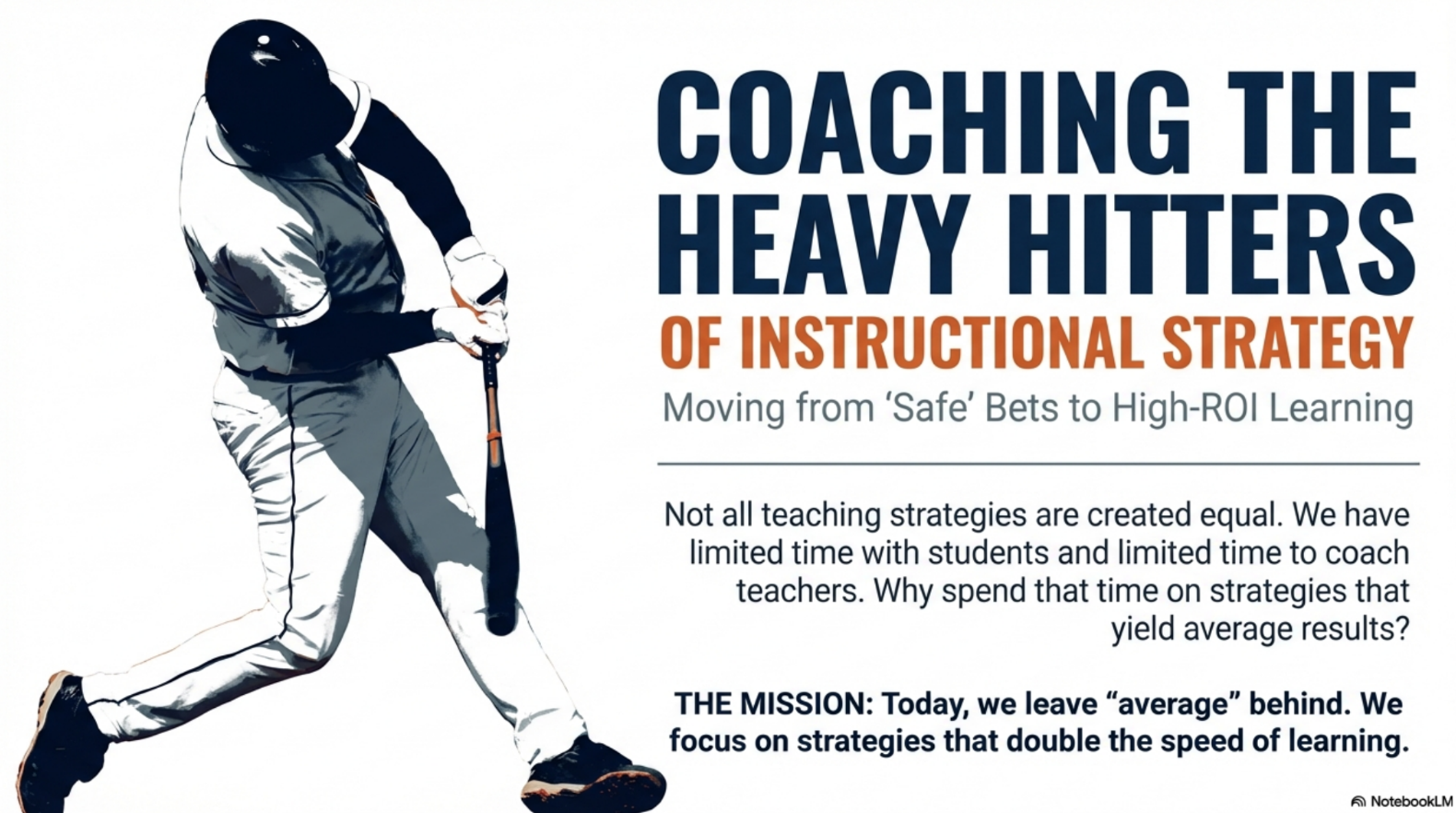
View slide deck via NotebookLM
Outline of My Talk
I. Introduction & Warm-Up (approx. 10 mins)
• Participant Introductions: Attendees share their backgrounds (mix of coaches, administrators, and teachers) and discuss their “go-to” instructional strategies in small groups.
◦ Discussion Highlight: One group discussed the resurgence of handwriting/notebooks versus technology for retention.
• Logistics & Resources:
◦ Introduction to the “Resource Locker” website and the custom AI “Session Assistant” (Google Gem).
◦ Free resource gift: An AI’s Guide to Instructional Coaching ebook,.
II. The Evidence Base: Why “Heavy Hitters”?
• The Hinge Point: Explanation of John Hattie’s research. The goal is to move beyond the “hinge point” of 0.40 (one year of growth) to strategies with effect sizes of 0.74 or higher,.
• The “Stop Doing” List: Reference to Mike Bell’s The Fundamentals of Teaching. The easiest way to improve learning is to stop doing things shown not to work,.
• SOLO Taxonomy: Using the taxonomy to map strategies to learning phases:
1. Surface Learning: Introducing ideas (Uni-structural/Multi-structural).
2. Deep Learning: Connecting ideas (Relational).
3. Transfer Learning: Applying ideas to new contexts (Extended Abstract),.
◦ Key Insight: Coaches must help teachers “match the horse to the rider”—using the right strategy for the right phase,.
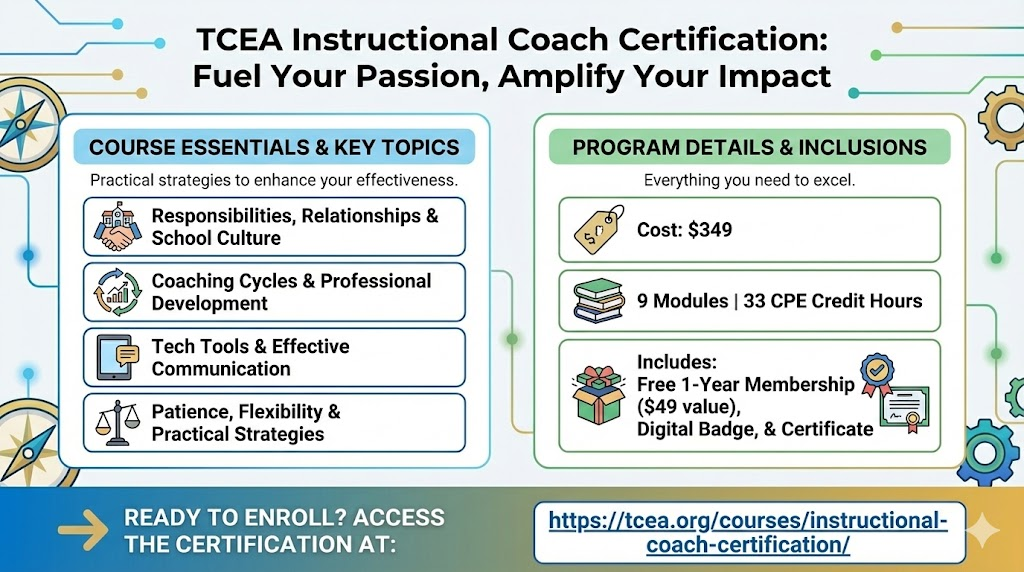
Learn more about the Certification below at
https://tcea.org/courses/instructional-coach-certification/
III. Strategy Deep Dive 1: The Jigsaw Method (ES 0.92)
• The Concept: Moving from Home Groups → Expert Groups → Home Groups. It spans Surface and Deep learning,.
• Implementation: The importance of the “Expert Group” phase where students debate and master the content before teaching it to peers,.
• Coaching Activity (Troubleshooting):
◦ Scenario: A teacher tries Jigsaw, but students return to home groups and just read their notes aloud robotically,.
◦ Audience Solutions: Participants suggested coaching the teacher to model the conversation, provide sentence stems, or forbid “reading” to force internalization,.
IV. Strategy Deep Dive 2: Reciprocal Teaching (ES 0.74)
• The Concept: A deep learning “powerhouse” involving four specific roles (The “Fab Four”),:
1. Predicting: Using clues/titles to hypothesize what comes next (The “Crystal Ball”),.
2. Questioning: Generating deep questions about the text.
3. Clarifying: Identifying confusing vocabulary or concepts.
4. Summarizing: Condensing essential information.
• Coaching Activity (The Hand-Off):
◦ Scenario: The teacher is doing all the work (summarizing/questioning) while students remain passive,.
◦ Task: Participants use the Notice-Wonder-Next framework to craft a coaching question that helps the teacher realize they need to release control,.
V. Rapid-Fire Strategies (Overview)
• Outlining & Organizing (ES 0.86):
◦ The Problem: Students creating “laundry lists” or passively copying the teacher’s outline (the “Copy-Paste” problem),.
◦ The Fix: Students must do the cognitive work of establishing the hierarchy. AI can be used to generate a scrambled list of facts that students must organize,.
• Transfer Strategies (ES 0.75):
◦ The Goal: Applying learning to novel or “ill-structured” problems,.
◦ Technique: Using AI as a “Consultant” to present scenarios where students must apply prior knowledge,.
• Self-Reported Grades (ES 0.96):
◦ The Concept: Students utilizing clear success criteria to accurately evaluate their own work (not just guessing or giving an ‘A’ for effort),.
VI. Conclusion
• The Challenge: The facilitator challenges participants to pick one Heavy Hitter to implement next week rather than coaching on general management or low-impact strategies,.
• Closing Logistics: CPE credit information and final Q&A.
Discover more from Another Think Coming
Subscribe to get the latest posts sent to your email.
 Another Think Coming