

Earlier today, I had the chance to speak on radio with Owala Maima and Dr. Chris Kulesza. They asked a lot of great questions, but alas, my segment was super short for the topic (isn’t it always?). Anyways, here’s an AI processed outline of the conversation, including quotable quotes, etc. It also features the Chancellor of Austin Community College and some takeaways at the end.
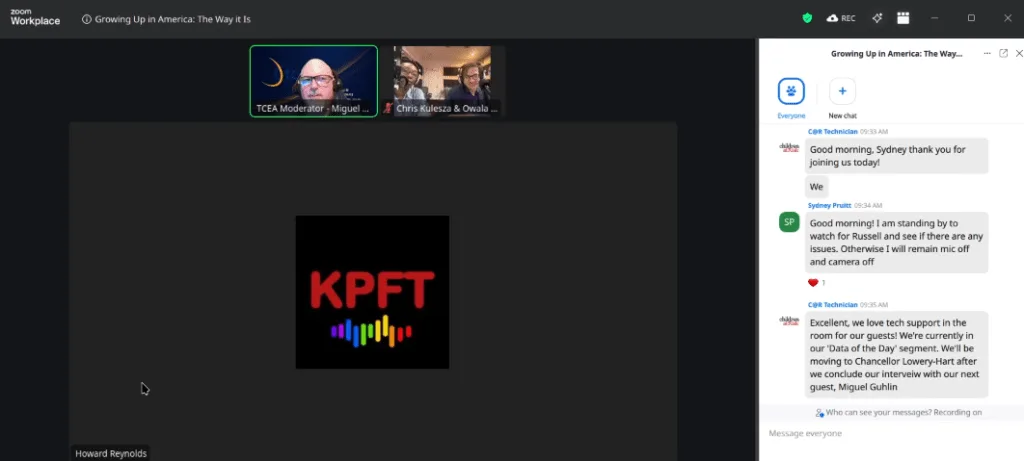
You can listen to the audio next Monday, May 18, 2026 online. You can click here to download a copy of the original audio file from KPFT’s online archive (search for Growing Up in America).
Growing Up in America: AI in Education
Children at Risk on KPFT 90.1 — May 13, 2026 — Transcript Outline
I. Opening Segment: U.S. High School Graduation Rates
“Education is actually strongly connected to long-term health and economic outcomes.”
A. Headline Statistic
1. The average U.S. high school graduation rate is 86.6% (2021–2022 data).
2. Texas sits slightly above the national average at 89.7%.
3. The lowest state rate referenced was 77.3%.
B. Trends and Context
1. Graduation rates have been trending upward over time.
2. A plateau is anticipated, with potential decline projected to follow.
3. Higher educational attainment correlates with higher earnings, better health literacy, and lower chronic disease risk.
C. Barriers and Texas Responses
1. Key barriers to graduation success:
a. Poverty.
b. Chronic absenteeism.
c. Mental and physical health challenges.
d. Homelessness and food insecurity.
2. Communities in Schools of Texas provides wraparound services: mental health resources, tutoring, attendance interventions, and family assistance.
3. Texas College and Career Readiness school models combine early education, career pathways, and workforce preparation to lift both graduation and post-graduation outcomes.
II. Miguel Guhlin (TCEA): Why Banning AI Is a Missed Opportunity
“It’s a missed opportunity because it takes adults out of the conversation.”
A. Introducing TCEA’s Work
1. TCEA is a nonprofit education association focused on professional learning for educators globally.
2. Offerings include online courses, an annual convention, and online events such as the upcoming AI Conference and Library Conference.
3. Miguel’s focus: blog entries and how-to pieces that blend emerging technologies with effective pedagogy.
B. The Case Against Outright Bans
1. Banning ChatGPT and similar tools removes adults from the conversation children are already having with technology.
2. Personal illustration: Miguel’s daughter co-wrote a book with homeschooled children in Tennessee on a desktop computer beside him — the conversation only happened once she was ready to publish.
3. Parents and educators want to share values and guide children, which requires being present in the technology conversation.
4. Schools should provide modeling for responsible use, which depends on building relationships with students around these tools.
C. Frameworks for Observing Learning: SOLO and ACE
1. SOLO Taxonomy describes the structure of observed learning — the words needed to describe what we see when a child learns.
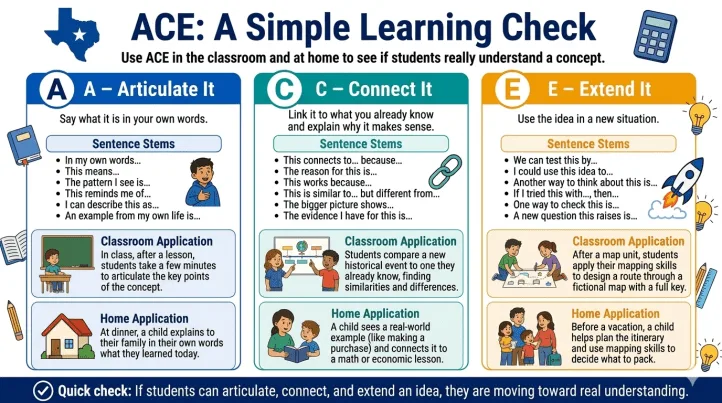
2. ACE is a parent-friendly alternative Miguel uses:
a. Articulate — Can the child express the idea or concept?
b. Connect — Can they tie it to their own experiences?
c. Extend — Can they apply it to new situations and new problems?
3. The goal is moving past imitation toward deeper connection and authentic application.
III. Miguel Guhlin: Protecting Critical Thinking in an AI-Saturated Classroom
“The more high-tech access we have, the more low-tech we need to go.”
A. Cognitive Offloading and Productive Struggle
1. Generative AI delivers information quickly but its trustworthiness must be evaluated in context.
2. Working through ideas by hand — sketching, drawing, writing in print or cursive — activates the brain and builds a solid foundation.
3. Only after that foundation is laid should AI assist in extending and prototyping new solutions.
B. The Return to Low-Tech for Assessment
1. Online instructors face real difficulty verifying whether students are using AI on exams.
2. Higher AI saturation calls for more deliberate low-tech opportunities for students to process information.
3. Struggle is not suffering — it is the cognitive work that moves information into long-term memory and personal relevance.
C. High-Effect-Size Instructional Strategies
1. Approaches that build durable learning without relying on AI:
a. Jigsaw approach for surface learning and introduction of new ideas.
b. Small-group processing and classroom argumentation.
c. Writing workshops, e.g., Nancy Atwell’s “In the Middle” approach.
2. These strategies don’t necessarily ban technology, but they require students to manipulate ideas socially before turning to generative AI.
D. Disciplined AI Use After Foundational Learning
1. Once students can articulate and connect, AI becomes a tool for rapid prototyping and applying learning to real-world or social-justice problems.
2. Effective AI use depends on the user bringing existing knowledge and providing the context the model needs to produce useful predictions.
IV. Dr. Russell Lowery-Hart (ACC): A Human-Centered AI Initiative
“We want to use AI to maximize our humanity, not replace it.”
A. Vision and Partnership
1. Austin Community College aims to use AI to pull real-time student data and connect students to supports before academic, social, or economic crises occur.
2. Expected outcomes: dramatically improved completion rates and stronger student learning outcomes.
3. The initiative is built in partnership with the Trellis Foundation to help higher-ed institutions leverage AI to free employees to support students more fully.
B. Pilot Program Components
1. Two pilot focus areas launching in fall:
a. Basic-needs interventions — childcare, transportation, housing, food, and emergency aid, preemptively connected via financial aid data.
b. Academic support — e.g., a student earning a 72 on a math assignment receives an AI nudge offering 30 minutes of tutoring (in-person, online, or immediate) before the next assignment.
2. Predictive analytics show students scoring 78 or higher are much more likely to complete the course — the intervention targets that gap in real time.
3. Pilot runs in fall 2026 with scaled rollout planned for spring semester 2027.
C. Workforce Development and Small Business Support
1. Central Texas — and Austin specifically — is experiencing an AI boom, raising both opportunity and equity concerns.
2. ACC and Trellis are launching a small business AI training platform, with an initial pilot completed alongside the Greater Austin Asian Chamber of Commerce.
3. Training covers marketing support, client identification, process improvement, and billing — enabling small businesses to compete as if they were medium or large operations.
D. Keeping AI Human-First
1. Bad actors will use AI to replace humans; ACC chooses to use AI to maximize humans.
2. Staff time currently consumed moving data between systems can be redirected to mentoring, coaching, and connecting with students.
3. Guiding ethos: “we’re going to love our students to success.”
V. Closing Reflections: Analog Tasks and AI Wishes
“I don’t need AI writing my emails for me or sending my texts for me. I want that human-to-human interaction and I want it to be authentic and real.”
A. Analog Tasks Worth Preserving
1. Personal communications — emails and texts — should remain authentically human.
2. A growing trend: leaving intentional typos so messages don’t read as AI-generated.
B. Problems Awaiting AI Solutions
1. Time students and employees spend navigating bureaucracy — hunting websites, finding forms, waiting weeks for appointments that need to happen within an hour.
VI. Next Steps and Action Items
A. For Austin Community College (Dr. Lowery-Hart)
- Launch the basic-needs and academic-support AI pilot in fall 2026.
- Refine the platform during the pilot for a scaled rollout in spring semester 2027.
- Continue the Trellis-supported small business AI training, expanding beyond the initial Greater Austin Asian Chamber of Commerce pilot.
B. For TCEA (Miguel Guhlin)
- Continue offering online courses and professional learning resources for educators.
- Promote and deliver the upcoming AI High Conference and Library Conference.
- Continue publishing blog entries and how-to guides on blending emerging technologies with effective pedagogy.
C. For Educators and School Districts
- Move away from outright AI bans and toward modeling responsible use.
- Use frameworks such as SOLO and ACE to assess whether students are imitating answers or genuinely understanding.
- Build in deliberate low-tech, paper-and-pencil opportunities so students can struggle productively with new ideas.
- Apply high-effect-size strategies — jigsaw, writing workshops, small-group argumentation — before introducing generative AI.
D. For Parents
- Stay in the conversation about technology use rather than leaving children to navigate AI alone.
- Use the ACE prompts — Articulate, Connect, Extend — to gauge whether a child has truly learned something.
E. For Listeners
- Tune in next Wednesday from 9 a.m. to 10 a.m. for the next Growing Up in America segment.
- Check for new Children at Risk podcast episodes each Thursday morning.