University of Texas at Austin professor David DeMatthews says the Texas public school enrollment decline was “completely predictable.”
“This all could have been mitigated with smarter policy,” DeMatthews said. (Source: Spectrum1news via Threads)
I was surprised to see Texas is down in total enrollment (76k students) for schools. That means schools lost approximately and on average: $1,086,800,000, roughly speaking and check my math since it’s based on average funding per child and there are a lot of variables.
Money continues to be funneled to private/charter schools and funding cuts at state and federal levels target public schools, leaving them gasping for funding.
Lower student attendance means less money for everything in Texas public schools.
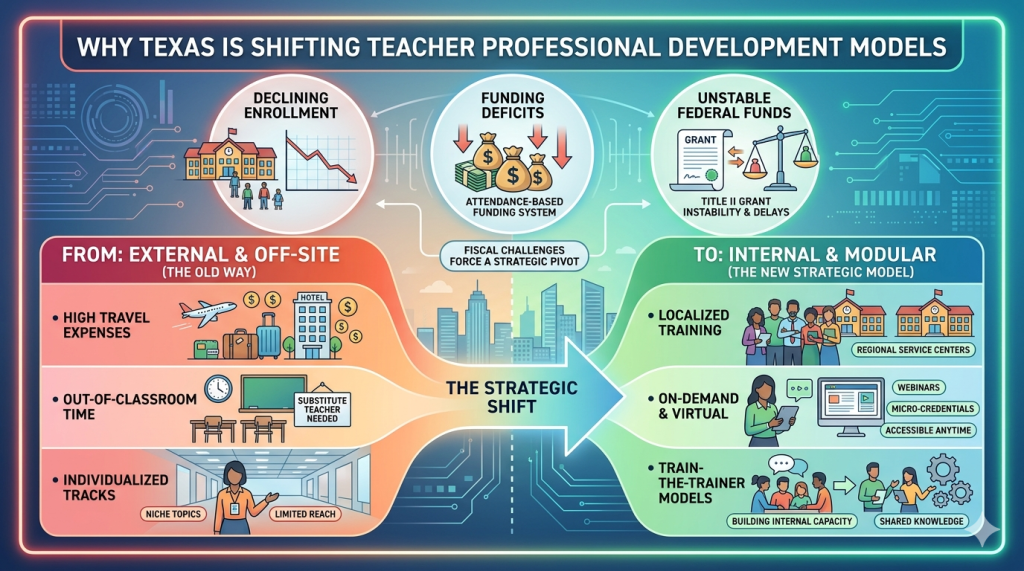
As a result, schools are making the shift from off-site events to local training, on demand and virtual, or train the trainer models. Obviously, this affects attendance at big events since it means there is a higher bar for attendance.
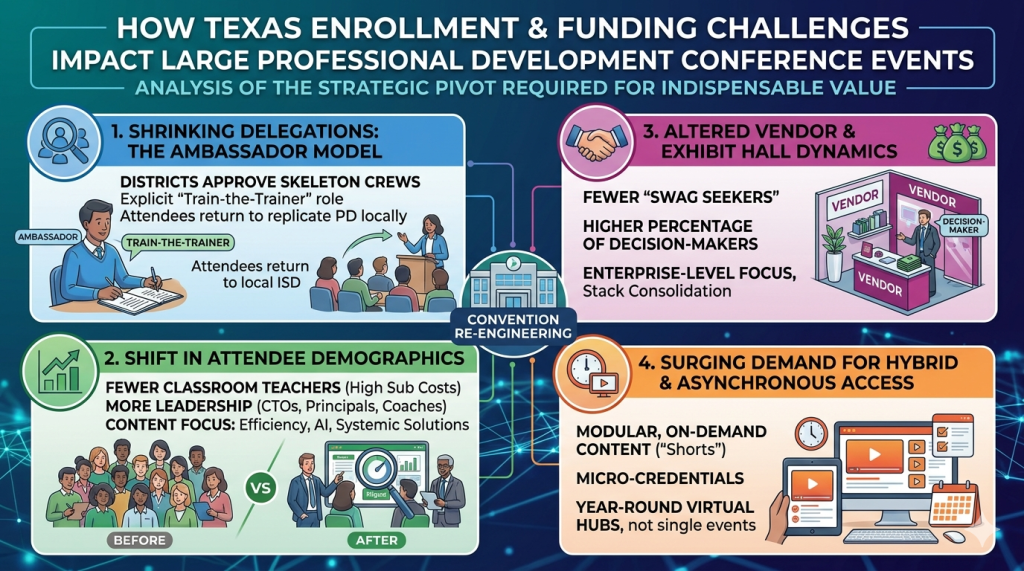
This, of course, to be direct, affects attendance at conferences and conventions organized for professional development. So what can professional development organizations do in these times to better meet needs of schools?
Operational Strategies for Professional Development Associations
- Monetize district-wide enterprise site licenses to guarantee stable, predictable recurring annual revenue streams.
- Pivot to asynchronous micro-credentials and bite-sized modular learning videos for busy educators.
- Deliver regional, on-site customizable workshops directly to districts to eliminate educator travel expenses.
- Curate high-value programming focused strictly on operational efficiency and AI-driven administrative task automation.
- Launch specialized train-the-trainer certification programs to help districts build internal professional capacity.
- Expand corporate sponsorship opportunities by connecting edtech vendors directly with high-level decision makers.
Will these strategies work? Only time will tell. One thing is for certain…
State demographers project that public school enrollment could drop by roughly 500,000 students over the next four to five years due to a declining birth rate, slowing immigration, and the expansion of alternative schooling options. Because the state funding system remains strictly tied to average daily attendance, district operational budgets will remain under intense pressure, keeping discretionary line items like out-of-district travel and substitute teacher coverage locked down tightly. (Adapted from Texas Tribune)
Consider that discretionary line items like out-of-district travel and substitute teacher coverage will be locked down even more as enrollment decreased, funding goes down, and schools struggle to keep operating.
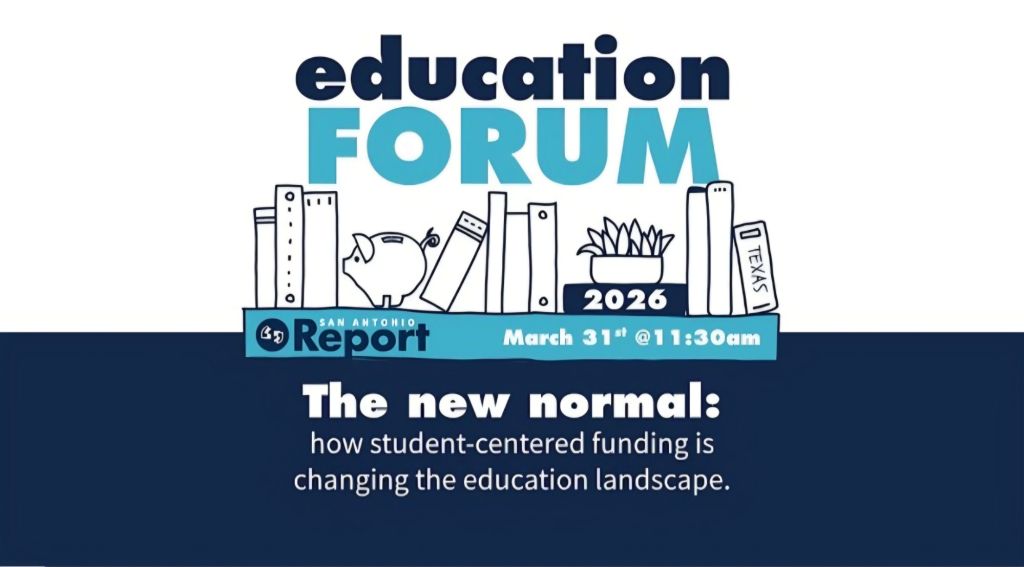
Given these structural budget constraints, do you think large state associations should focus more on lowering individual in-person registration costs to attract self-funded educators, or shift entirely to selling premium enterprise-wide virtual packages to central office administrators?
I am betting on the latter.
The Great Contraction Begins
The Great Contraction isn’t a temporary storm to be weathered; it is a permanent shift in the educational climate.
“There were always those who told us that taxes couldn’t be cut until spending was reduced. Well, you know, we can lecture our children about extravagance until we run out of voice and breath. Or we can cure their extravagance by simply reducing their allowance.” Source: President Ronald Reagan on “starve the beast”
Juxtaposition of Texas’s attendance-driven funding, starve the beast tactics at state and federal levels, with a shrinking student population, the playbook must change for organizations and those offering services to schools.
Discover more from Another Think Coming
Subscribe to get the latest posts sent to your email.
 Another Think Coming