
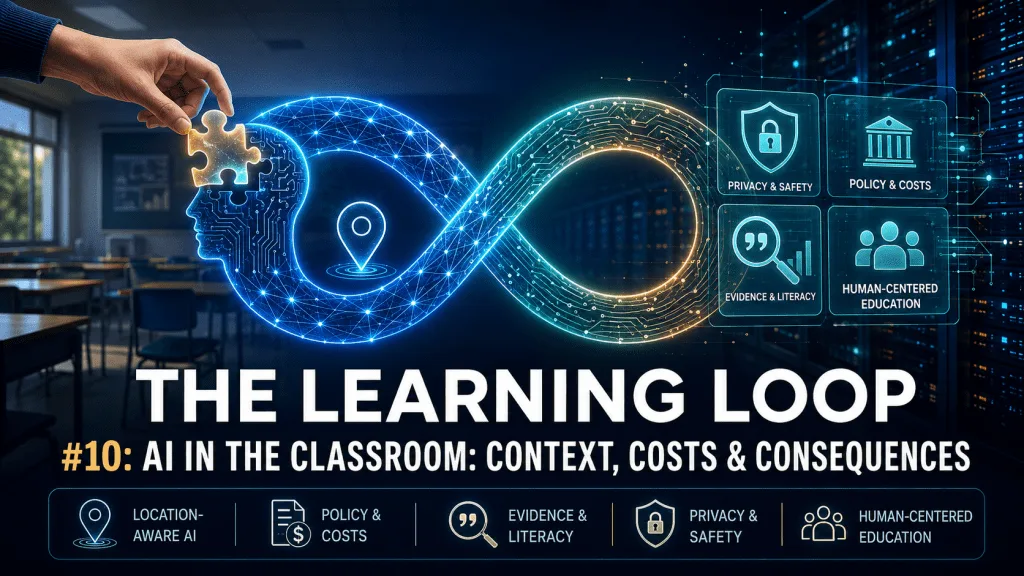
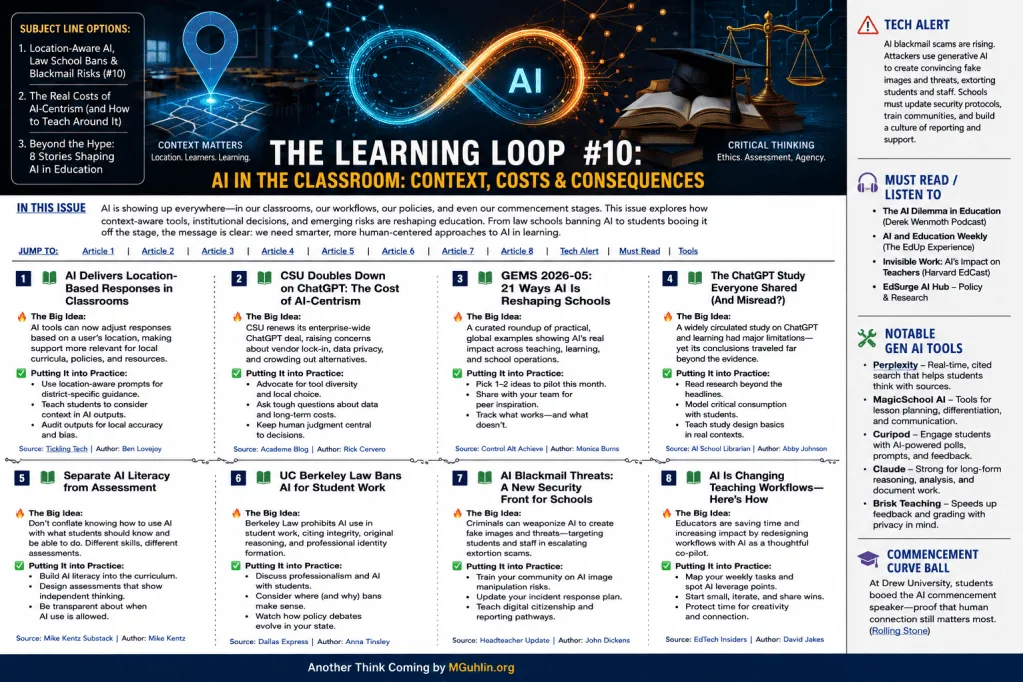
In This Issue
AI is showing up everywhere—in our classrooms, workflows, policies, research summaries, and even commencement stages. This issue explores what happens when AI becomes less of a novelty and more of an invisible layer shaping education. From location-based classroom responses to law school bans, AI blackmail threats, and the cost of institution-wide AI contracts, the message is clear: context, evidence, privacy, and human judgment matter more than ever.
Jump to: Article 1 | Article 2 | Article 3 | Article 4 | Article 5 | Article 6 | Article 7 | Article 8 | Article 9 | Tech Alert

📗 AI Delivers Location-Based Responses in Classrooms
🔥 The Big Idea:
AI tools are becoming more responsive to local context, including a learner’s location, school setting, and regional needs. That sounds promising because classrooms are not one-size-fits-all spaces. But location-aware responses also raise questions about privacy, bias, and whether AI is adapting to students or quietly profiling them.
✅ Putting It into Practice:
- Use location-aware prompts carefully: Ask AI to adapt examples for your district, state standards, local history, or community context without sharing student-identifying details.
- Teach students to question context: Have learners compare a generic AI response with a local-context response and identify what improved—and what may have gone wrong.
- Audit for assumptions: Check whether AI makes inaccurate claims about local culture, demographics, policy, or student needs.
- Protect student privacy: Avoid using names, addresses, school IDs, disability information, or sensitive family details in prompts.
Source: Tickling Tech | Author: Dr. Robbie Barber

📗 Paying the Costs of AI-Centrism: CSU Re-Ups ChatGPT
🔥 The Big Idea:
When a university system renews a major AI agreement, it is not just buying software. It is making a statement about pedagogy, vendor dependence, budget priorities, data governance, and the future of academic labor. The concern is not simply “Should schools use ChatGPT?” but whether AI becomes the center of institutional strategy before educators have had a meaningful say.
✅ Putting It into Practice:
- Ask governance questions: Who chose the tool, who benefits, and who carries the risk?
- Look beyond access: Free access to a tool does not solve issues of equity, training, privacy, intellectual property, or pedagogical fit.
- Avoid single-vendor dependence: Encourage tool diversity and local experimentation rather than locking all teaching into one platform.
- Include faculty and staff voices: AI adoption should involve those who will actually redesign assignments, support students, and respond to misuse.
Source: Academe Blog | Author: Rick Cervero

📗 GEMS 2026-05: 21 Ways AI Is Reshaping Schools
🔥 The Big Idea:
AI in education is no longer limited to chatbots or essay generation. It now touches lesson design, productivity, accessibility, tutoring, media creation, research, and school operations. Curated roundups like GEMS help educators see the breadth of change without chasing every new tool individually.
✅ Putting It into Practice:
- Pick one small experiment: Choose one idea from the roundup to pilot this month rather than trying to overhaul everything.
- Share with your team: Use the list as a faculty meeting discussion starter or professional learning menu.
- Sort by purpose: Group tools and examples by planning, feedback, accessibility, creativity, communication, or assessment.
- Track what actually helps: Keep a simple “worth repeating” list so AI use becomes intentional rather than scattered.
Source: Control Alt Achieve | Author: Eric Curts

📗 The ChatGPT Study Everyone Shared—and Misread?
🔥 The Big Idea:
Research about ChatGPT and learning often travels faster than careful interpretation. A study can be useful and still be exaggerated, misquoted, or stripped of its limitations once it hits social media. For educators, the lesson is clear: AI literacy includes research literacy.
✅ Putting It into Practice:
- Read past the headline: Before citing an AI study, check the sample size, context, age group, task design, and limitations.
- Teach “research humility”: Ask students what a study does and does not prove.
- Compare claims: Have students compare the original research summary with how it was described online.
- Model careful language: Use phrases like “suggests,” “in this context,” and “for this group” instead of overstating findings.
Source: AI School Librarian | Author: Abby Johnson

📗 Separate AI Literacy and Assessment
🔥 The Big Idea:
Students need to learn how AI works, how to use it responsibly, and when not to use it. But that is different from assessing whether they can think, write, solve, explain, or create on their own. When AI literacy and assessment are blurred together, teachers lose clarity and students lose trust.
✅ Putting It into Practice:
- Name the purpose first: Decide whether the task is teaching AI use, assessing independent skill, or blending both.
- Create clear AI-use labels: Mark assignments as “No AI,” “AI for brainstorming,” “AI for revision,” or “AI collaboration expected.”
- Assess process, not just product: Include checkpoints, conferences, drafts, reflections, and oral explanations.
- Be transparent with students: Explain why AI is allowed in some tasks and restricted in others.
Source: Mike Kentz Substack | Author: Mike Kentz

📗 UC Berkeley Law Bans AI for Student Work
🔥 The Big Idea:
UC Berkeley Law’s AI ban reflects a growing concern that some forms of AI use may interfere with professional identity, independent reasoning, and the development of core disciplinary judgment. In law, as in education, the question is not just whether AI can produce work. The deeper issue is whether students are still doing the thinking needed to become competent professionals.
✅ Putting It into Practice:
- Discuss professionalism: Ask students where AI assistance supports learning and where it undermines responsibility.
- Clarify discipline-specific norms: Different fields will draw different lines around acceptable AI use.
- Use bans carefully: A ban may protect certain learning goals, but it must be paired with explanation and enforceable expectations.
- Watch policy trends: Law, medicine, education, and engineering programs may become early signals for broader AI governance.
Source: The Dallas Express | Author: Anna Tinsley

📗 AI Blackmail Threat: Schools Need Image Security Guidance
🔥 The Big Idea:
Generative AI has made it easier to create convincing fake images, impersonations, and threats. Schools are now facing risks that blend cyber safety, student well-being, media literacy, and crisis response. AI image abuse is not a future problem; it is a current safeguarding issue.
✅ Putting It into Practice:
- Update incident response plans: Include AI-generated images, deepfakes, impersonation, sextortion, and blackmail scenarios.
- Teach verification habits: Show students how fake images spread and how to pause before reposting or responding.
- Create reporting pathways: Students and staff should know exactly who to contact when AI-generated threats appear.
- Avoid victim-blaming: Center safety, documentation, support, and rapid escalation.
Source: Headteacher Update | Author: John Dickens

📗 How AI Is Changing Teaching Workflows
🔥 The Big Idea:
AI is changing teacher work less by replacing teachers and more by reshaping the small tasks that fill the week. Planning, differentiation, feedback, communication, rubric design, and resource creation can all be accelerated with thoughtful AI use. The challenge is to preserve teacher judgment while reducing avoidable friction.
✅ Putting It into Practice:
- Map your weekly workflow: Identify repetitive tasks where AI might save time without lowering quality.
- Use AI as a co-planner: Ask for first drafts of lesson hooks, exemplars, checks for understanding, or parent communication.
- Protect the human parts: Feedback, relationships, classroom culture, and professional judgment should stay teacher-led.
- Build reusable prompts: Save prompts that work so AI use becomes faster and more consistent.
Source: EdTech Insiders | Author: David Jakes

📗 College Students Boo AI Commencement Speaker
🔥 The Big Idea:
When students booed an AI commencement speaker, they were not just reacting to a gimmick. They were pushing back against the feeling that an important human ritual had been automated. The moment is a reminder that education is not only about efficiency; it is also about belonging, recognition, voice, and shared experience.
✅ Putting It into Practice:
- Protect human-centered moments: Graduation, recognition ceremonies, feedback conferences, and mentoring should not feel outsourced.
- Ask students what matters: Before using AI in public-facing student experiences, gather student input.
- Use AI behind the scenes: Let AI help draft, organize, or brainstorm—but keep the final human voice authentic.
- Discuss symbolic use: Have students analyze when AI use feels helpful, performative, disrespectful, or meaningful.
Source: Rolling Stone | Author: Miles Klee

⚠️ Tech Alert: AI Blackmail and Image-Based Abuse Are Escalating
Schools need to treat AI-generated image abuse as both a digital citizenship issue and a safeguarding issue. Deepfake threats, fake nude images, impersonation, and extortion attempts can spread quickly and cause real harm even when the media is synthetic. Every campus should update reporting procedures, preserve evidence, involve families appropriately, and train staff to respond without amplifying the harm.
📚 Must Read / Listen To
- The AI Dilemma in Education – A practical reflection on the competing pressures schools face when responding to AI.
- AI and Education Weekly – Useful podcast conversations about how AI is reshaping schools, leadership, and learning.
- Invisible Work: AI’s Impact on Teachers – Follow EdTech Insiders for workflow-focused analysis of how AI changes teacher practice.
- EdSurge AI Hub – A helpful collection of policy, classroom, and research resources.
🛠️ Notable Gen AI Tools
- Perplexity: Helps students and teachers search with cited sources, making it useful for evidence-checking and research comparison.
- MagicSchool AI: Supports lesson planning, differentiation, rubric creation, communication, and classroom workflow tasks.
- Curipod: Helps teachers build interactive AI-supported lessons, polls, prompts, and student engagement activities.
- Claude: Strong for long-form reasoning, document analysis, policy review, and careful drafting.
- Brisk Teaching: Speeds up feedback, resource creation, and grading support with classroom privacy in mind.

Another Think Coming by MGuhlin.org
Note: This newsletter provides original commentary and summaries of publicly available sources for educational and informational purposes. Readers are encouraged to visit the linked sources for the full context. Article images are represented with placeholders unless separately licensed or created for this issue.