
The short version
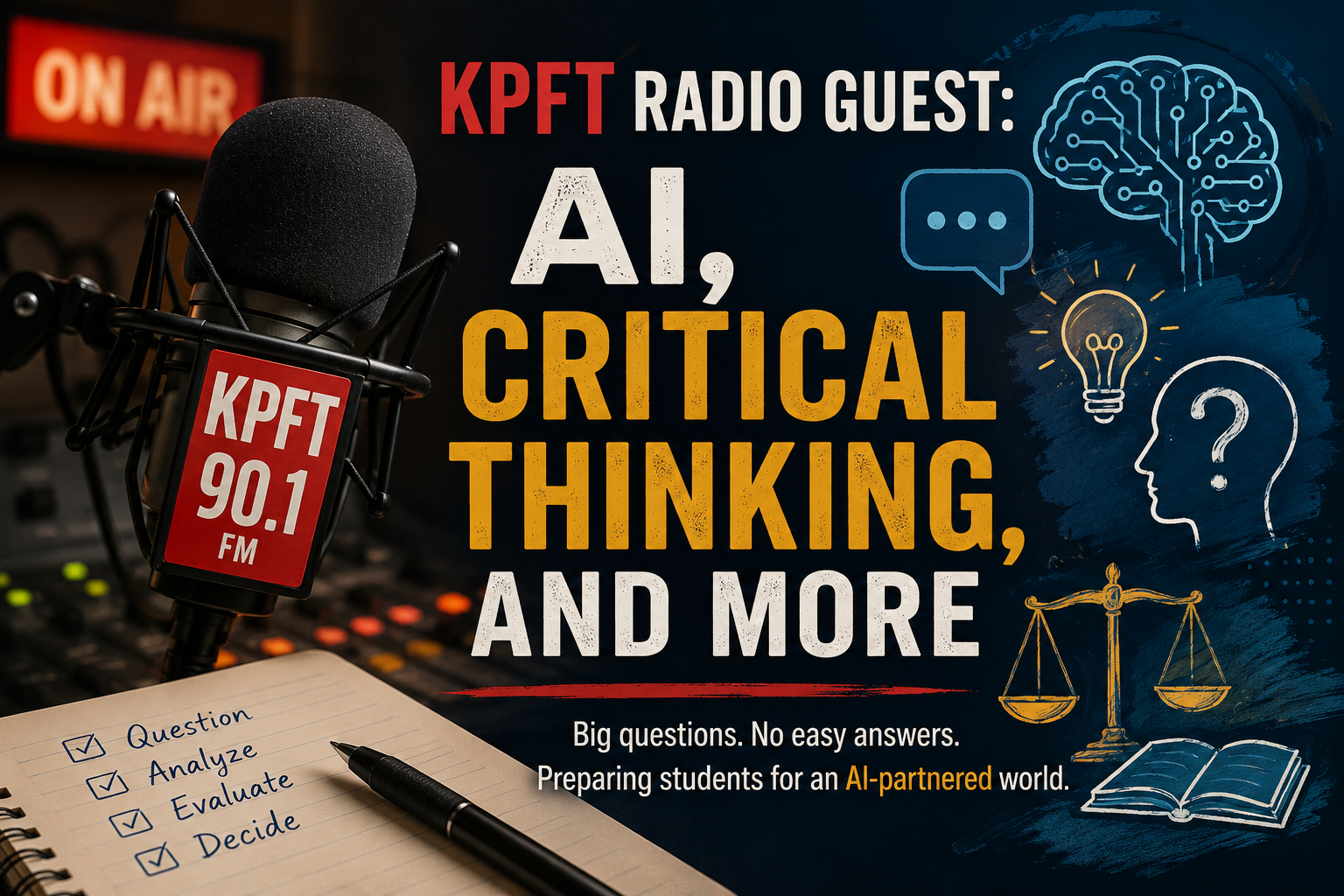
This morning, I'll be spending some time chatting with the hosts of Children at Risk KPFT radio program about some important questions. They were kind enough to share some of the questions ahead of time. Listen in.
This morning, I spent some time chatting with the hosts of Children at Risk KPFT radio program about some important questions. They were kind enough to share some of the questions ahead of time, and wow, they are tough ones. They are tough because no one person or organization has the right answer. They are tough because in Texas, there’s no to little guidance on using Gen AI in schools, as I shared in this blog about the EPIC/TACC’s effort at a white paper on AI Literacy for Innovation, Growth, and Networking (ALIGN).
The Problem
Some of the stats are mind-boggling:
| Who | AI Usage | District Policy Available? |
|---|---|---|
| Teachers | 86% | 29% |
| Students | 61% | 20% |
This data (cited in the link above for ALIGN) highlights that Texas is among five states that lack K-12 guidance. Schools are moving slowly from prohibition to preparation, but not fast enough. That’s why ALIGN is so important because AI literacy is a habit of the mind. The vision statement for ALIGN is:
All Texas students prepared to thrive personally and professionally in an AI-partnered world.
That’s a pretty ambitious perspective but it won’t happen unless we:
- Establish state leadership
- Issue statewide guidance
- Fund professional development
- Update learning standards
Right now, that’s happening with other initiatives but not Gen AI, which has already “arrived” in schools from K through Higher Education.
Cognitive offloading. It happens when students get finished answers from a chatbot. Students end up skipping the analytical work that would have built the skill. A 2025 study by Michael Gerlich found frequent AI users scored lower on critical reasoning. The youngest users leaned on it most. A K-12 scoping review saw the same. More time on AI, less cognitive engagement. This means that students hand off the part that is supposed to be hard.
When students got errors from a chatbot, they often took the answer anyways. (source).
Critical Thinking
You know, a tutor strengthens your thinking. A substitute hides the fact that you didn’t think. If a student can’t explain it without the screen, the tool probably did too much. The real question is, “Who owns the thinking?” That’s why I like solutions like ACE:
- Articulate It: Explain ideas in your own words
- Connect It: Show how it relates to something you already know
- Extend It: Apply it to a new situation
To really kick it up, we need to teach kids how to engage in critical thinking. While I love the work of Melanie Trecek-King’s (Thinking Is Power FLOATER, I have been working on the CLEAR framework. What’s more, I have a whole series of activities available. Read more about that below:
- Crack the Case with CLEAR, Smart Thinking, Part 1
- Three Critical Thinking Online Breakouts for 2026-2027 (CLEAR, Part 2)
- Science Detectives: Critical Thinking Online Breakouts (CTOBs) for Your K-2 Classroom
- Celebrate America’s 250th Birthday with Fourth of July Critical Thinking Breakouts (CTOBs)
And, more CTOBs are planned. Be sure to visit the TCEA TechNotes blog for more. You will see them popping up between now and the end of August for science, Bible as Literature, and more.
I hope you’ll listen in today.
Post-Show Reflection
Wow, this was a fast-moving show with Dr. Robert Sandborn and Luis Negreros. I always feel like my brain is too slow to keep up. Make sure you give them a listen: