
The short version
Katy ISD’s AI limits raise bigger questions about access, equity, and instruction.
If you’re following the train wreck that is Gen AI in K-16 schools and higher education, you no doubt caught the recent news about Katy ISD:
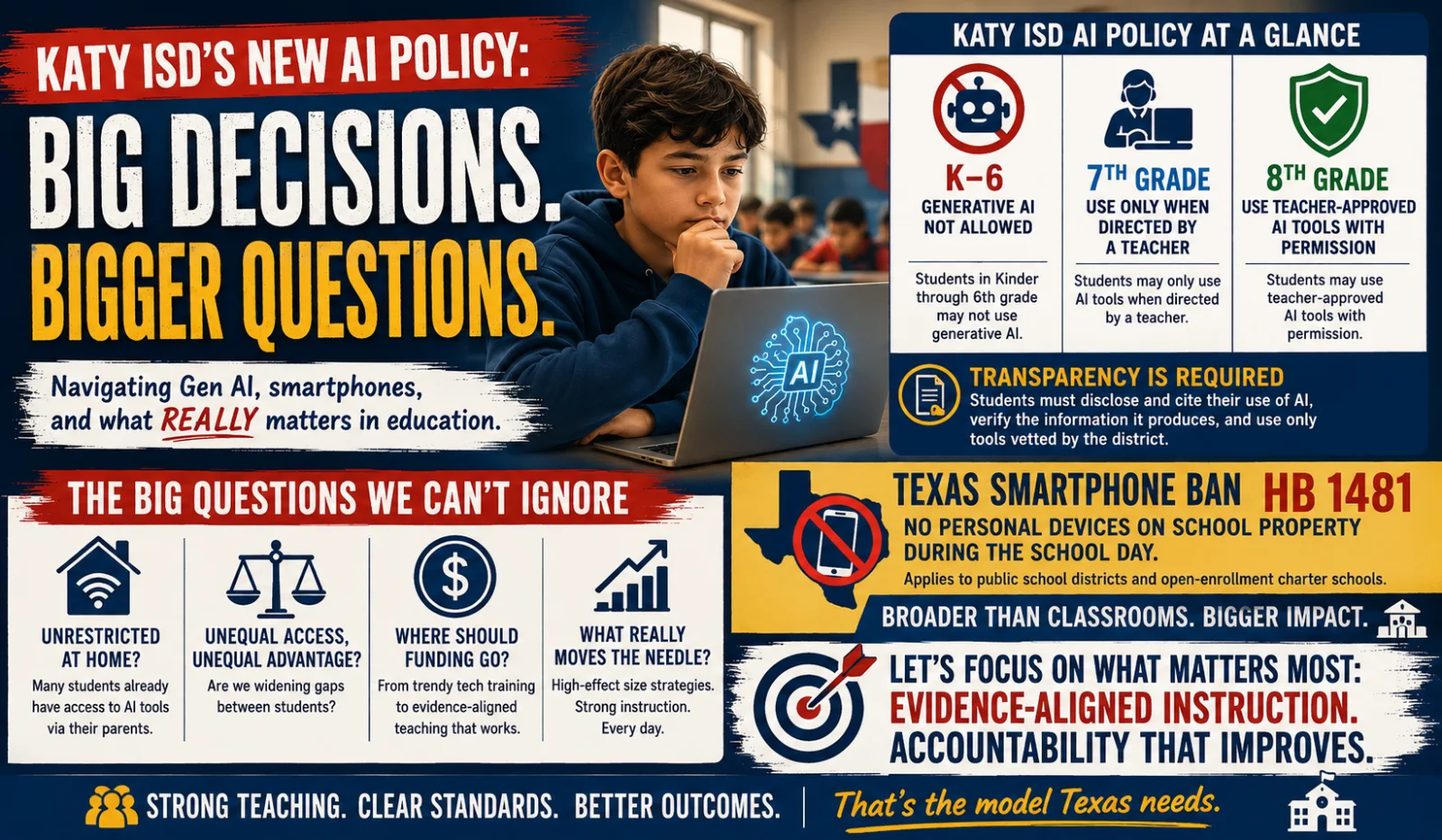
Katy ISD students in sixth grade and younger will be prohibited from using generative AI under new district rules that phase in classroom use by grade level beginning in the 2026-27 school year.
To summarize, here’s what’s NOT allowed:
Kinder through sixth grade using Generative AI
- Unrestricted use in seventh grade; instead, students only use Gen AI when directed by a teacher
- Unapproved use of AI tools in eighth grade; instead, students use teacher-approved AI tools with permission
Gen AI Use Must Be Transparent
What’s more, “Students must disclose and cite their use of AI, verify the information it produces and use only tools vetted by the district” says Assistant Superintendent of Teaching and Learning Sanée Bell (as cited in the Houston Chronicle piece).
I can’t blame Katy ISD for being responsive to its parents. If there are parents out there who think productive struggle is NOT desirable and conducive to learning for their kids, then they might need to speak up. However, the whole point of school IS to ensure productive struggle, learning, long-term information retention, happens. If a new technology short-circuits that process, preventing it from happening, then all schools can do it try to find a way to stop it. The real issue is that these technologies were pushed into K-16 in a rush, presumably so Big Tech could get “more training data” to improve the models, as well as make new generations dependent on using Gen AI tools in lieu of yesterday’s approach to getting things done.
While that approach makes a lot of business sense (it’s all about the almighty dollar, isn’t it?), it makes less sense for children in K-12, and apparently, college students engaged in university studies.
Do You Agree with This Action?
Whether you agree with this or not, the question going around in my head is, “Isn’t that cat already out of the bag?” If everyone is using Gen AI, won’t students already have unrestricted use via their parents? And, if there are parents blocking usage by their students, are those students at a disadvantage to those students whose parents give them access?
This will, of course, have to go hand-in-hand with a smartphone ban.
The Texas Smartphone Ban (HB 1481)
Texas House Bill 1481 amended Texas Education Code §37.082. It requires public school districts and open-enrollment charter schools to prohibit students from using personal communication devices on school property during the school day.
The ban is broader than a classroom-only or instructional-time ban. This means that students without device access (and presumably, Gen AI access) would be unable to access AI tools not under school control. This makes the parent push to curtail screentime even MORE concerning with school district computing devices.
| School type | HB 1481 applies? | Explanation |
|---|---|---|
| Traditional public school districts | Yes | Every district must maintain the required student-device policy |
| Open-enrollment charter schools | Yes | The law expressly names their governing bodies |
| District-operated charter campuses | Yes | They remain part of a covered public school district |
| Private and parochial schools | No | HB 1481 does not place the statewide mandate on private schools |
| Certain charter adult-education programs | No | The statute contains a specific exemption |
So, if you teach in private/parochial schools, you definitely have some latitude in allowing students to use smartphones in class. Will private/parochial schools follow in the footsteps of public schools, simply because they are doing it?
Professional Development
It also raises the question, “Should school districts be spending any money on professional learning or training on how to best use technology with students?” If you are a private/parochial school, then, “Yes, you should learn how to use smartphones students walk in the door with.” But it may be easier to simply focus on traditional instructional practices.
Another question is, “How will that funding be re-directed to cover learning how to teach with evidence-based, high-effect size instructional strategies?”
Increased Accountability, More Evidence-Aligned Instructional Ingredients
For me, this is where we need to be spending our time. But what instructional strategies, instructional methods, now in vogue, are we spending our time and effort on? Should ALL Texas schools now be adopting evidence-aligned instructional ingredients placed inside a highly centralized, compliance-oriented accountability system?
The next blog entry takes a stab at capturing what this type of “model” might look like.