
The short version
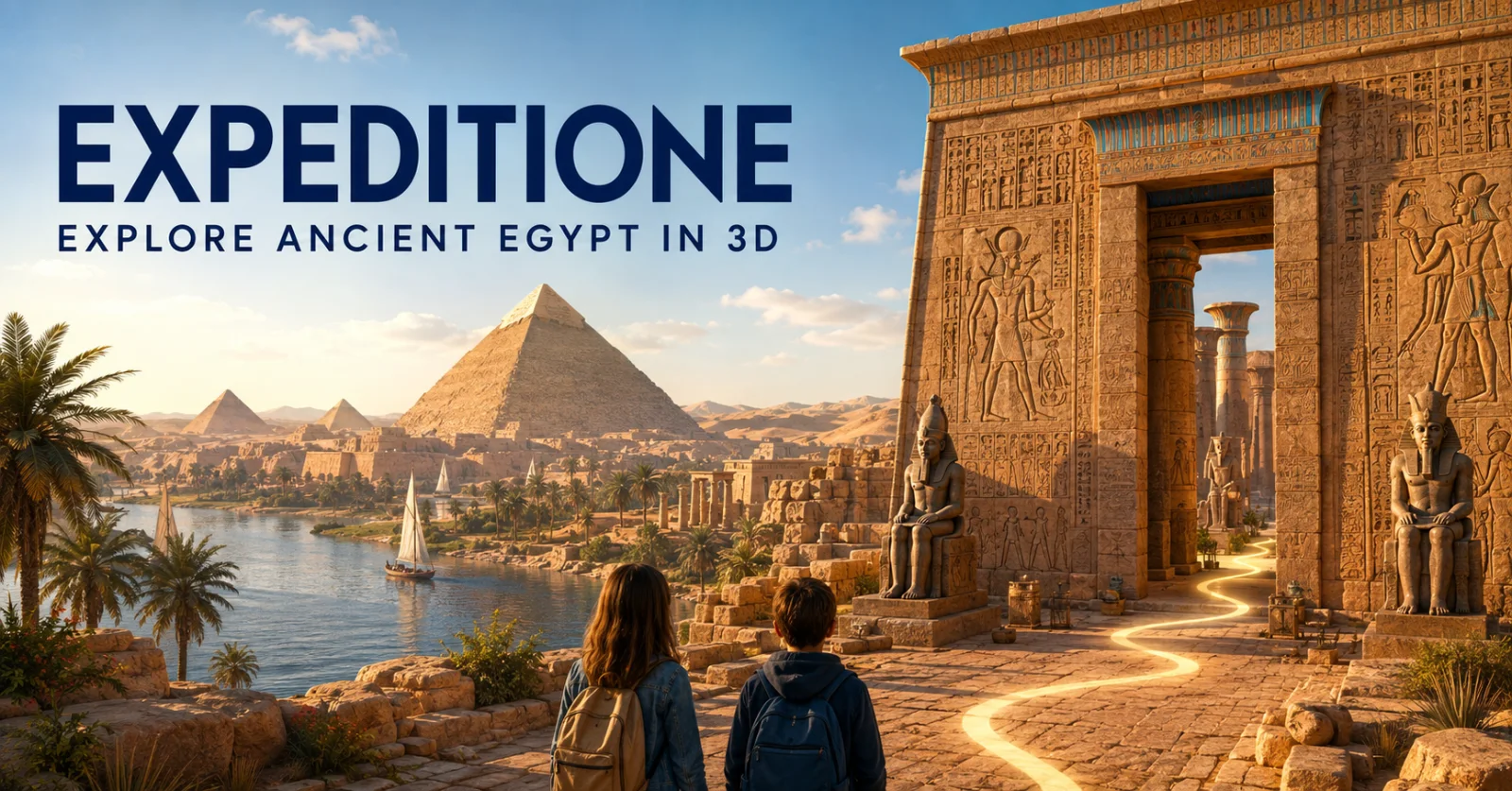
Explore Ancient Egypt through immersive 3D scenes, evidence, and inquiry.
One place that captures my interest? Egypt. I’ve seen so many exciting movies, read adventure stories, all of which are situated in Egypt or Ancient Egypt. As you might imagine, Ancient Egypt can lose some of its magic when K-12 students meet it through a textbook paragraph and a picture of the pyramids. The pyramids deserve better than four bullet points and a vocabulary quiz. They deserve a powerful story and a way to visually explore the background.
That is why Expeditione caught my attention. This free, browser-based 3D encyclopedia invites students to explore history instead of simply reading someone else’s summary of it.
Explore the Ancient World
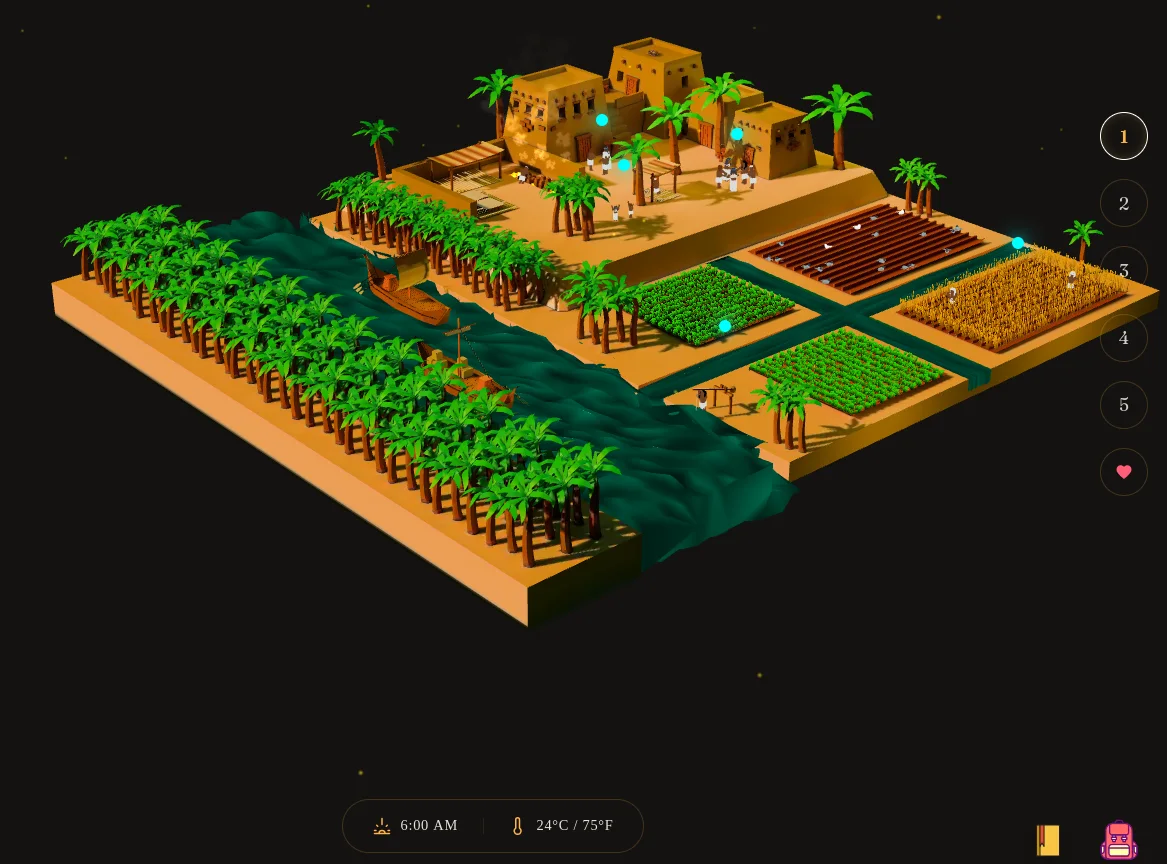
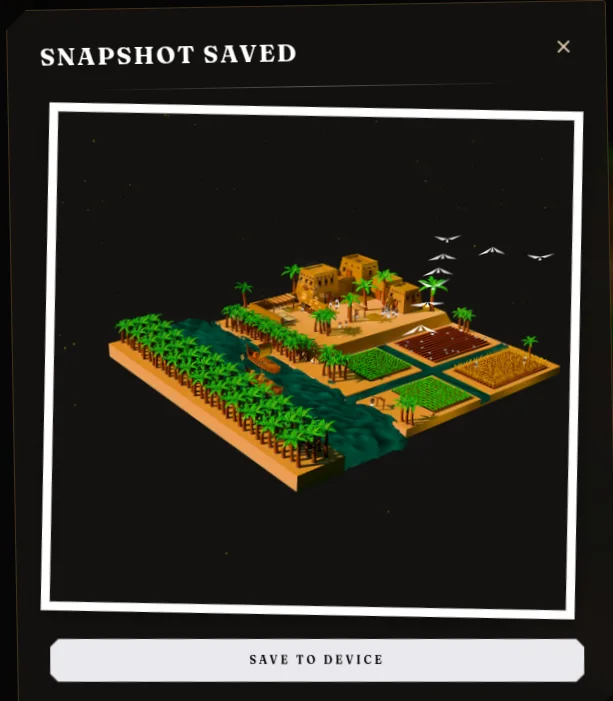
Expeditione’s first journey takes students into Ancient Egypt through interactive 3D scenes. They can examine daily family life, quarry work, temples, the Nile Delta, pyramid construction, and the fierce Khamsin sandstorms. There are several scenes you can explore, and you can take snapshots along the way.
Anyone who’s watched recent movie releases spanning history knows that it is not packaged as one tidy answer. When historians disagree, such as how the pyramids may have been built, Expeditione presents multiple evidence-based theories. I like that choice because it gives teachers something better than another round of fact recall: an opening for students to compare evidence, explain their reasoning, and decide which theory they find most convincing.
ACE Ancient Egypt
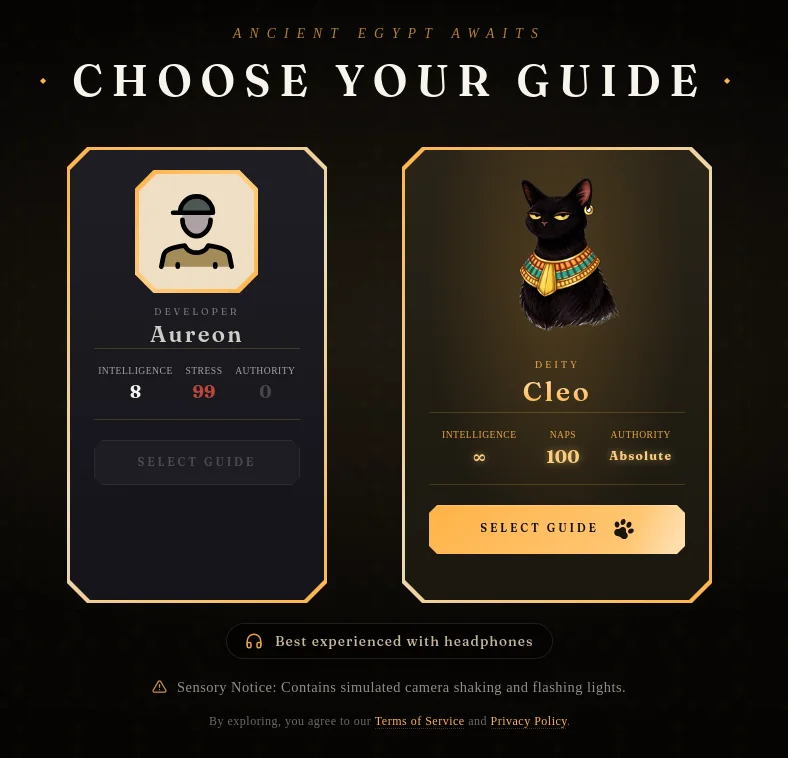
For fun, I added wondered might this look like through the ACE Framework. I hope Aureon doesn’t mind me having fun with Expeditione in this way:
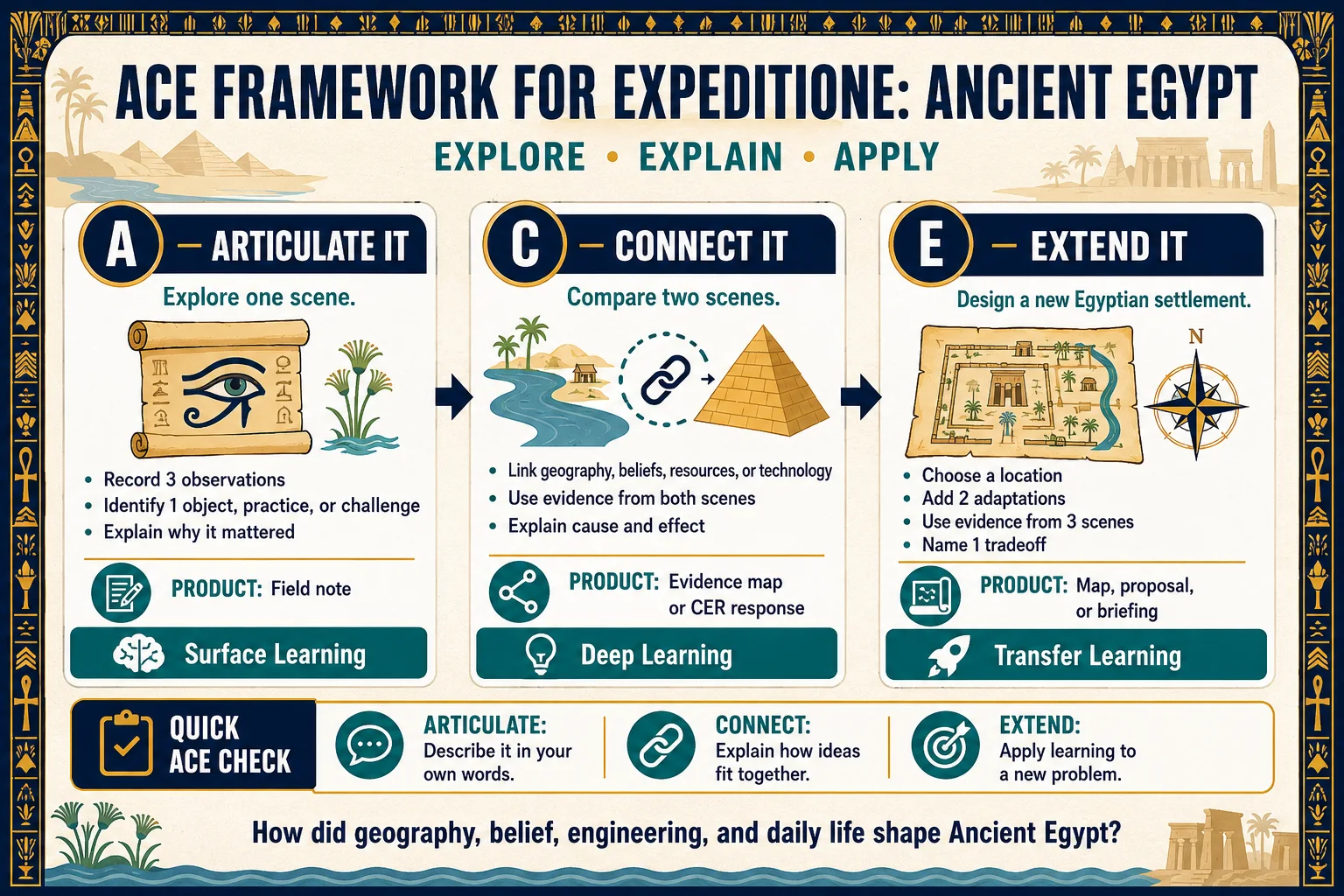
If you want to explore the ACE Connection further, it appears below the divider at the end of this blog entry.
Built for School Devices
Independent creator Aureon de Veyra researched, wrote, programmed, designed, animated, and modeled Expeditione. Each 3D scene is approximately one megabyte. The hope is that it will load quickly on standard school Chromebooks and iPads.What’s more, a Performance Mode setting reduces the demands on lower-powered devices. The 3D scenes are beautifully detailed and worthy of exploring. Students can also be guided through work. The music and sounds put you in the mood for the exploration of Ancient Egypt:
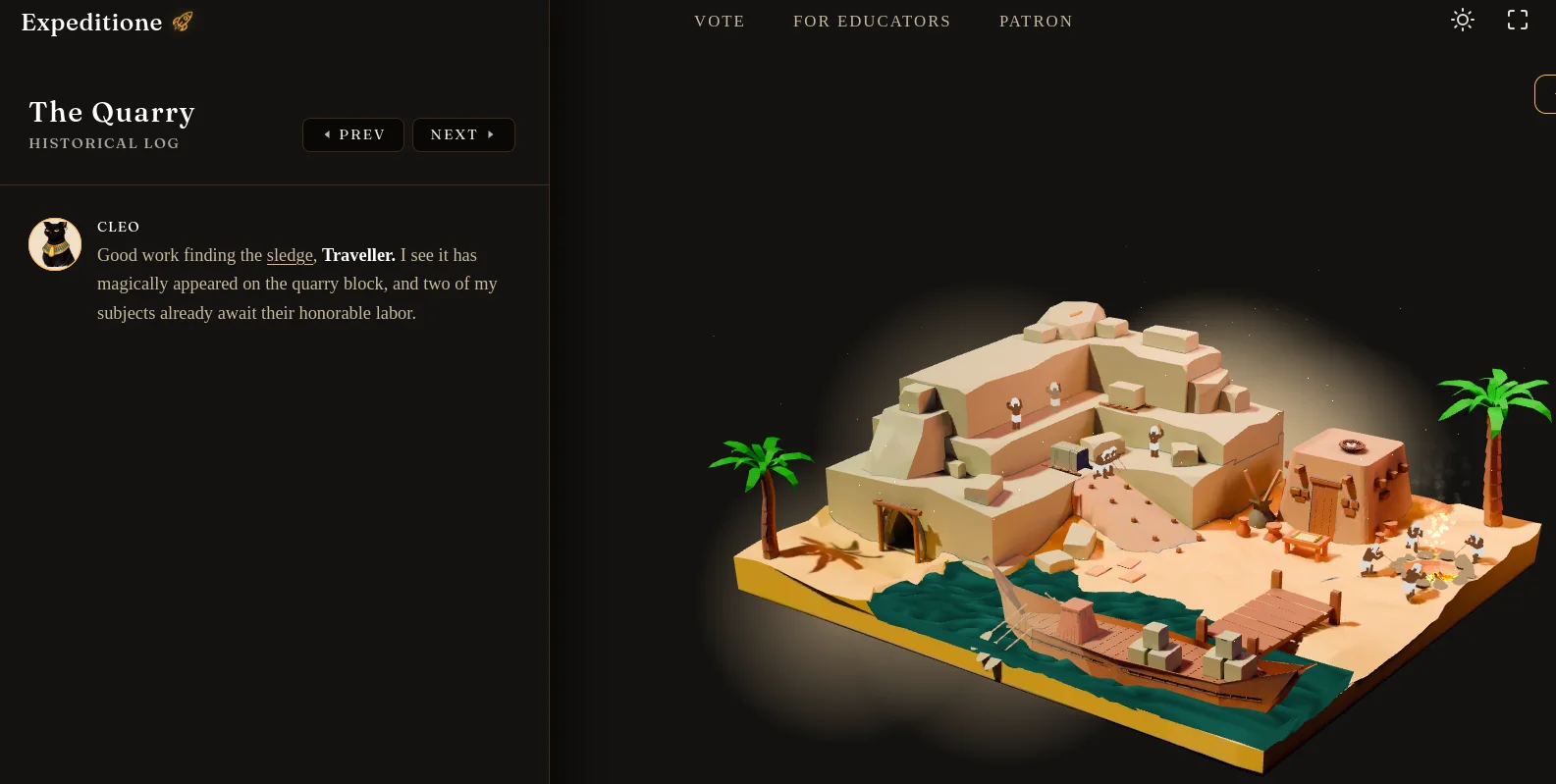
These still images really don’t do the simulation justice. And, other benefits for use in the classroom abound. Expeditione cuts out much of the usual classroom setup headache:
- No ads
- No tracking
- No login
- No pop-ups
- No cost for students, families, or educators
Small mercy: you will not spend the first ten minutes of class helping students reset passwords.
Try It in the Classroom
The accompanying educator’s field guide suggests using one scene for a 10- to 15-minute investigation or completing the full expedition across several class periods. The included student worksheet adds challenges involving a lost copper chisel, a damaged stone barge, a Khamsin sandstorm, and a cracked pyramid block.
Start small. Put students in pairs and ask them to explore one scene. Have them record one observation, identify one piece of evidence, and write one question the scene raises. Then let them compare notes before you provide the historical explanation.
Expeditione launches on August 11, 2026 (in two days), and will be completely free to explore.
Take your students on an Ancient Egyptian expedition at Expeditione.
ACE Framework for Expeditione: Ancient Egypt
Grade band: 6–8 Time: 30–45 minutes Essential question: How did geography, belief, engineering, and daily life work together to shape Ancient Egyptian civilization?
A — Articulate It
Explore and describe what you notice.
Students explore one Expeditione scene, such as the Nile Delta, family life, quarry work, temples, pyramid construction, or a Khamsin sandstorm.
Student task:
- Record three important observations.
- Identify one object, practice, or challenge.
- Explain the scene’s importance in your own words.
Sentence stems:
- “In this scene, I noticed…”
- “This mattered to Ancient Egyptians because…”
- “In my own words, this shows…”
Product: A brief field note containing three observations and a one-sentence explanation.
C — Connect It
Connect evidence across scenes and ideas.
Students compare their scene with another Expeditione scene. They explain how geography, resources, beliefs, technology, or social organization influenced what they observed.
Possible connections include:
- The Nile Delta and farming
- Quarry work and pyramid construction
- Temples and religious beliefs
- Sandstorms and environmental adaptation
- Family life and the larger Egyptian economy
Students can also compare the evidence-based theories presented for pyramid construction.
Sentence stems:
- “This connects to ___ because…”
- “The relationship between these scenes is…”
- “The strongest evidence for this explanation is…”
- “One theory is more convincing because…”
Product: A cause-and-effect map or short claim-evidence-reasoning response using evidence from at least two scenes.
E — Extend It
Apply the learning to a new historical problem.
Students take the role of an adviser to an Ancient Egyptian community. They must propose a response to a new challenge:
A growing settlement needs food, water, shelter, religious spaces, and protection from environmental hazards. Where should it be built, and how should its people organize it?
The proposal must include:
- A recommended location
- Two environmental or engineering adaptations
- One connection to Egyptian beliefs or daily life
- Evidence from at least three Expeditione scenes
- One tradeoff or possible weakness in the plan
Sentence stems:
- “The settlement should be built…”
- “Evidence from the expedition suggests…”
- “If the Egyptians tried ___, then…”
- “A possible problem with this plan is…”
- “A new question this raises is…”
Product choices: Annotated settlement map, museum display, written proposal, audio briefing, or two-minute presentation.
Quick ACE Check
| ACE step | Evidence of learning |
|---|---|
| Articulate | Accurately describes important details in the student’s own words |
| Connect | Explains a meaningful relationship using evidence from multiple scenes |
| Extend | Applies historical understanding to a new problem and acknowledges a tradeoff |
Closing prompt: “Ancient Egypt succeeded because its people understood how to ___, connect ___, and adapt to ___.”