
The short version
Exploring Lumo AI, a privacy-first Gen AI tool. I'm considering it as a privacy-oriented Gen AI tool that doesn't keep a record of chats.
This month is the first that I’ve gone without a BoodleBox Gen AI account in my back pocket. One of the main reasons I kept BoodleBox is that the majority of the work I did with Gen AI involved using web-based chatbots. Over the last few months, as I’ve moved towards using Gen AI at the command line with OpenAI Codex and Anthropic Code, my use of web-based chatbots has decreased. Most of my web-based use is just-in-time questions (e.g. nutrition facts for a meal I’m considering eating), or planning a project in ChatGPT, then, if it’s a work-related project, expanding it using Claude Code. If it’s a personal project (e.g. DrawSplat.org), or a project for a friend, I ask ChatGPT to give me a plan for development as a markdown code block. Then, I take that markdown code block and put it into whatever CLI tool works best.
If Not BoodleBox, Then What?
That’s meant moving away from BoodleBox. What I really liked about BoodleBox, aside from the access to multiple Gen AI models, was the assurance of privacy. Then, Proton announced Lumo, a privacy-first AI assistant:
Lumo is powered by an open-source decoder-only transformer architecture similar to the LLaMA 2 family. According to Proton’s official information, here are the key details:
Model Architecture:
- Based on open-source large language models (not a partnership with OpenAI, Anthropic, or other major AI companies)
- Standard transformer stack with multi-head self-attention and feed-forward layers
- Substantially expanded context window (twice as large in Lumo 2.0 compared to earlier versions)
Key Differentiators:
- Privacy-focused: Runs on Proton’s European datacenters under Swiss privacy laws
- Zero-access encryption: Your conversations are end-to-end encrypted and never logged
- No third-party sharing: Queries don’t go to US or Chinese AI companies
- Not used for training: Conversations are not used to train future models
Important Note: Proton doesn’t disclose the exact specific model variant (e.g., LLaMA-2-70B vs. other sizes). What they emphasize is their approach—taking open-source base models and adding proprietary safety and privacy layers while maintaining full control over the infrastructure.
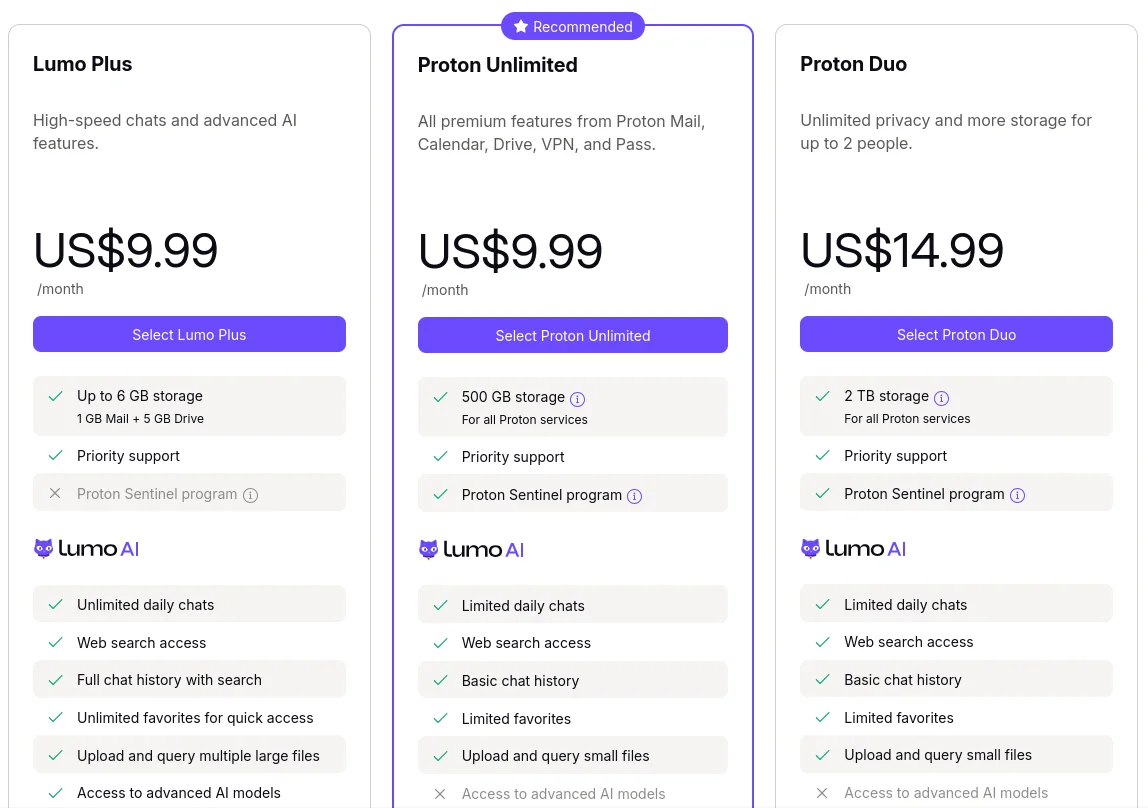
A quick, just-in-time privacy tool for quick conversations, Lumo has proven itself as a less expensive replacement for BoodleBox.At the level I pay for currently, my chat history is limited to 7 days.
Keep your chat history
Your chat history is limited to 7 days. Upgrade to Lumo Plus for unlimited history and other premium features.
Digging a little deeper, if you take Proton at its word:
If you’re signed in (Free or Plus plan) Your chat history is stored in two places:
- On your device — the primary local copy, so you can search and review conversations.
- Synced to Proton’s servers — but only as zero-access encrypted data. That means it’s encrypted locally before it’s uploaded, so only you can decrypt and read it by logging into your Proton Account. Proton itself can’t see the content.
If you’re using Guest mode Nothing is stored. The conversation is erased at the end of each session.
A few privacy details worth knowing
- Your questions are sent to the servers over TLS encryption, processed, and then the data is erased immediately.
- Lumo doesn’t keep metadata like timestamps, IP addresses, or chat context.
- Your chats aren’t used for model training and aren’t shared with third parties.
You can verify these details anytime at https://proton.me/support/lumo-privacy
Pricing for Lumo
It appears pricing for Lumo Plus is $120 a year, if you pay up front:
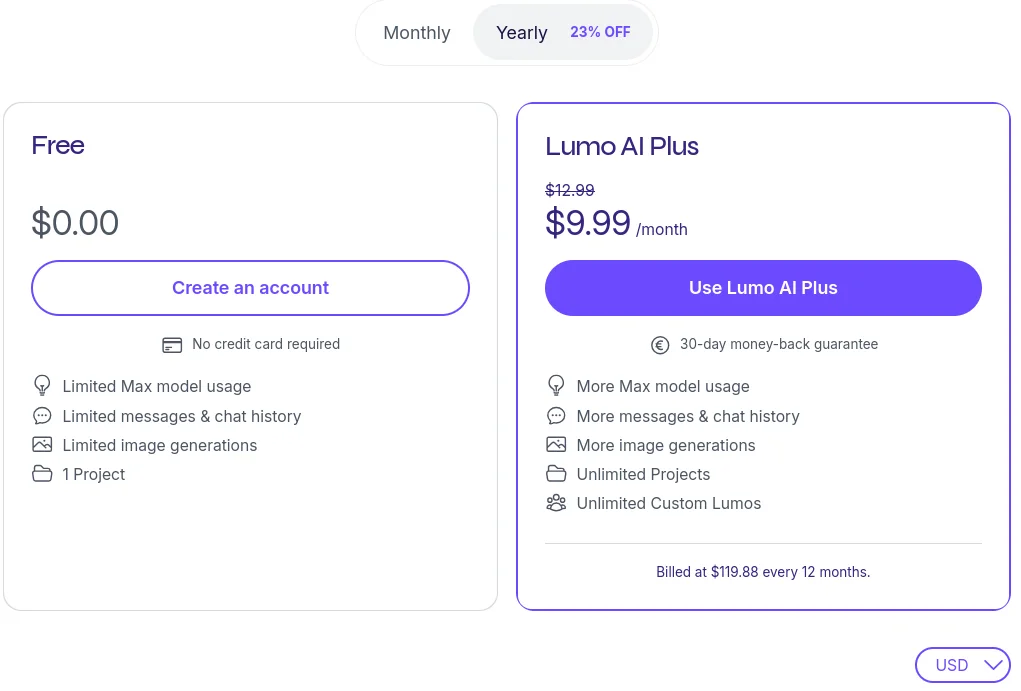
I currently have the free version but I’m considering Lumo Plus upgrade to my existing Proton account. I’ll probably try it for a bit longer, then see if it’s worth the investment. For now, it’s working quite well and is super-fast, even on Max (Reasoning).