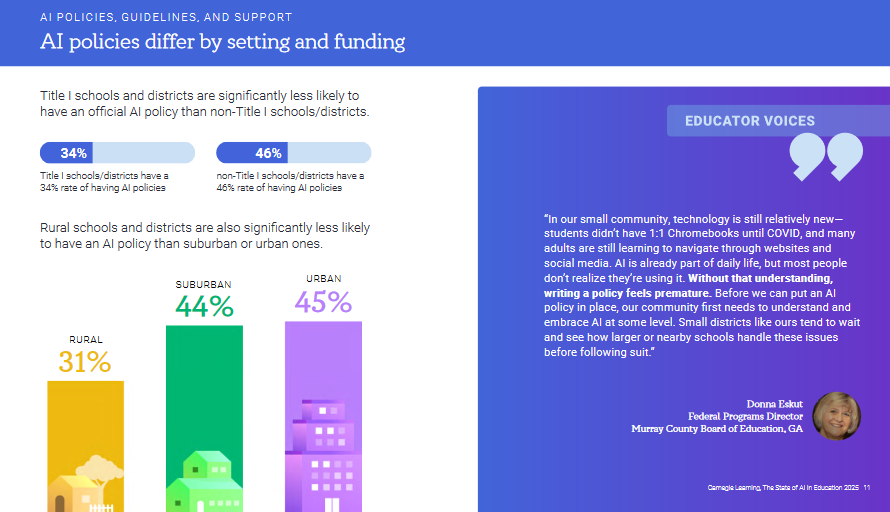
Earlier this week, I had the opportunity to watch and listen to the Carnegie Learning AI in Education webinar facilitated by Amanda Bickerstaff. The webinar is accompanied by a link to a report from Carnegie Learning. There are some beautiful, informative graphs in the report (some included below).
On watching the webinar, I took about a page and half of notes. The information fell into a mix of suggestions for AI usage, concerns, and affirming what only humans can do. I also asked Google Gemini to come up with overarching quotes which appear below indented in italics. I wrote my notes beneath each.
My Notes
“Harness AI’s potential with critical literacy: Use it as a co-pilot for efficiency and ideas, but always keep your hands on the pedagogical wheel.” (Source: AI-generated quote summarizing my notes)
Some of the key ideas captured from the webinar center around how teachers are using AI now. For example, the top uses of AI include:
- Creating or adapting teaching materials (especially for differentiation)
- Brainstorming ideas
- Drafting communications
These three uses are spot-on reflecting how I use AI, so found that quite accurate.

AI really seems to be helpful because it:
- Facilitates brainstorming
- Getting new perspectives like a peer co-worker (I like to think of this as a thought partner)
- Reducing administrative tasks although it may also add complexity
That last point really hits home for me. When I’m working on a project with AI, I am able to go deeper into a topic and develop more, but time is seldom reduced, unless it’s a simple data sorting/organization task.
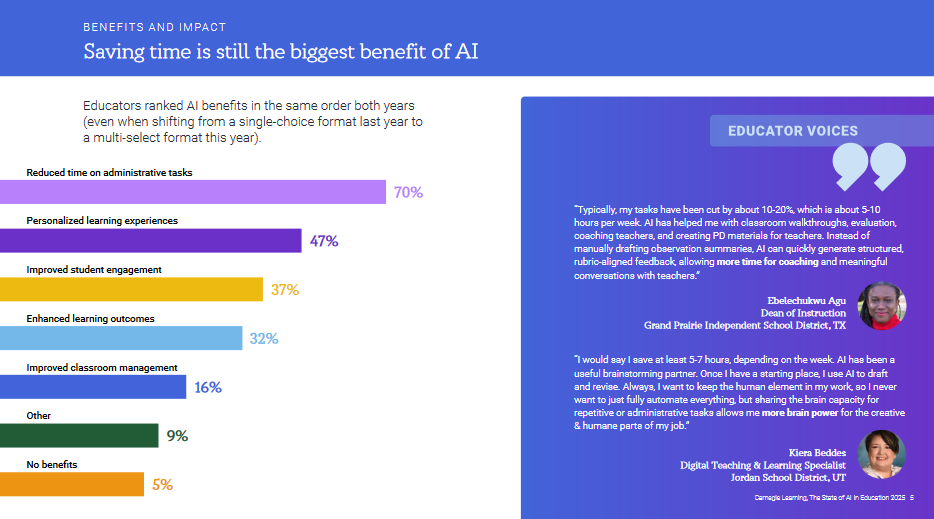
Most of the time, my efforts results in MORE time spent to get a product I probably couldn’t have achieved without having a partner or team member working with me. This is great because it means that folks who are loners can continue to develop content and resources without having to connect with a team. That’s also not so great because the human connection helps ground our work.
“AI is a powerful tool, not a magic wand; embrace its ‘toddler stage’ potential while vetting its output and remembering human connection remains paramount.”
Effective AI use was another big theme in the webinar. Time was spent pointing out that strong prompting skills are a must. And, that when you learn prompting, you can apply it to different AI chatbots. I have certainly found that to be true, although different chatbots may require more or less detailed directions.
Skills needed for effective AI use are similar to those an educated person needs, such as:
- Critical thinking
- Creativity
- Evaluation
- Communication
These qualities are important because any AI outputs have to be critically evaluated for quality, appropriateness, and accuracy.
Attributes that AI won’t (allegedly) be able to replace include the human connection, pedagogical best practices, and addressing students’ basic needs.

“Beyond detecting cheats, rethink assessment: Build AI literacy and adaptable skills, ensuring technology serves—not replaces—meaningful learning and human values.”
This idea of responsible AI use, increasing AI literacy are built on a strong foundation of strong policies, cybersecurity infrastructure, user awareness regarding free tools (like the fact that you don’t have privacy protections for data shared with AI via free tools and browser extensions). Data safety remains a big concern.
Quotable Quotes
Some quotable quotes that resonated with me from panelists in the webinar:
- “What I use it in my day to day for is…having that person to have a conversation with.”
- “If it is free, you are the product.”
- “We need to think more about how to better assess mastery.”
Discover more from Another Think Coming
Subscribe to get the latest posts sent to your email.
 Another Think Coming
These are great, Miguel. I appreciate the rundown and detail on what you heard and your observations. Your experience is much like mine. The only place we differ is I do not like the term “thought partner.” AI doesn’t think. It also can’t be a partner. A partner implies an equal. It is a tool for thinking, perhaps. I guess I’m careful on anthropomorphising AI as the worldview I want to teach the kids. Otherwise, this is a fantastic overview and very helpful and I’ll be sharing it. Thanks for being awesome!
Thanks, Vicki! In regards to “thought partner,” I’m not wedded to the idea. I’m looking for something that captures the process of thinking with an AI:
– I ask a question or offer a prompt
– The AI responds
– I ask clarifying questions, make suggestions to customize the ouput
– These steps are an iterative, recursive process
– I get a result that I wouldn’t have gotten alone, but the AI couldn’t have done either
What does the AI bring to the equation of collaborative thinking? Not a sense of will but the demeanor of an all-knowing sage without its own agency.
[…] LINK 🔗 MyNotes: Carnegie Studying’s State of #AI in #Training #EduSky – One other Suppose Coming […]
[…] LINK 🔗 MyNotes: Carnegie Learning’s State of #AI in #Education #EduSky – Another Think Coming […]
[…] LINK 🔗 MyNotes: Carnegie Learning’s State of #AI in #Education #EduSky – Another Think Coming […]
[…] LINK 🔗 MyNotes: Carnegie Learning’s State of #AI in #Education #EduSky – Another Think Coming […]