Does this feel true to you? It does to me in nonprofit organizations I have listened to, a small handful. Here’s an excerpt from Steve Yegge’s comment that you will want to read in its entirety…
@Steve_Yegge says:
I was chatting with my buddy at Google, who’s been a tech director there for about 20 years, about their AI adoption. Craziest convo I’ve had all year.
The TL;DR is that…Most of the industry has the same internal adoption curve: 20% agentic power users, 20% outright refusers, 60% still using Cursor or equivalent chat tool.
***
Some companies at the bottom have near-zero AI adoption and can’t even get budget for AI. They may have moats and high walls, but the horde is coming for them all the same. And then there are a few companies I’ve met recently who are *amazingly* leaned in to AI adoption….
As for the rest, well, it’s the Great Siloing. Everyone’s flying blind. With nobody moving companies, no company knows where they stand on the AI adoption curve. Nobody knows how they’re doing compared to everyone else.
Half of them just check a box: “We enabled {Copilot/Cursor} for everyone!” Cue smug celebrations. They think this is like getting SOC2 compliance, just a thing they turn on and now it’s “solved.” And they don’t realize that they’ve done effectively nothing at all. All because of a hiring freeze.
How many AI adoptions have you seen limping along like this? For K-12 schools, I suppose this is just more of the same. I could never understand why my CIO (MZ) in a large urban district (SATX) was so keen to roll out tech without professional learning and development.
Forrester finds the same in business, as this article by Bruce Crumley highlights:
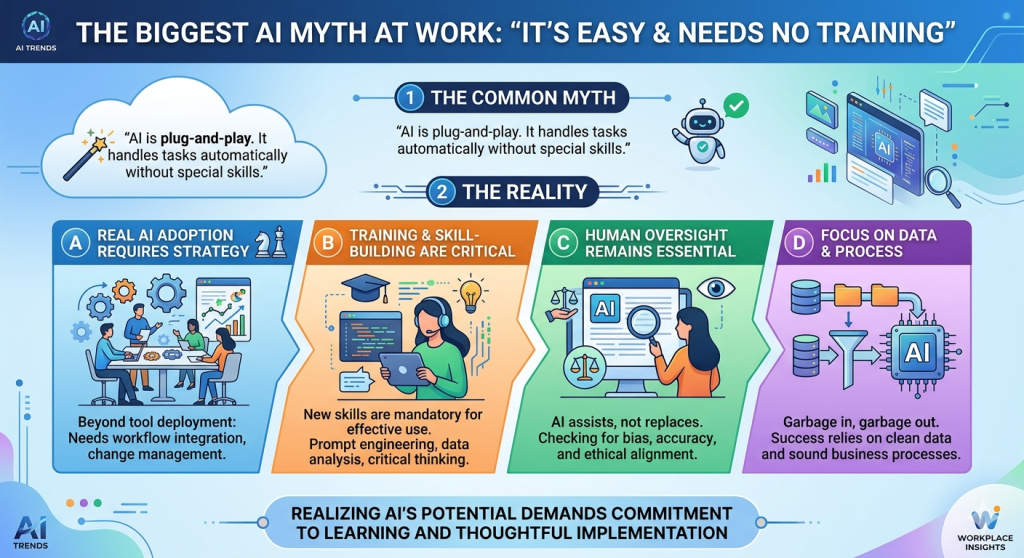
Forrester research shows companies are rolling out AI tools faster than they’re teaching employees how to use them—putting productivity gains and ROI at risk.
I find this quote right on the money:
That’s happening because many adopting employers believe “the lie that AI is easy for employees to use, doesn’t require any special skills, and automatically drives massive productivity increases” on its own.
How is your organization handling this?
Discover more from Another Think Coming
Subscribe to get the latest posts sent to your email.
 Another Think Coming