
In This Issue
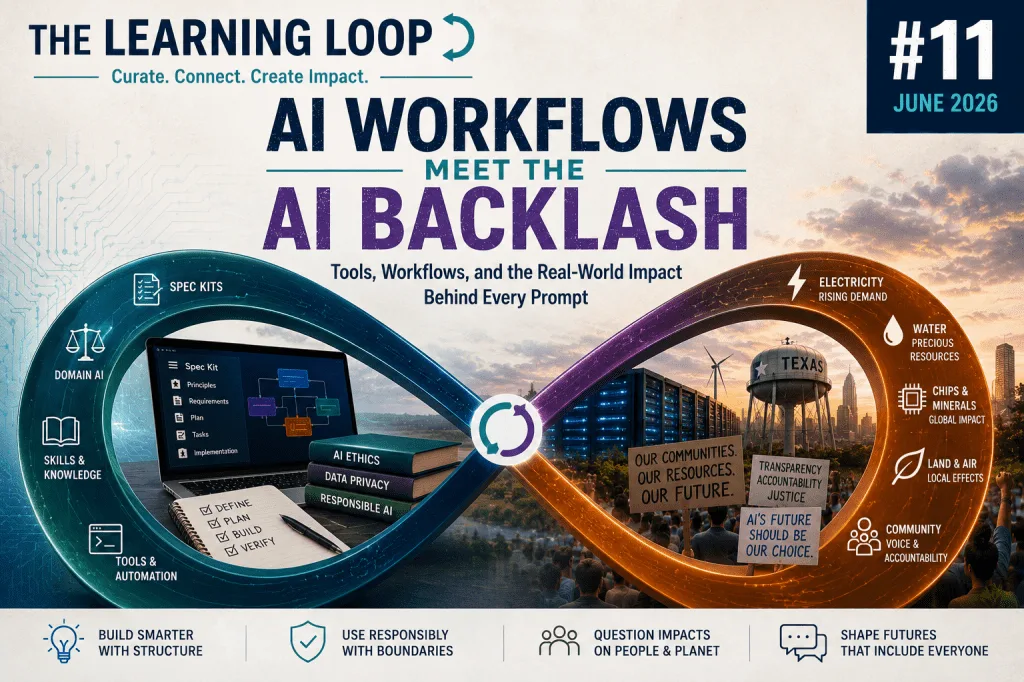
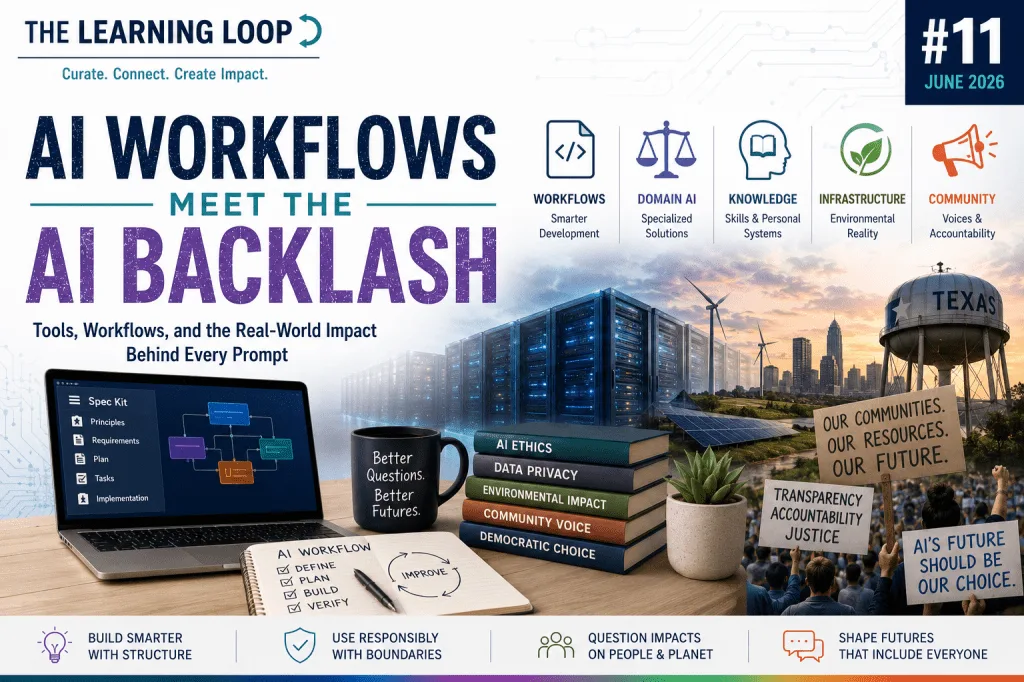
AI is shifting from a novelty we chat with into a set of structured workflows we build with: specs, skills, legal agents, personal wikis, and browser-based research tools. At the same time, those digital workflows are tied to very physical realities: water, electricity, land, chips, local politics, and community resistance. This issue looks at both sides of the AI moment: how educators can use structured AI systems more responsibly, and how communities can question the infrastructure required to make those systems run. The challenge is not whether to use AI, but whether we can make its use transparent, grounded, and accountable.
Jump to: #1 - Spec-Driven Development | #2 - Domain-Specific AI | #3 - Skills & Personal Knowledge | #4 - AI Infrastructure | #5 - The AI Backlash | Tech Alert

📗 Spec-Driven Development: Less Vibe Coding, More Clarity
🔥 The Big Idea:
GitHub’s Spec Kit argues that AI-assisted development works better when specifications come first. Instead of asking an AI coding assistant to improvise a finished product, users define principles, requirements, plans, tasks, and implementation steps. For educators, this is a powerful reminder that AI quality depends less on “better prompting” and more on structured thinking before the prompt ever begins.
✅ Putting It into Practice:
- Start with Success Criteria: Before students use AI to build, write, or research, have them define what a successful product must do.
- Teach the Workflow: Use a simple sequence: purpose → requirements → plan → tasks → draft → verify.
- Reduce Prompt Drift: Ask students to revise the specification before revising the AI output, especially when projects get messy.
Source: GitHub Spec Kit | Author: GitHub
📗 Claude for Legal: Domain-Specific AI Is Arriving
🔥 The Big Idea:
Anthropic’s Claude for Legal repository offers reference agents, skills, and connectors for legal workflows such as privacy, corporate work, employment, litigation, regulatory review, AI governance, intellectual property, and law school learning. The larger lesson is that AI tools are becoming increasingly specialized. Rather than one general chatbot for everything, the future is likely to include domain-tuned assistants with explicit playbooks, escalation rules, and workflow boundaries.
✅ Putting It into Practice:
- Create Role Boundaries: When using AI in schools, define what the assistant may do, what it may not do, and when a human must step in.
- Build Local Playbooks: Develop department-specific AI guidance for lesson planning, parent communication, data review, and accessibility work.
- Discuss Professional Judgment: Use legal AI as a classroom case study for why expertise still matters when tools sound confident.
Source: Claude for Legal | Author: Anthropic
📗 Skills, Books, and Personal Knowledge Systems
🔥 The Big Idea:
Several of this week’s tools point toward the same trend: turning knowledge into reusable AI skills. Andrej Karpathy Skills packages coding guidance into a CLAUDE.md file, while book-to-skill turns technical books, PDFs, folders, and documents into Claude Code skills that can be loaded on demand. Miguel Guhlin’s “wikifying” workflow extends that idea into personal knowledge management, using Gen AI to organize local notes, project instructions, and files without automatically sending everything to the cloud.
✅ Putting It into Practice:
- Turn Notes into Tools: Have students convert a unit’s notes into a study guide, glossary, checklist, or “skill card” before using AI to quiz themselves.
- Protect Local Knowledge: Keep sensitive student, family, and personnel information out of consumer AI tools unless approved by policy.
- Model Reusable Learning: Ask learners to create reusable project instructions so future AI work reflects what they already know.
Source: Andrej Karpathy Skills, book-to-skill, Another Think Coming | Author: multica-ai, virgiliojr94, Miguel Guhlin
📗 AI Infrastructure: The Hidden Physical Layer
🔥 The Big Idea:
The Independent reports that the United Nations is warning countries to confront AI’s environmental costs, including electricity, water for cooling, land use, chip production, critical minerals, e-waste, and the cumulative impact of billions of prompts and generated outputs. Courier Texas connects those concerns directly to Texas, where the state has become a major data center hotspot. The issue for schools is not just digital citizenship anymore; it is resource citizenship.
✅ Putting It into Practice:
- Make AI Visible: Ask students to map the physical infrastructure behind a simple AI query: data center, electricity, cooling, chips, minerals, and network.
- Compare Benefits and Costs: Have students debate when AI use is worth the resource cost and when a simpler tool would do.
- Localize the Question: Research whether nearby communities are hosting data centers, chip plants, or energy projects connected to AI growth.
Source: The Independent, Courier Texas | Author: Anthony Cuthbertson, Joi Louviere
📗 The AI Backlash Is Becoming Local
🔥 The Big Idea:
The Council on Foreign Relations argues that AI policy may become a major political issue as the technology’s disruptions become more personal. That prediction is already visible in Texas, where communities are questioning data centers, chip factories, water demand, energy strain, tax incentives, and transparency. Angela Valenzuela frames this resistance as a democratic question: technological futures are not inevitable; they are political choices.
✅ Putting It into Practice:
- Teach Public Impact Analysis: When students evaluate AI, include jobs, taxes, energy, water, privacy, public health, and community voice.
- Use Local Government Records: Have students examine public meeting agendas, tax abatements, zoning notices, and environmental reports.
- Move Beyond Pro/Anti AI: Frame the discussion around better questions: Who benefits? Who pays? Who decides? Who is left out?
Source: Council on Foreign Relations, Educational Equity, Politics & Policy in Texas, Business Insider | Author: Chris McGuire, Angela Valenzuela, Business Insider
⚠️ Tech Alert: AI Convenience Can Hide Data and Resource Risk
The newest AI tools make it easier to crawl websites, summarize books, generate skills, organize notes, and automate professional workflows. That convenience can also blur important boundaries around copyright, privacy, accuracy, and infrastructure impact. Before adopting any AI workflow, educators should ask where the data goes, what sources are being transformed, whether the output can be verified, and what institutional policy applies.
📚 Must Read / Listen To
- The Coming AI Backlash: A policy-focused argument that AI disruption may become a major political issue as its effects become personal.
- The Empire of AI Comes to Texas: A community-centered look at data centers, coloniality, environmental responsibility, and resistance.
- Wikifying My Files with Gen AI: A practical example of building a local personal knowledge system with AI support.
🛠️ Notable Gen AI Tools
- GitHub Spec Kit: Helps structure AI-assisted development through specifications, plans, tasks, and implementation workflows.
- Claude for Legal: Provides reference agents, skills, and connectors for legal and governance workflows.
- Andrej Karpathy Skills: Packages practical coding guidance into reusable Claude Code behavior instructions.
- book-to-skill: Turns technical books, PDFs, and folders into Claude Code skills grounded in the provided text.
- Crawl4AI UI: Offers a Streamlit interface for crawling pages into clean Markdown, previewing links and images, capturing screenshots, and exporting results.
Another Think Coming by MGuhlin.org
Note: This newsletter provides original commentary and summaries of publicly available sources for educational and informational purposes. Readers are encouraged to visit the linked sources for the full context. Article images are represented with placeholders unless separately licensed or created for this issue.