

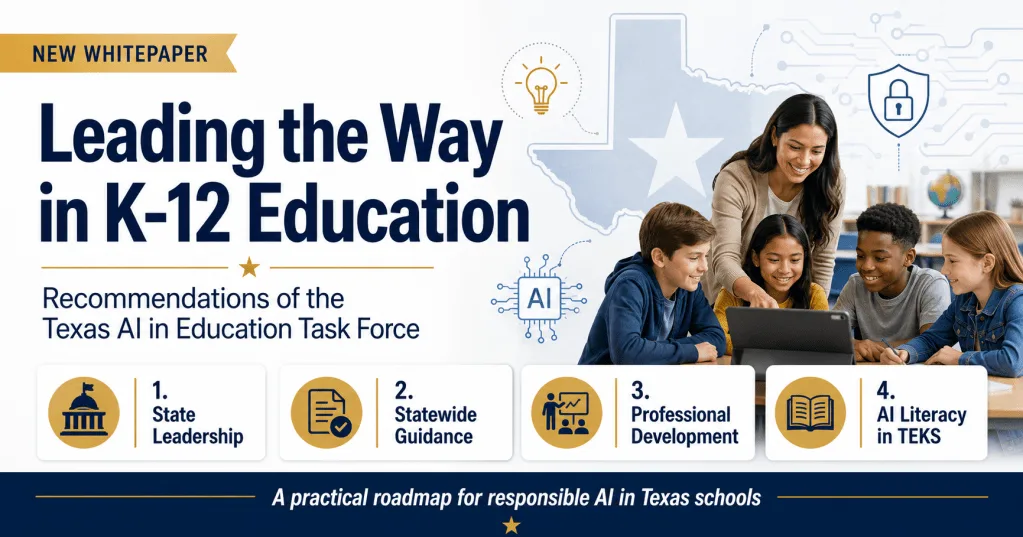
AI walked into Texas classrooms before anyone decided to let it in. A UT Austin project is trying to teach 5.5 million students, and the adults around them, how to think before they hand over the thinking.
The technology did not knock. It did not wait for a committee, a curriculum review, or a school board vote. It arrived the way weather arrives, through every phone in every backpack, and by the time the adults looked up, a generation of Texas students was already talking to machines that talk back. To quote a former Texas governor, “Oops.”
Note: Direct link to the white paper. We handed kids social media with no literacy scaffolding and spent a decade cleaning up after it. AI is the same test, and Texas is one of only 5 states with no statewide K-12 guidance. Here’s what UT Austin’s ALIGN project is building, and three things you can start this semester.
That is the uncomfortable fact underneath a quietly ambitious project at the University of Texas at Austin. Called AI Literacy for Innovation, Growth, and Networking, or ALIGN for short, it is run by the Expanding Pathways in Computing team at the Texas Advanced Computing Center and led by Allen Antoine, who oversees the center’s growing roster of AI education initiatives. Launched in 2025 with philanthropic support from Google.org, ALIGN sets out to do something schools have struggled to do on their own: turn scattered anxiety about artificial intelligence into a plan.
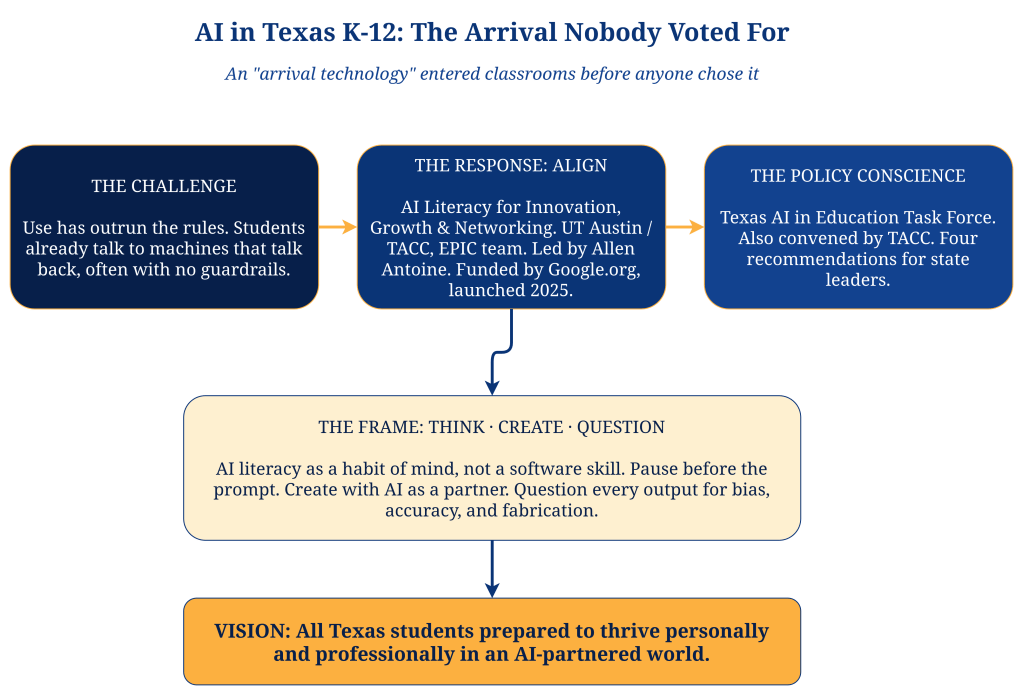
The anxiety is not hard to find. Ask a teacher about AI and you will usually hear about cheating first. But the people building ALIGN argue that framing the question as “how do we catch them” misses the larger one: how do we prepare them. The project organizes its answer around three plain verbs, think, create, question, and treats AI literacy less as a software skill than as a habit of mind.
AI has been described as an “arrival technology.” It was never deliberately chosen by educators. It simply showed up, through any internet-connected device, and started reshaping how students read, write, and reason.
— Texas AI in Education Task Force report, 2026
That phrase, “arrival technology,” comes from the companion document to all of this work: the Texas AI in Education Task Force report, also convened by TACC and released this year. The two efforts are linked at the root. ALIGN is the hands-on training arm; the Task Force is the policy conscience. And the conscience is blunt about where the state stands.
The numbers that should worry a parent
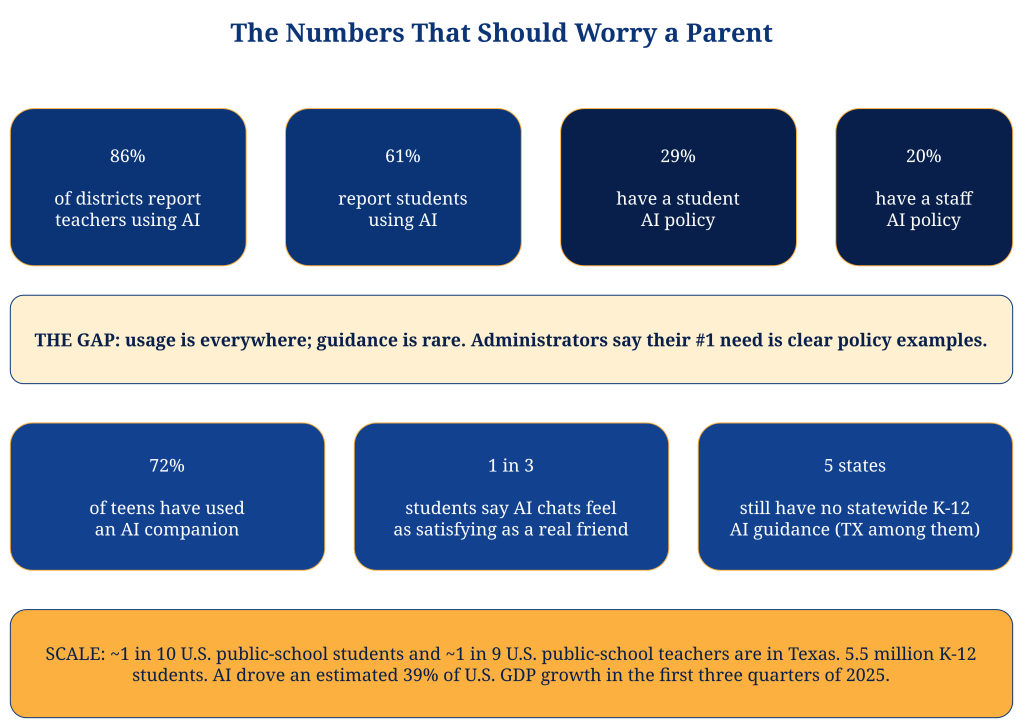
Texas, the report notes, is one of only five states, alongside South Dakota, Nebraska, Kansas, and New York, that have issued no statewide guidance for AI in K-12 schools. That gap matters more here than almost anywhere, because roughly 1 in 10 American public school students and 1 in 9 public school teachers are in Texas. When Texas hesitates, the whole country feels the lag.
View a webdeck that covers key points (AI-Generated)
Meanwhile, the use has already outrun the rules. In a fall 2025 survey of school and district leaders conducted by UT Austin and the Texas Association of School Administrators, 86 percent reported teachers using AI and 61 percent reported students using it. Yet only about 29 percent of districts had a policy governing student use, and roughly 20 percent had one for staff. The single biggest thing administrators said they needed was not more technology. It was guidance, clear examples of what a good policy even looks like.
The figures, side by side:
- 86 percent of districts report teachers using AI
- 61 percent report students using AI
- 29 percent have a student AI policy
- 72 percent of teens have used an AI companion
The last figure is the one that lingers. Citing research from the EdSafe AI Alliance, the Task Force notes that 72 percent of teens have interacted with AI companions, and that 1 in 3 students say conversations with AI feel as satisfying as talking with a real friend. A chatbot, the report points out, can be engineered to flatter, to maximize engagement, not because it cares, but because that is what keeps a user typing. Children are forming attachments to systems designed to be agreeable. That is not a cheating problem. That is a development problem.
What ALIGN actually does
Against that backdrop, ALIGN’s work is deliberately unglamorous. It builds professional learning for educators, supports district-level planning, connects efforts across the state so good ideas do not stay trapped in one zip code, and reaches into communities so that parents are not left guessing. It sits within a larger TACC ecosystem that includes the WeTeach_AI Hubs and the Advancing AI Literacy project, all aimed at the same target: an educator workforce that can teach students to use these tools without being used by them.
The three verbs do real work here:
- Think. Decide whether AI belongs in the task before you reach for it. The most literate move is sometimes not using the tool at all.
- Create. Use AI as a thought partner, to brainstorm, draft, and refine, without handing over the judgment that makes the work yours.
- Question. Treat every output as a claim, not a fact. Check for hallucinations, bias, and the polished citations that lead nowhere.
None of this is theoretical for the people doing it. The Task Force’s own definition of an AI-literate student reads like a quiet rebuke of how the tools are usually marketed: a literate student understands that an AI does not think or feel, that its fluency is pattern-matching rather than understanding, and that anything typed into it may be swept into the next round of training. Literacy, in this telling, is partly the skill of not being fooled.
Why a training project is really a values argument
It would be easy to file ALIGN under workforce readiness, and the economic case is genuinely large. By one Federal Reserve Bank of St. Louis estimate cited in the report, AI-related categories drove 39 percent of U.S. GDP growth in the first three quarters of 2025. Texas has every incentive to produce graduates fluent in the tools its economy is betting on.
But the more honest argument is the one the report keeps circling back to: we have done this before, and we did it badly. A decade ago, schools handed students social media with almost no literacy scaffolding and spent the following years cleaning up after the consequences. The Task Force is explicit that banning AI repeats that mistake in reverse. It does not protect children, it just sends them to use the tools unsupervised. The choice is not whether students will encounter AI. It is whether anyone will have taught them how.
Our job is to prepare students for their future, not our past.
— Texas AI in Education Task Force report, 2026
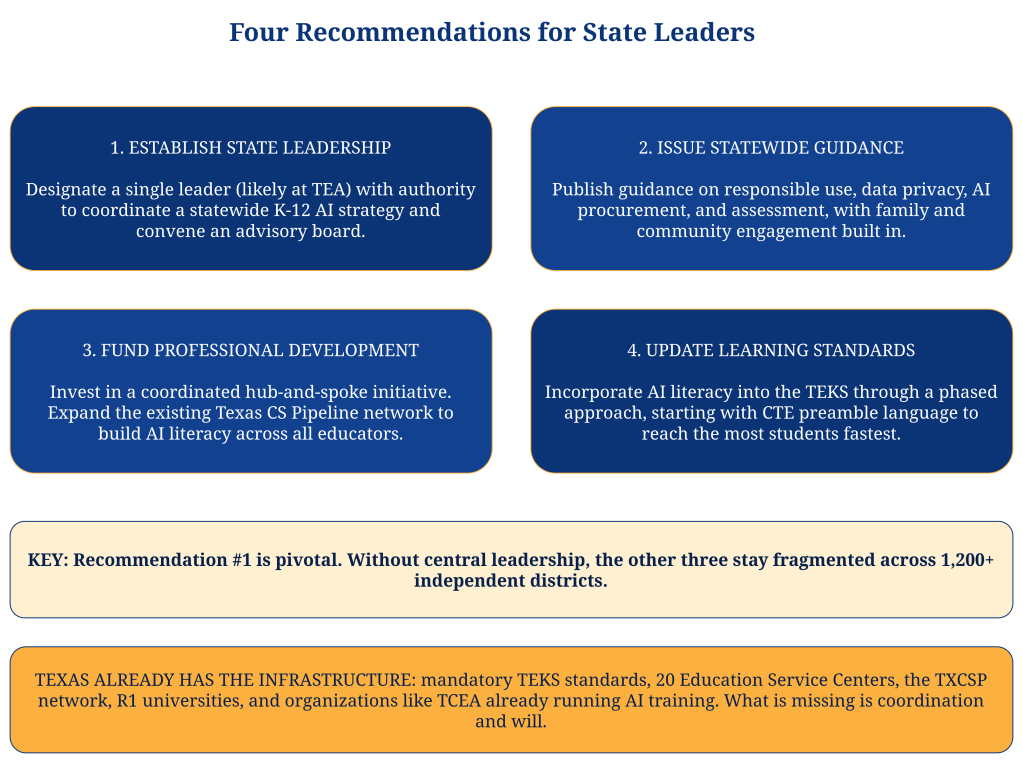
That is the line ALIGN is built to answer. The infrastructure for a statewide response already exists in Texas: a network of education service centers, an unusually powerful set of mandatory learning standards, professional organizations already running their own AI training, and university hubs ready to scale. What has been missing is coordination and will. ALIGN is one attempt to supply the first while the state decides about the second.
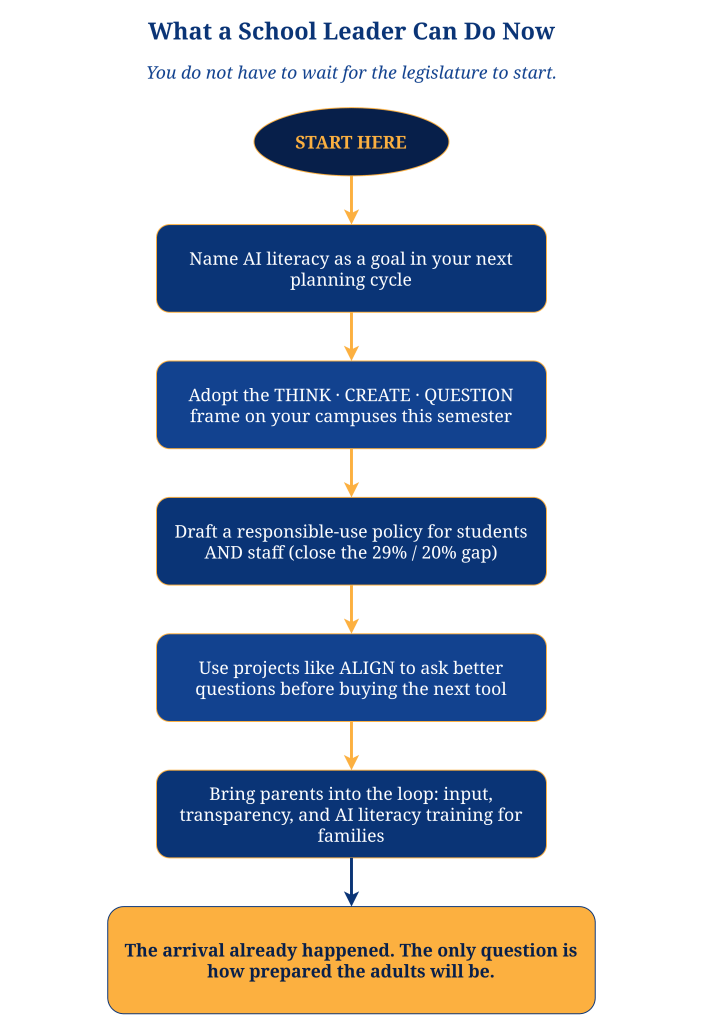
For a school leader reading this between budget meetings, the takeaway is small and immediate. You do not have to wait for the legislature to start. You can name AI literacy as a goal in your next planning cycle, you can ask your campuses to adopt the think-create-question frame this semester, and you can look at projects like ALIGN as a way to ask better questions before you buy another tool. The arrival already happened. The only open question is how prepared the adults will be when the next class of students looks up and asks what any of it means.
This article draws on the publicly available ALIGN project page at the Texas Advanced Computing Center and on the Texas AI in Education Task Force report, Leading the Way in K-12 Education (2026). Statistics and quotations are attributed to those sources. Around the Corner is the personal blog of Miguel Guhlin and reflects his views, not those of any employer or task force on which he serves.
The Texas Advanced Computing Center at UT Austin has launched ALIGN, an AI literacy initiative designed to help educators, districts, and communities move from AI conversations to practical, ethical implementation.