

Larry Cuban shares this perspective…
In short, I learned that any successful district reform was as much building political coalitions within the system while mobilizing public support as it was having the necessary resources to do the job. (source)
This is such an obvious point in hindsight, but accomplishing it, such a difficult thing with a million moving parts. I can admit that if I had to do my career over again, this might be worth spending more time on up front learning how to do. But then, that requires more patience than I had in my youth.

It’s simply something that I didn’t learn as an only child focused on singular achievement and work. Cooperation was cheating, and it might have been Catholic school experiences, isolation of culture shock, or plumb impatience and a general lack of awareness of the world and how it works.
At times, I am astonished at how I survived to my current state. A little love from family and a dash of privilege, no doubt, to keep my blinders on. Ah, well.
Where did I put those blinders? 🤣
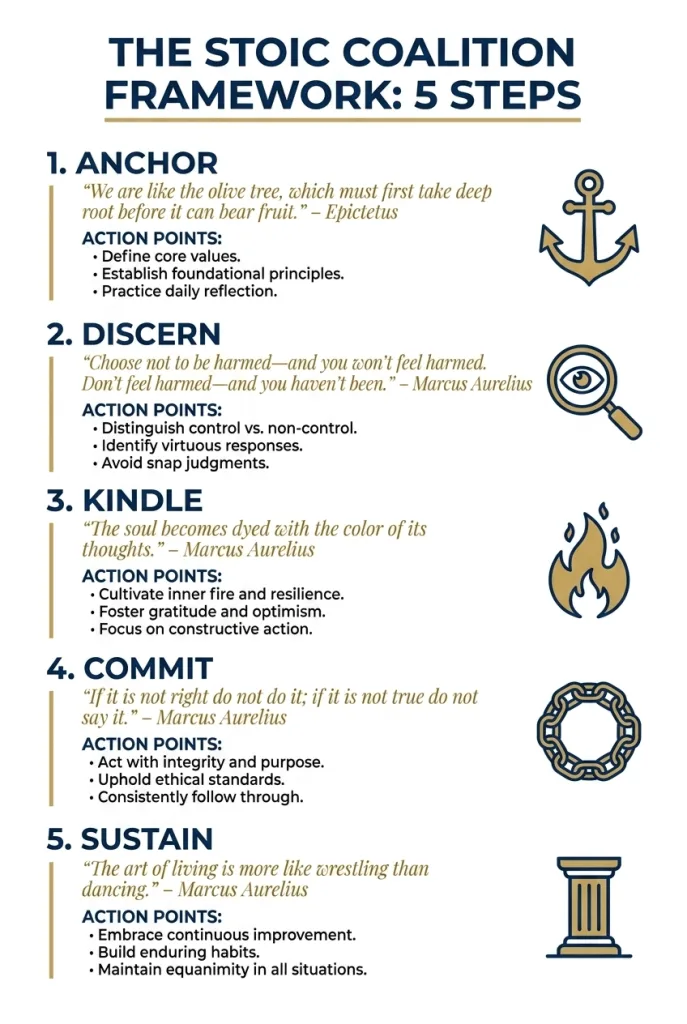
Five Steps
Step 1: ANCHOR — Define the Common Good Before You Recruit Anyone
Before you knock on a single door, get crystal clear on the why. Stoics didn’t build coalitions around personal ambition; they built them around the commonweal.
“If reason is general, then is that reason also, which prescribeth what is to be done and what not, common unto all… then are we fellow-citizens… then are we partners in some one commonweal.” (Marcus Aurelius, Meditations, Book IV)
Modern Take: Write a one-sentence “common good” statement for your reform. If it sounds like your win instead of our win, rewrite it. People join missions, not egos.
Action: Draft your reform’s purpose in language a parent, teacher, and board member would all nod at.
Step 2: DISCERN — Vet Partners by Where They Place Their Interest
Not everyone who says “I’m in” actually is. Epictetus gives you the sharpest filter ever written for separating real allies from opportunists.
“Examine this only, wherein they place their interest, whether in externals or in the will… if you hear that in truth these men think the good to be only there, where will is, and where there is a right use of appearances… confidently declare that they [are friends].” (Epictetus, Discourses, Book II)
Modern Take: Watch where their loyalty lives. If a potential partner’s “yes” depends on titles, optics, or who’s watching—they’ll bail when the heat comes. If their commitment lives in their will (their values), they’ll stay through the storms.
Action: Before formalizing any partnership, ask: “What would make you walk away from this?” Their answer reveals everything.
Step 3: KINDLE — Recruit Through Mutual Emulation, Not Persuasion
Stop selling. Start sharpening. Seneca taught that wise people don’t recruit each other—they kindle each other.
“One wise man helps another, even in the exercise of the virtues; and the one has need of the other, both for conversation and counsel; for they kindle a mutual emulation in good offices.” (Seneca, Morals: Of a Happy Life)
Modern Take: The strongest coalitions form when partners make each other better. Don’t pitch your reform like a sales call. Invite peers into a working partnership where everyone levels up.
Action: In your first meeting with any potential partner, ask what they’re trying to build. Find the overlap. Coalitions form at intersections, not at podiums.
Step 4: COMMIT — Bind the Coalition Through Shared Identity
Loose alliances dissolve under pressure. Epictetus warns that when “I” and “mine” are scattered across competing interests, everything collapses under the weight of self-interest.
“For where the I and the Mine are placed, to that place of necessity the animal inclines… If then I am there where my will is, then only shall I be a friend such as I ought to be… for this will be my interest, to maintain the character of fidelity, of modesty, of patience, of abstinence, of active co-operation.” (Epictetus, Discourses, Book II)
Modern Take: Get partners to publicly locate their “I” inside the coalition’s mission. Shared identity beats shared interest every time. When partners say “we are doing this,” not “I’m helping you do this,” you’ve got a coalition.
Action: Co-author something together early—a public statement, an op-ed, a charter. Public commitment cements private resolve.
Step 5: SUSTAIN — Practice the Coalition Like a Habit
Coalitions die not from betrayal but from neglect. Epictetus knew that virtues—and partnerships—are built through repeated acts, not noble intentions.
“If you would make yourself skilled in anything, then do it… For it is impossible but that aptitudes and faculties should spring up where they were not before, or spread and grow mightier, by the corresponding acts.” (Epictetus, Discourses, Book II)
Modern Take: Reform is a marathon disguised as a series of meetings. Build rhythms—weekly check-ins, quarterly reviews, public wins celebrated together. The coalition you don’t practice is the coalition you don’t have.
Action: Schedule your sustainment cadence before launch: meeting rhythms, communication norms, conflict-resolution protocols. Habits build coalitions; hope dissolves them.