
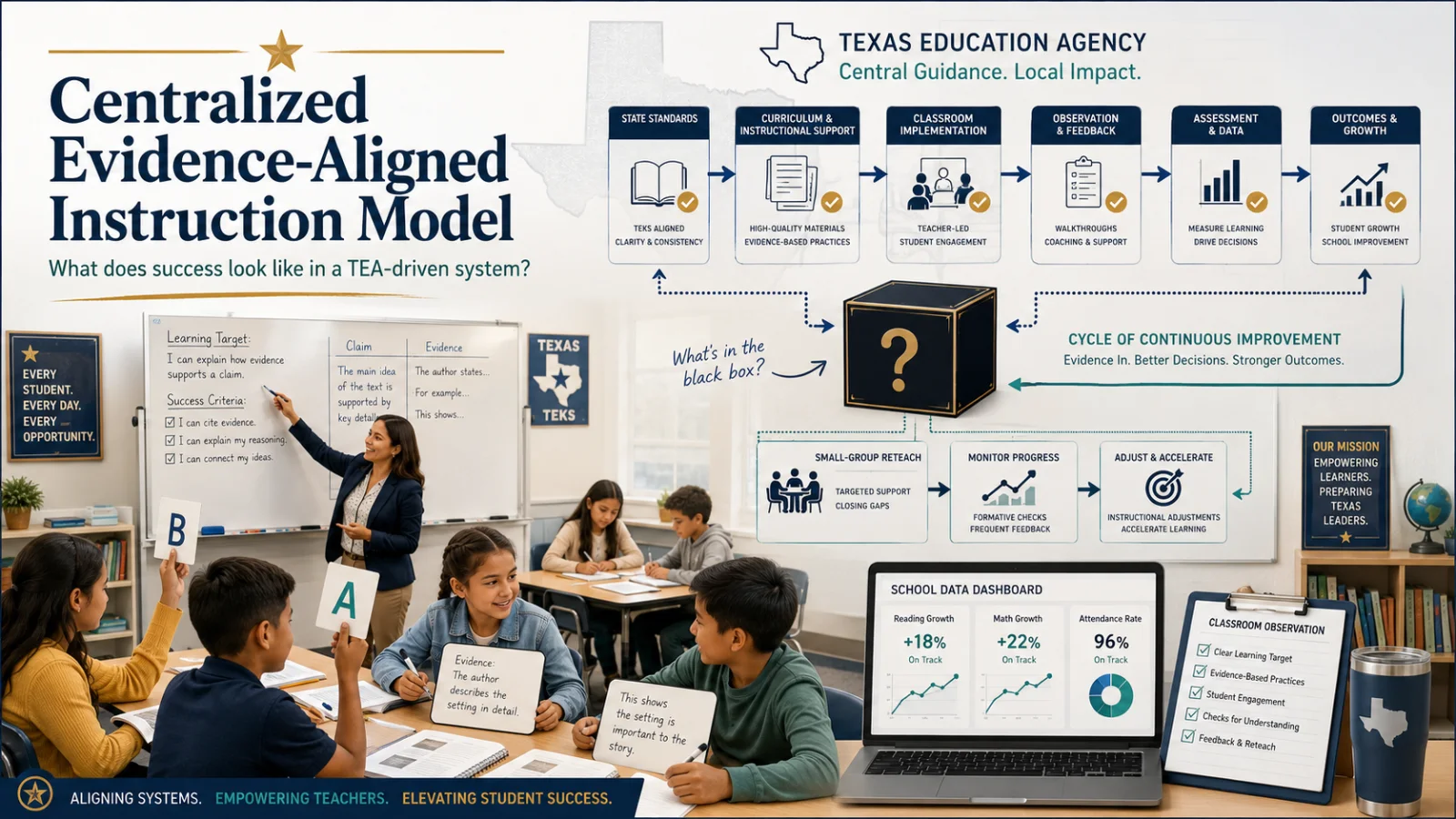
In my previous blog entry, I wondered, “What would an instructional model look like that had the components in a classroom that couldn’t rely on technology except that which had been approved by the State? More importantly, if technology wasn’t the key engagement tool, or distraction depending on your point of view, what would the instructional model be?”
Building a Model
Putting together an instructional model with Gen AI isn’t difficult. Ask Gen AI to analyze existing systems, then put them together with evidence-based practices. What follows below is intended to be a replicable model that Texas schools could use IF (a BIG, HUGE if) they wanted to follow the plans of the Texas Education Agency.
This would be a centralized, evidence-aligned instruction model that centralized accountability but also relied on evidence-based practices. Curious to see what that might look like? I am, too. More curious is how such a system would be implemented successfully. We’ve already heard that schools taken over by TEA have experienced less than desirable results, with over a thousand educators resigning from Houston ISD, Ft. Worth ISD, and less than successful experiences with smaller districts if reports on this Children At Risk podcast are accurate.
Right now, it feels like, to me at least, that finding the right instruction model is critical. If that model varies by district, then what uniform path to success is there available? If I, as someone external to schools as a consultant on instructional practices (including technology and Gen AI), don’t know what the formula for success is according to the State of Texas, then how is anyone else supposed to know that?
For me, “success in K-12 schools” is a big, black box. It varies by district, by leadership, and a million other variables.
Centralized Evidence-Aligned Instruction Model
Purpose
This model places evidence-aligned instructional practices inside a centralized accountability system without reducing instruction to script compliance.
The system centralizes:
- Curriculum quality
- Learning expectations
- Assessment schedules
- Intervention requirements
- Observation procedures
- Data-review routines
- Reporting expectations
The system protects teacher judgment in:
- Selecting examples and representations
- Adjusting lesson pacing when students need more time
- Choosing response strategies
- Providing scaffolds
- Forming small groups
- Reteaching misconceptions
- Extending learning for students who demonstrate mastery
The governing principle is:
Centralize what must be consistent. Preserve flexibility where professional judgment improves student learning.
1. Establish the Instructional Non-Negotiables
Required instructional ingredients
Every classroom should consistently include the following evidence-aligned elements.
| Instructional ingredient | Central expectation | Teacher flexibility |
|---|---|---|
| Grade-level curriculum | Teach adopted grade-level standards and curriculum | Adjust examples, representations, and supporting resources |
| Clear learning purpose | Identify what students should know or do | State or display the purpose in a format appropriate to the lesson |
| Explicit instruction | Model new knowledge and processes clearly | Select explanations, examples, analogies, and worked problems |
| Active student response | Require all students to think and respond | Use writing, discussion, whiteboards, response cards, polling, or demonstrations |
| Checks for understanding | Collect evidence during instruction | Choose the method and frequency based on lesson complexity |
| Guided practice | Practice with feedback before independent work | Adjust group size, prompts, and scaffolds |
| Independent application | Require students to demonstrate learning individually | Select an appropriate product, response, or task |
| Feedback | Provide specific information students can use | Deliver orally, in writing, through conferencing, or through digital tools |
| Retrieval and review | Revisit previously taught content | Select spacing, cumulative review, and retrieval formats |
| Reteaching and extension | Respond to evidence of learning | Determine grouping, duration, materials, and instructional approach |
Prohibited substitutions
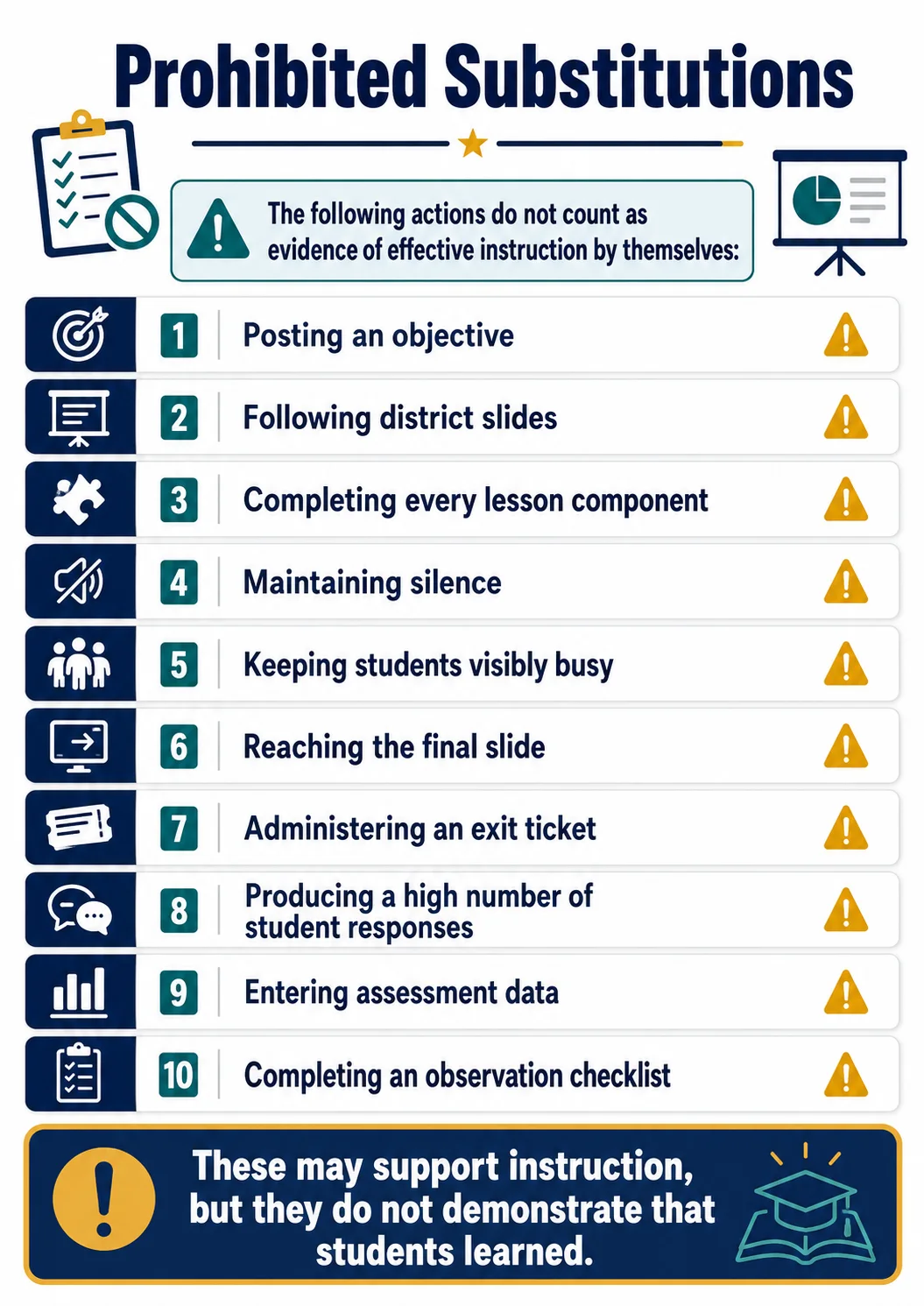
- Posting an objective
- Following district slides
- Completing every lesson component
- Maintaining silence
- Keeping students visibly busy
- Reaching the final slide
- Administering an exit ticket
- Producing a high number of student responses
- Entering assessment data
- Completing an observation checklist
These may support instruction, but they do not demonstrate that students learned.
2. Use a Common Lesson Architecture
Standard instructional cycle
Schools may require a common lesson cycle while allowing variation in how each part is carried out.
| Phase | Teacher action | Student action | Evidence collected |
|---|---|---|---|
| Prepare | Activate prior knowledge and clarify the learning purpose | Recall, predict, or connect | Responses revealing readiness and misconceptions |
| Model | Explain and demonstrate new learning | Observe, question, annotate, and explain | Student questions and brief checks |
| Practice | Guide students through examples or tasks | Respond, discuss, solve, write, or demonstrate | Errors, partial understanding, and successful strategies |
| Check | Gather individual evidence of learning | Complete a brief independent response | Student work tied directly to the learning target |
| Respond | Reteach, scaffold, extend, or continue | Revisit, practice, or apply learning | Improved performance or evidence that a different approach is needed |
| Review | Retrieve prior learning over time | Recall and apply earlier content | Retention and transfer across lessons |
Lesson design rule
Teachers must implement every phase when it is instructionally appropriate, but they are not required to spend equal time on each phase or follow a fixed minute-by-minute script.
3. Define Fidelity Correctly
Three levels of fidelity
| Fidelity level | What must remain consistent | What may vary |
|---|---|---|
| Curriculum fidelity | Standards, sequence, essential content, and assessment intent | Examples, supplemental resources, grouping, and pacing |
| Instructional fidelity | Modeling, active response, checking, feedback, and student practice | Specific strategies and classroom routines |
| Intervention fidelity | Target skill, frequency, duration, group size, and progress monitoring | Examples, materials, and delivery methods approved for the intervention |
Acceptable adaptation protocol
Teachers may adapt district materials when they can answer four questions:
- What evidence shows that an adaptation is needed?
- What specific change will be made?
- How will the change preserve the intended standard and cognitive demand?
- What evidence will show whether the adaptation worked?
Adaptations should be documented briefly rather than requiring a lengthy approval process.
4. Build a Multiple-Measure Assessment System
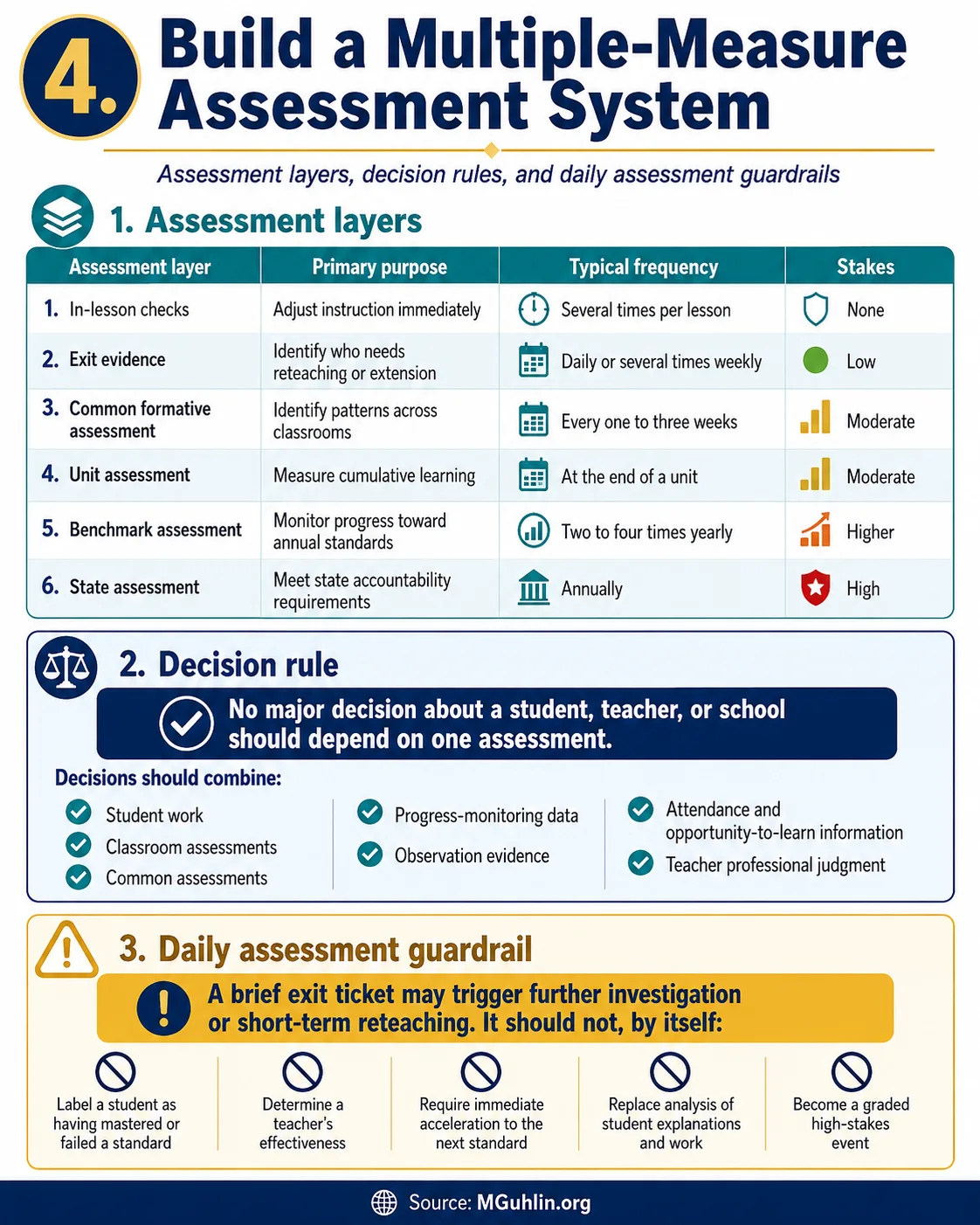
Assessment layers
| Assessment layer | Primary purpose | Typical frequency | Stakes |
|---|---|---|---|
| In-lesson checks | Adjust instruction immediately | Several times per lesson | None |
| Exit evidence | Identify who needs reteaching or extension | Daily or several times weekly | Low |
| Common formative assessment | Identify patterns across classrooms | Every one to three weeks | Moderate |
| Unit assessment | Measure cumulative learning | At the end of a unit | Moderate |
| Benchmark assessment | Monitor progress toward annual standards | Two to four times yearly | Higher |
| State assessment | Meet state accountability requirements | Annually | High |
Decision rule
No major decision about a student, teacher, or school should depend on one assessment.
Decisions should combine:
- Student work
- Classroom assessments
- Common assessments
- Progress-monitoring data
- Observation evidence
- Attendance and opportunity-to-learn information
- Teacher professional judgment
Daily assessment guardrail
A brief exit ticket may trigger further investigation or short-term reteaching. It should not, by itself:
- Label a student as having mastered or failed a standard
- Determine a teacher’s effectiveness
- Require immediate acceleration to the next standard
- Replace analysis of student explanations and work
- Become a graded high-stakes event
5. Create a Standard Response-to-Evidence Cycle
The response cycle
| Evidence pattern | Required response | Timeframe |
|---|---|---|
| Most students demonstrate understanding | Continue and include spaced review | Next lesson |
| A small group has a shared misconception | Provide targeted small-group instruction | Within one to two school days |
| Many students share a misconception | Reteach using a different representation or explanation | Before advancing |
| Students know procedures but cannot explain reasoning | Add discussion, comparison, explanation, and justification | During the current learning sequence |
| Students demonstrate secure understanding | Provide extension, application, or transfer tasks | Within the same lesson or next lesson |
| Students continue to struggle after reteaching | Begin or intensify intervention and progress monitoring | According to MTSS procedures |
Reteaching rule
Reteaching should not mean repeating the same explanation more slowly.
A valid reteach should change at least one of the following:
- Representation
- Example
- Group size
- Level of scaffolding
- Teacher explanation
- Student response method
- Practice sequence
- Feedback method
6. Separate Coaching from Evaluation
Two observation systems
| Feature | Coaching visit | Evaluation observation |
|---|---|---|
| Purpose | Improve instruction | Make a formal performance judgment |
| Frequency | Frequent | Limited and scheduled according to policy |
| Duration | Brief or extended | Long enough to collect representative evidence |
| Feedback | Immediate and focused | Formal and documented |
| Compensation impact | None | May contribute only as one of several measures |
| Personnel impact | None by itself | Governed by formal evaluation procedures |
| Observer | Coach, administrator, or instructional leader | Trained and calibrated evaluator |
| Teacher vulnerability | Encouraged | Protected through clear procedures and appeal rights |
Coaching cycle
- Identify one improvement goal
- Observe for evidence related to that goal
- Provide specific feedback
- Model or rehearse the strategy
- Revisit the classroom
- Review changes in student evidence
- Select the next goal
Evaluation safeguard
Brief walkthroughs may identify patterns and coaching needs. They should not independently determine:
- Employment
- Compensation
- Formal effectiveness ratings
- Campus sanctions
- Teacher placement
High-stakes judgments should require multiple observations, more than one source of evidence, and calibrated evaluators.
7. Use an Evidence-Focused Observation Rubric
Observation domains
| Domain | Evidence to collect | Avoid rating based only on |
|---|---|---|
| Learning purpose | Students understand what they are learning and why | Whether an objective is posted |
| Content quality | Tasks match the standard and maintain appropriate cognitive demand | Whether district slides are visible |
| Explanation and modeling | Students receive clear examples, demonstrations, and worked reasoning | Whether the teacher follows a script |
| Student thinking | Students explain, solve, write, compare, question, or create | Number of hands raised |
| Checks for understanding | The teacher gathers representative evidence from the class | Presence of an exit ticket |
| Instructional response | The teacher adjusts based on student evidence | Completing every planned activity |
| Feedback | Students receive information that improves their work | Amount of praise |
| Access and support | Scaffolds help students reach grade-level learning | Giving different students easier work |
| Learning evidence | Students demonstrate progress during the lesson | Visible compliance or quiet behavior |
Observation score rule
An instructional practice should receive credit only when the observer can identify:
- What the teacher did
- What students did
- What evidence of thinking or learning resulted
- How the teacher responded
8. Create a Central Curriculum Quality Process
Curriculum review criteria
Every district-created or adopted unit should be reviewed for:
- Standards accuracy
- Grade-level cognitive demand
- Coherent sequencing
- Accurate content
- Worked examples
- Multiple representations
- Opportunities for student explanation
- Guided and independent practice
- Cumulative review
- Multilingual learner supports
- Accessibility
- Assessment alignment
- Opportunities for extension and transfer
Curriculum revision process
| Step | Action |
|---|---|
| Review | Teachers and content specialists inspect the unit before implementation |
| Pilot | Selected classrooms use the materials |
| Collect | Gather student work, teacher feedback, pacing evidence, and assessment results |
| Revise | Correct content, improve scaffolds, and remove unnecessary requirements |
| Publish | Release the revised version with clear change notes |
| Reassess | Review the unit annually or when standards change |
District curriculum should be treated as a maintained instructional product, not a finished document.
9. Establish a Centralized MTSS Structure
Tier expectations
| Tier | Students served | Core features |
|---|---|---|
| Tier 1 | All students | Grade-level curriculum, explicit instruction, differentiation, checks for understanding, and responsive teaching |
| Tier 2 | Students needing targeted support | Small-group intervention focused on specific skills, delivered in addition to Tier 1 |
| Tier 3 | Students needing intensive support | More frequent, explicit, individualized intervention with close progress monitoring |
MTSS non-negotiables
- Tier 2 and Tier 3 must supplement rather than replace grade-level instruction
- Intervention must target a diagnosed skill need
- Group size, frequency, and duration must be specified
- Progress must be monitored regularly
- Students must move between tiers based on evidence
- Intervention time must not permanently remove students from science, social studies, the arts, physical education, or other required learning
- Special education referral must not be delayed when a disability is suspected
10. Build Central Data Routines Without Creating Data Theater
Required meeting structure
Data meetings should answer five questions:
- What were students expected to learn?
- What evidence shows what they understood?
- What misconceptions or unfinished learning appear?
- What instructional response will occur?
- When will the team check whether the response worked?
Required outputs
Each meeting should produce:
- One or two priority learning needs
- Named student groups
- A specific instructional response
- An assigned staff member
- A follow-up date
- The evidence that will be reviewed
Practices to avoid
- Reading scores aloud without planning a response
- Ranking teachers publicly
- Creating color-coded spreadsheets with no instructional action
- Treating one assessment as definitive
- Requiring teachers to defend every low score
- Spending more time entering data than analyzing student work
- Using data meetings primarily to enforce pacing
11. Use a Balanced Accountability Scorecard
School-level scorecard
| Domain | Suggested weight | Evidence |
|---|---|---|
| Student growth and achievement | 30% | Multiple assessments, disaggregated by student group |
| Quality of classroom instruction | 20% | Calibrated observations and student work |
| Curriculum implementation | 15% | Standards alignment and use of required instructional ingredients |
| Intervention effectiveness | 15% | Progress-monitoring results and movement between tiers |
| Student opportunity and engagement | 10% | Attendance, course access, discipline, and student surveys |
| Professional learning and improvement | 10% | Coaching participation, implementation progress, and improvement cycles |
Teacher-level scorecard
| Domain | Suggested weight | Evidence |
|---|---|---|
| Instructional practice | 35% | Multiple formal observations by trained evaluators |
| Student learning evidence | 25% | Multiple classroom measures and growth evidence |
| Professional growth | 20% | Coaching goals, implementation, and reflection |
| Contribution to team practice | 10% | Planning, collaboration, and shared problem solving |
| Professional responsibilities | 10% | Required duties, communication, and ethical practice |
No single test, walkthrough, or metric should account for more than one-third of a formal rating.
12. Define Central and Local Decision Rights
Decision-rights matrix
| Decision | Central office | School leadership | Teacher or team |
|---|---|---|---|
| Standards and adopted curriculum | Leads | Implements | Advises |
| Essential unit sequence | Leads | Monitors | Implements |
| Common assessment windows | Leads | Schedules | Administers and analyzes |
| Daily lesson pacing | Sets general range | Supports | Adjusts based on evidence |
| Instructional examples | Provides options | Supports | Selects or develops |
| Student grouping | Provides guidelines | Monitors equity | Decides |
| Reteaching method | Provides approved resources | Supports | Decides |
| Intervention entry criteria | Defines | Applies | Recommends |
| Coaching focus | Defines broad priorities | Coordinates | Co-selects individual goal |
| Formal evaluation | Defines system | Conducts | Provides evidence and response |
| Curriculum revision | Maintains process | Submits feedback | Provides evidence and recommendations |
13. Establish an Earned-Flexibility System
Flexibility levels
| Level | Conditions | School flexibility |
|---|---|---|
| Directed support | Weak outcomes, poor implementation, or serious inequities | Required curriculum, frequent coaching, structured intervention plans, and close monitoring |
| Supported implementation | Mixed results or inconsistent practices | Required curriculum and assessments with moderate local adaptation |
| Demonstrated reliability | Strong outcomes across student groups and sound implementation | Greater flexibility in pacing, materials, intervention design, and professional learning |
| Innovation status | Sustained results and documented capacity | Permission to pilot alternatives with an approved evaluation plan |
Equity safeguard
Schools should not earn autonomy solely from overall test scores. Decisions must consider:
- Outcomes for student groups
- Access to grade-level instruction
- Special education compliance
- Multilingual learner progress
- Disciplinary disparities
- Attendance
- Student mobility
- Evidence that strong results are not produced by exclusion or narrowing opportunity
14. Create a Compliance Safeguard Review
Quarterly review questions
District leaders should examine whether the accountability system is producing unwanted behavior.
| Warning sign | Possible system problem | Corrective response |
|---|---|---|
| Teachers rush through lessons | Pacing is valued over understanding | Permit documented pacing adjustments |
| Objectives are posted but students cannot explain them | Visible compliance has replaced meaning | Observe student understanding rather than wall displays |
| Every classroom looks identical | Fidelity has become scripting | Define required principles and adaptation boundaries |
| Students take excessive quizzes | Assessment volume is being mistaken for formative practice | Reduce testing and improve use of evidence |
| Teachers hide problems during observations | Coaching feels punitive | Separate coaching records from evaluation |
| Intervention replaces core subjects | Accountability pressure is narrowing opportunity | Protect a broad instructional program |
| Data meetings focus on blame | Accountability has displaced improvement | Require action planning and follow-up evidence |
| Staff turnover increases | The model is producing unsustainable working conditions | Review workload, observation frequency, and leadership practice |
| Scores rise while student explanations remain weak | Procedural performance may be masking shallow learning | Add explanation, writing, reasoning, and transfer measures |
15. Implementation Sequence
Phase One: Define
Duration: Four to eight weeks
- Identify the instructional non-negotiables
- Define central and local decision rights
- Select or review the core curriculum
- Establish assessment purposes
- Create coaching and evaluation protocols
- Publish adaptation rules
- Train observers and school leaders
Phase Two: Pilot
Duration: One semester
- Select representative schools
- Train teachers in the common instructional cycle
- Conduct low-stakes coaching visits
- Pilot common assessments
- Test data-meeting routines
- Collect workload and implementation feedback
- Revise tools before expansion
Phase Three: Implement
Duration: One school year
- Expand the model across schools
- Provide content-specific coaching
- Monitor curriculum quality
- Use the balanced accountability scorecard
- Publish school-level implementation reports
- Provide additional support to schools with persistent needs
Phase Four: Evaluate
Duration: Annual
Evaluate:
- Student achievement and growth
- Retention and transfer
- Student work quality
- Teacher turnover
- Student engagement
- Opportunity gaps
- Intervention effectiveness
- Observation reliability
- Staff perceptions
- Unintended consequences
Phase Five: Revise
Use evaluation findings to:
- Remove low-value compliance tasks
- Improve curriculum
- Adjust pacing expectations
- Strengthen observer calibration
- Modify accountability weights
- Expand or reduce local flexibility
- Replace ineffective interventions
- Protect teacher and student workload
16. Required System Artifacts
A school system implementing this model should maintain:
- Instructional non-negotiables guide
- Curriculum quality rubric
- Common lesson architecture
- Assessment map
- Assessment decision rules
- Reteaching and extension protocol
- MTSS handbook
- Coaching rubric
- Formal evaluation rubric
- Observer calibration process
- Data-meeting template
- Adaptation documentation form
- Balanced accountability scorecard
- Decision-rights matrix
- Earned-flexibility criteria
- Quarterly compliance safeguard report
- Annual public evaluation report
17. Model Evaluation Questions
The district should answer these questions each year:
Student learning
- Are students learning more?
- Are gains sustained over time?
- Can students explain, apply, and transfer what they learned?
- Are gains shared across student groups?
Instruction
- Are teachers using evidence-aligned practices?
- Are teachers responding to student evidence?
- Is curriculum quality improving?
- Are interventions producing measurable progress?
Accountability
- Are ratings based on multiple reliable measures?
- Are observations calibrated?
- Are schools improving rather than merely appearing compliant?
- Are low-value compliance tasks being removed?
Workforce
- Do teachers understand the model?
- Do they receive useful coaching?
- Can they exercise professional judgment within clear boundaries?
- Is the workload sustainable?
- Is turnover increasing or decreasing?
Student experience
- Do students receive grade-level instruction?
- Do students have opportunities to discuss, explain, write, inquire, and solve problems?
- Are students experiencing excessive testing?
- Are electives and enrichment protected?
- Do students perceive the classroom as orderly, challenging, and supportive?
18. Final Design Principles
- Centralize curriculum quality, standards, assessments, and intervention expectations
- Require evidence-aligned instructional ingredients rather than one rigid teaching script
- Judge instruction through student thinking and learning evidence
- Separate developmental coaching from high-stakes evaluation
- Use multiple measures for consequential decisions
- Permit documented adaptations based on student evidence
- Require a different instructional approach when reteaching
- Protect grade-level instruction and a broad curriculum
- Use accountability to identify support needs, not merely rank schools
- Monitor the system for compliance theater and unintended consequences
- Expand flexibility when schools demonstrate reliable and equitable results
- Evaluate the full model independently rather than assuming that each component works because some ingredients are research-aligned