
The short version
Discover how Expeditione turns curiosity, questions, and classroom exploration into student-led learning adventures.
About the Guest Blog Author, Aureon de Veyra
I love making things that don’t already exist. Expeditione gives me a place to combine history, science, design, storytelling, engineering, hospitality, and whatever else I become obsessed with next into something people can explore. I can’t think of a better place to apply all of that than education. It’s one of the most important things we do as a society, yet so much of its potential remains unexplored. I want to see what happens when we treat learning with the same creativity, craftsmanship, and care that we give to the things we build purely for joy.
When I was a kid, I asked a lot of questions—so many that I probably annoyed my parents and teachers. I still remember one science class where I kept asking questions, from how earthworms breathe to how night vision goggles work. For 30 minutes, I had a teacher who answered every one of them with patience.
Then the bell rang.
Most of my education wasn’t like that. Like millions of students in India, I was forced to spend far more time memorizing facts than exploring the questions behind them. Curiosity was left to fend for itself.
Curiosity is a fragile thing. Wonder. Spark. The instinct to ask why. They disappear much more easily than we realize.
Years later, while building Expeditione, I am trying to recreate that feeling of being a child who looks at ordinary things and asks beautifully simple questions:
- How high are the clouds?
- Why can’t we harness dark matter yet?
- How did anyone move stones that weighed dozens of tons without wheels?
I realized how universal this desire to explore is when Miguel Guhlin recently wrote a featured article about Expeditione. What surprised me wasn’t the review itself, but that he built an entire learning activity around it using his own ACE Framework.
I never asked him to do that.
He simply explored the world, interpreted it through his own experience as an educator, and created something new. It felt like he was having a lot of fun.
Watching that happen made me happier than any compliment could have because I realized something I hadn’t fully noticed before:
People don’t want to just experience the expedition.
They want to try to make it their own.
There Isn’t One Correct Lesson Plan
If you asked me whether Expeditione comes with classroom resources, the answer is yes. Beginning with Ancient Egypt, every expedition will include teacher guides, student worksheets, discussion prompts, and supporting materials. I know preparation takes time, and I want to make that part easier.
But I don’t think there is one correct lesson plan, nor do I think there should be an unlimited number of disconnected activities. A teacher brings years of experience, and students bring something equally valuable: their own lived experiences.
One student may have a family living beside a great river. Another might have a parent who works as an engineer. Someone else may have watched a documentary that completely changes what they notice first.
The curriculum brings structure, and Expeditione brings the explorable worlds. Together, we don’t simply study Ancient Egypt—we go on an expedition.
Some teachers may use my worksheet, while others may create something completely different. I really hope they do. If you’re one of them, I’d love to know what you end up creating.
The Webpage Is Just the Doorway
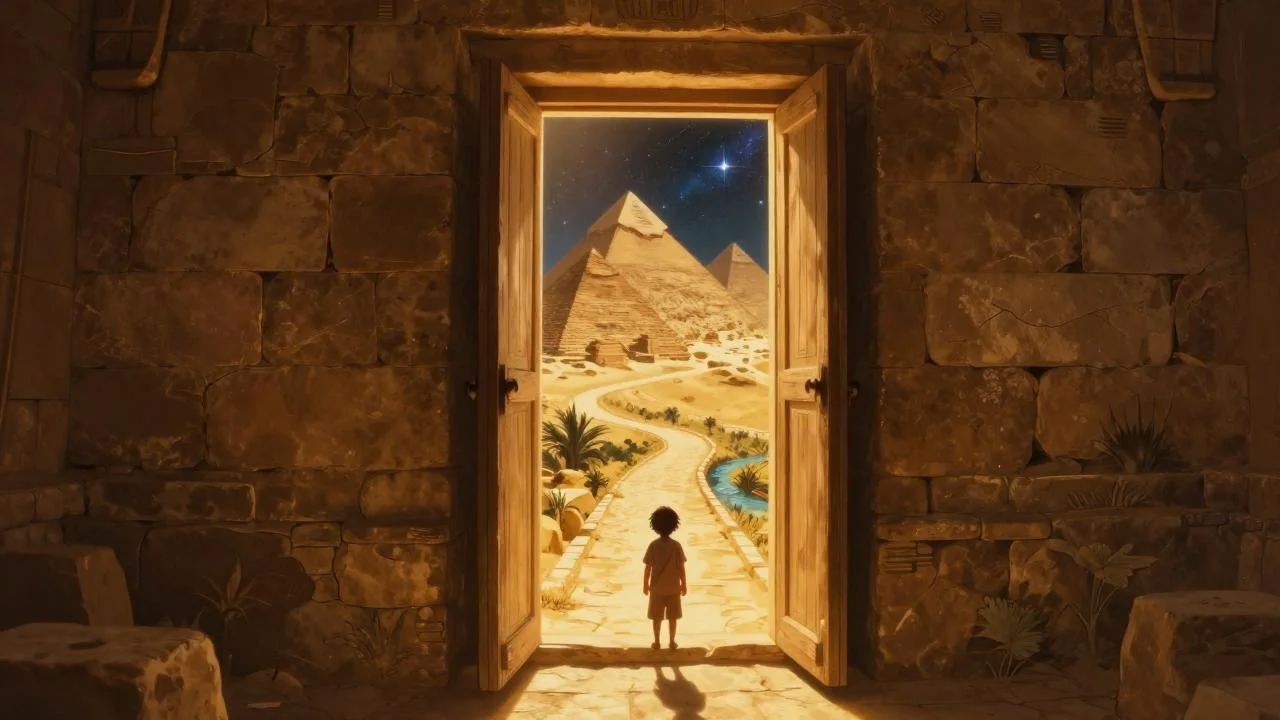
Technically, when someone opens Ancient Egypt, they’re visiting a webpage. I think that’s the least interesting way to describe it.
Imagine two students opening exactly the same expedition. They both begin in Ancient Egypt.
One notices the Nile and disappears into geography, rivers, irrigation, and farming. The other becomes fascinated by pyramid construction theories and spends the evening reading about archaeology and historical evidence.
They started in the same place, yet ended up in completely different worlds from where they originally began. Curiosity pulled them in different directions.
To me, that’s one of the core parts of an expedition. The webpage is simply the doorway.
That is why these environments are crafted with such care, not mass-produced. I want the spaces students explore to feel as warm, safe, and interconnected as the questions I hope they ask.
Teach Relationships, Not Isolated Facts
I think almost everything worth learning is an interconnected system: a rainforest, a cell, a civilization, an ecosystem, or even a city.
We usually divide knowledge into subjects because books need chapters and schools need timetables. While I understand that, I’ve seen that reality usually doesn’t work that way.
The Nile isn’t only geography. It shapes agriculture, which creates the surplus that supports cities and builds temples. Those temples then influence politics, religion, art, and engineering.
Everything touches everything else.
I hope students begin seeing relationships instead of isolated facts.
Second- and Third-Order Questions
A first-order question asks:
How were the pyramids built?
A second-order question asks:
Why did they build them? Which explanations are the most convincing?
A third-order question asks something even more interesting:
How do historians know which explanation is plausible?
That shift in thinking changes everything.
The goal shouldn’t be memorizing arbitrary dates that can be Googled, but rather trying to understand how the underlying systems work:
- Who discovered this?
- What evidence supports it?
- What contradicts it?
- What are we still uncertain about?
I think learning becomes much more exciting when students realize that knowledge is something people—and they themselves—can investigate, not just memorize.
Respect the Classroom
One of my favorite sentences from Miguel’s article was:
“You will not spend the first ten minutes of class helping students reset passwords.”
It sounds humorous, but I think it’s deeply important.
Every login screen, popup, installation, and forgotten password steals time from the classroom. Teachers already do an extraordinary amount of invisible work. The least I can do is avoid adding more.
That’s why Expeditione opens in a browser.
- No installations.
- No advertisements.
- No popups.
And I intend to keep it that way.
My Hope
The world is far too beautiful to fit inside a syllabus.
I hope students leave an expedition feeling fulfilled, not finished. I hope they leave with one beautiful, unanswered question. There are always more questions when you probe deeper.
Maybe they spend the evening reading about Jupiter. Maybe they become fascinated with dinosaurs. Maybe they begin wondering why historians disagree. Maybe they ask a question neither their teacher nor I ever anticipated.
And maybe that’s when they venture forth on an expedition of their own.
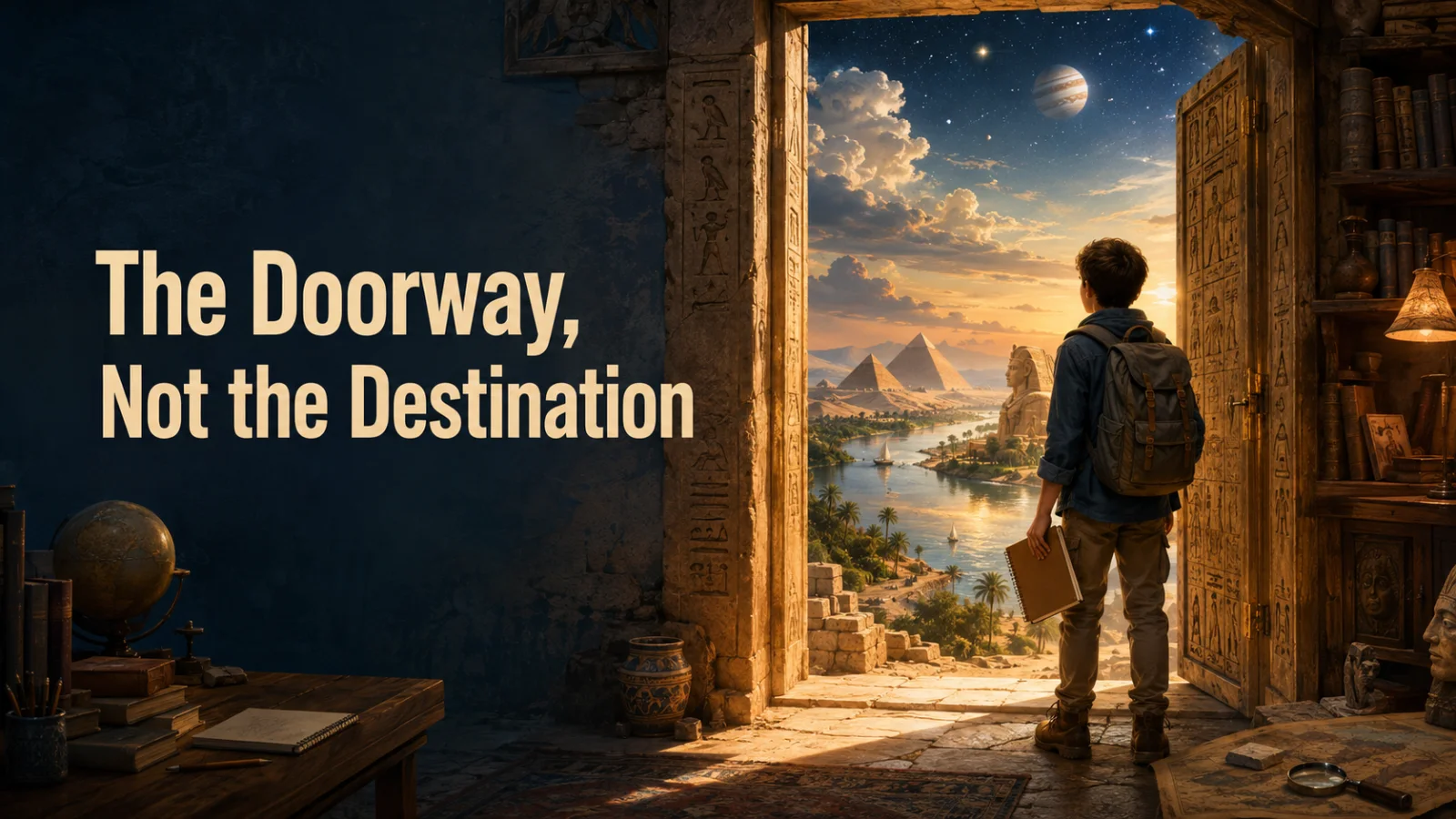
That is my hope: for knowledge to be a doorway, not the destination.
— Aureon de Veyra