I’d like to take a moment to thank Denis Wisner for his kind words in this LinkedIn post, but also for improving the visual for ACE, a framework I first shared on a KPFT radio station broadcast (catch me on there again on July 15, 2026). It was my way to simplify the Biggs’ and Collis’ SOLO Taxonomy. I could imagine people’s eyes glazing over as I started expounding on prestructural, unistructural, etc.
ACE is a lot easier to process. Denis made the visual I put together for a blog entry even better and did a nice write-up in the post linked above:
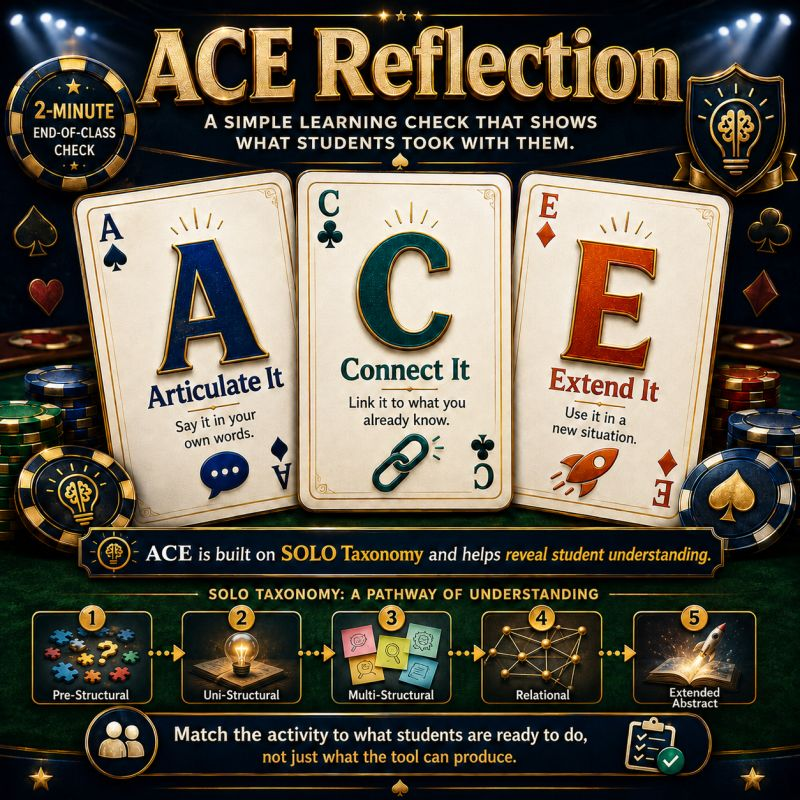
Sometimes teaching feels like dealing a hand of cards.
You deliver the lesson, provide examples, have the students practice, and facilitate student discourse.
But at the end, you still wonder, “Did they actually understand it, or are they just holding the cards?”
That’s why Miguel Guhlin’s work from Texas Computer Education Association on SOLO Taxonomy and heavy-hitter instructional strategies stood out to me.
SOLO reminds us that learning is not all-or-nothing. Students move through levels:
– They may start with no clear understanding.
– Then they recognize one idea.
– Then they collect several ideas.
– Then they connect those ideas.
– Finally, they can transfer the learning to something new.In card game terms, students are not always ready to play the winning hand.
Sometimes they are still learning the suits.That is where ACE Reflection becomes such a simple, practical move.
At the end of class, give students two minutes to play three quick cards:
A: Articulate it
Say the idea in your own words.
C: Connect it
Link it to something you already know.
E: Extend it
Use it in a new situation.Those three cards tell you a lot.
– Did students understand the concept?
– Can they connect it to prior learning?
– Can they apply it beyond the example you gave them?
– Or did they only watch the lesson happen?This matters even more as we bring AI into learning.
Credit to Miguel Guhlin and Texas Computer Education Association for the SOLO Taxonomy and heavy-hitter instructional strategies connection. It is a strong reminder that good technology use still starts with good instructional design.
Read the original blog entry and a follow-up over at TCEA TechNotes.
Discover more from Another Think Coming
Subscribe to get the latest posts sent to your email.
 Another Think Coming