

Listening to the Paul Roetzer and Mike Kaput podcast, The Artificial Intelligence Show, from three weeks back (it’s been a busy few weeks), on the ride to work this morning, I realized that Mike’s comment about how regular people are using tools like Claude Code and ChatGPT Codex applied to me.
Regular people, in this case, isn’t using these command-line tools for coding, but for organizing and preparing information. I’m on MXLinux, so that’s the only way I use Code and Codex these days, as opposed to the GUI available on Windows and Mac, although I have occasionally used those.
My Latest Projects
One of my latest projects, of course, has been using ChatGPT Codex for cleaning THOUSANDS, about 6,000 to 7,000, WordPress.com blog export files.
Everything from images to blog entries needed attention. That included cleaning up and throwing out old text and removing addendums to blog entries that made sense back when I was working as a K-12 technology director in a large, urban, political school district.
Now, a lot of that cruft needs to be cleaned out.
I also had images pointing to WordPress.com and, in some cases, BlogSpot. I don’t think I moved those images over. There were too many useless illustration images for more than 7,000 blog entries at Around the Corner.
I would NEVER have been able to clean out all that content myself. There’s just no way. I probably would have nuked it and started a new blog.
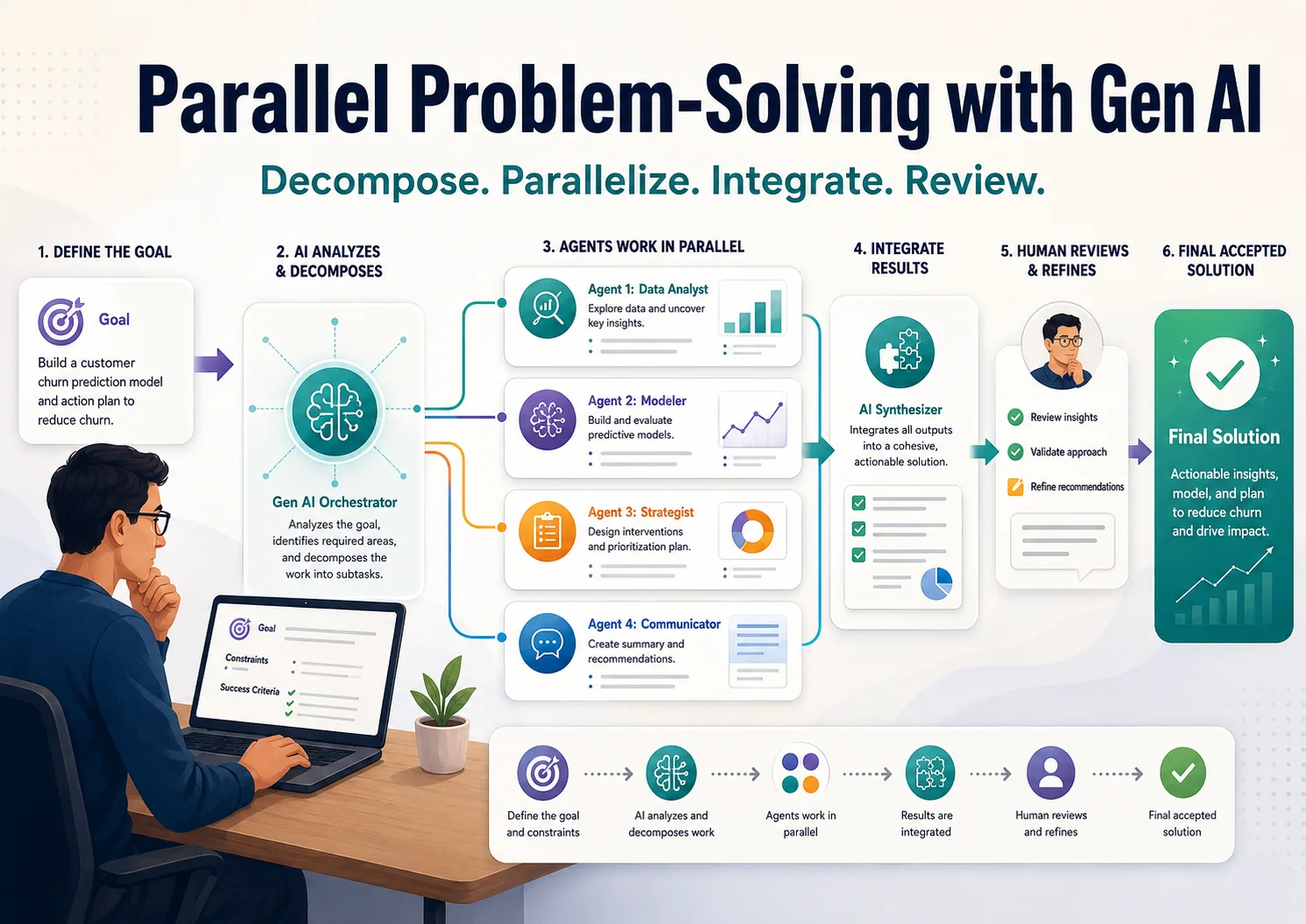
But Codex was able to go through all that content, make sense of it, and then make suggestions. Along the way, it engaged in parallel problem-solving.
Parallel Problem-Solving Through Decomposition and Synthesis
The idea of parallel problem-solving is one that I got from Dr. Judi Harris back in the 1990s.
It’s the idea that you give students a problem, and then have different groups working to solve it. The solutions they come up with are different, maybe, and you get to showcase how they arrived at those solutions.
What Gen AI does is a little different from that idea, but this is my brain making a connection.
I’m sure there’s a term for this, maybe decomposition, where a large task is broken into smaller ones. Assembly occurs, and then each individual item is synthesized into one.
A Diagram
Today, with Gen AI, I see tools like Codex and Code, which I’ve used to do some MASSIVE projects, gathering, organizing, curating, and blending content after I’ve set up the parameters of what I want.
Let me see if I can show this in a diagram:
flowchart TD
    A["Introduce goal or task for Gen AI"]
    B{"Gen AI analyzes the goal and assigns work"}

    C["Agent 1 works on Subtask 1"]
    D["Agent 2 works on Subtask 2"]
    E["Agent 3 works on Subtask 3"]
    F["Agent 4 works on Subtask 4"]

    G["Integrate the subtask results"]
    H["Present the proposed solution"]
    I{"Human reviews the solution"}
    J["Human provides screenshots, pasted text, corrections, or other feedback"]
    K["Gen AI revises the solution"]
    L{"Human accepts the solution?"}
    M["Final accepted solution"]

    A --> B

    B -->|Agent 1| C
    B -->|Agent 2| D
    B -->|Agent 3| E
    B -->|Agent 4| F

    C --> G
    D --> G
    E --> G
    F --> G

    G --> H
    H --> I

    I -->|Changes needed| J
    J --> K
    K --> L

    L -->|No| J
    L -->|Yes| M

    I -->|No changes needed| M
An Alternate Diagram
The diagram above is my version. Below is ChatGPT’s take on what my diagram should look like:
flowchart TD
    A["Human defines the goal, requirements, and constraints"]
    B{"Gen AI analyzes the goal and decomposes the work"}

    C["Agent 1 completes Subtask 1"]
    D["Agent 2 completes Subtask 2"]
    E["Agent 3 completes Subtask 3"]
    F["Agent 4 completes Subtask 4"]

    G["Integrate and synthesize the results"]
    H["Generate and present a proposed solution"]
    I{"Human reviews the solution"}
    J["Human provides corrections, examples, screenshots, or additional context"]
    K["Gen AI revises the solution"]
    L{"Human accepts the solution?"}
    M["Final solution"]

    A --> B

    B -->|Assigns work| C
    B -->|Assigns work| D
    B -->|Assigns work| E
    B -->|Assigns work| F

    C --> G
    D --> G
    E --> G
    F --> G

    G --> H
    H --> I

    I -->|Changes needed| J
    J --> K
    K --> L

    L -->|No| J
    L -->|Yes| M

    I -->|No changes needed| M