
The short version
An update on Gen AI from my email traffic.
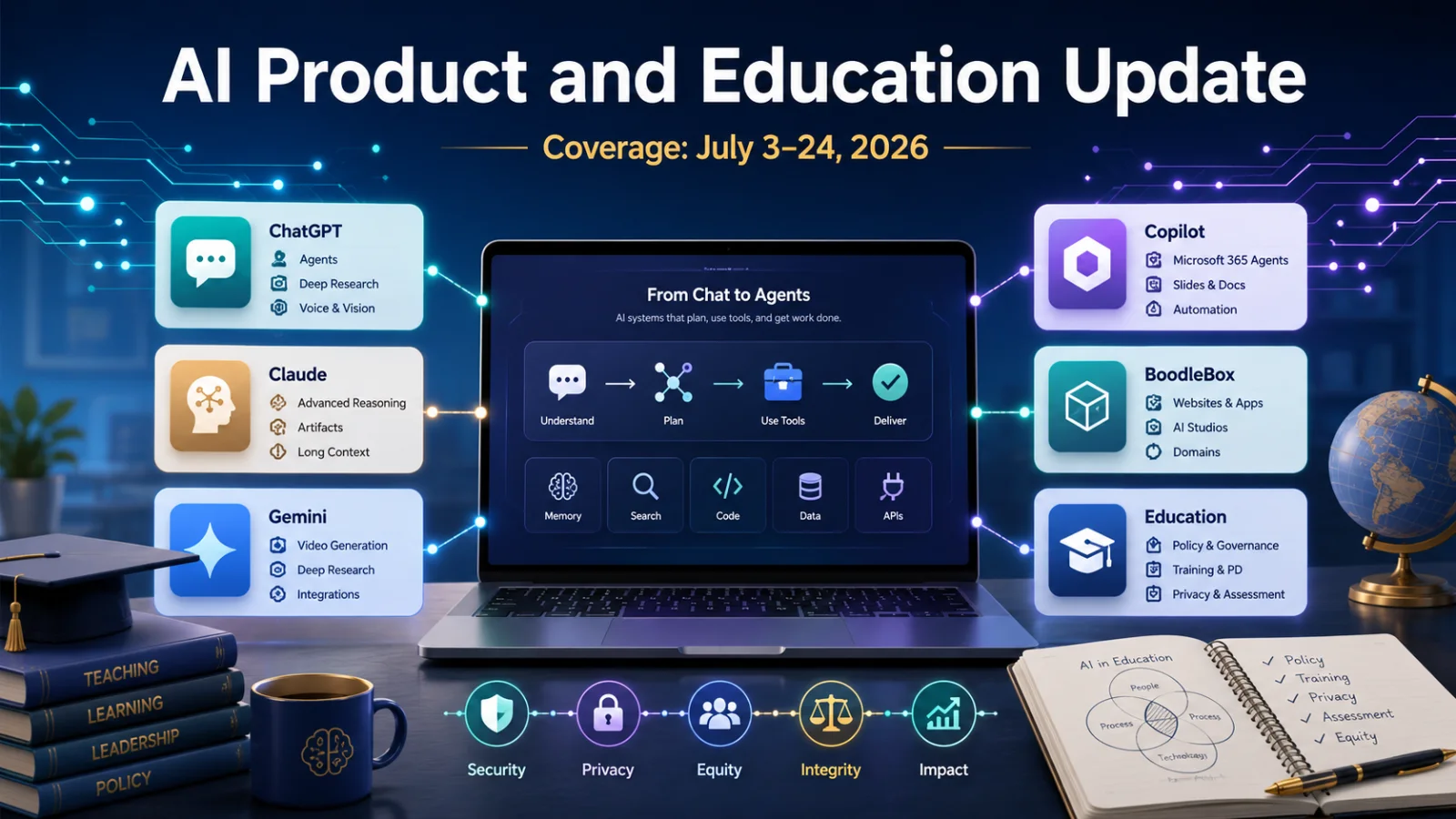
AI Product and Education Update
Coverage: July 3–24, 2026
Bottom Line
Gen AI products are moving beyond chat responses toward systems that complete projects, operate tools, create publishable materials, and preserve reusable workflows.
For schools, colleges, and universities, the immediate priorities are:
- Create separate rules for conversational chatbots and agentic tools
- Require independent verification of Gen AI output
- Use assessments that capture process, reasoning, and live understanding
- Review connectors, permissions, publishing controls, and data access
- Provide formal educator training before broad deployment
- Distinguish individual educator access from institutional approval
OpenAI and ChatGPT
GPT-5.6 Released
OpenAI released the GPT-5.6 model family on July 9:
- GPT-5.6 Sol: Designed for complex knowledge work, coding, science, and cybersecurity
- GPT-5.6 Terra: Balances capability, speed, and cost
- GPT-5.6 Luna: Designed for faster, high-volume work at a lower cost
Availability varies by product and subscription.
Education implications: GPT-5.6 may improve curriculum development, coding support, research synthesis, and document analysis. Stronger performance does not remove the need to verify facts, sources, calculations, and instructional alignment.
ChatGPT Work Added Multi-Step Agents
ChatGPT Work launched July 9 for longer assignments that require multiple steps. It can work with connected files and applications, conduct research, and produce documents, spreadsheets, presentations, reports, and websites.
Users can monitor its progress, answer questions, redirect the work, and approve consequential actions. Scheduled Tasks can run once, recur, or watch for changes.
Read the ChatGPT release notes
Education implications: ChatGPT Work can act across files and systems rather than simply answering prompts. Institutions should review:
- Which connectors may be enabled
- Whether local or cloud files may be accessed
- Who can approve consequential actions
- What activity records are retained
- Whether staff understand the difference between Chat and Work
ChatGPT Sites Entered Public Beta
ChatGPT Sites can create, preview, publish, and share interactive websites and lightweight applications from Work or Codex.
It is available through supported paid plans, subject to regional and workspace restrictions. Enterprise administrators can control site creation and publishing. Public publishing is disabled by default for Enterprise workspaces.
Education implications: Educators could use Sites to create class resources, simulations, resource hubs, and interactive demonstrations. Each site should be checked for accessibility, factual accuracy, copyright concerns, student-data exposure, and inappropriate public publishing.
ChatGPT Voice Expanded
OpenAI introduced GPT-Live-1 for paid consumer users and GPT-Live-1 mini for Free users. The models support more natural interruption and conversational turn-taking.
Voice also began rolling out to Enterprise and Edu workspaces in two forms:
- Voice conversations inside Chat
- Voice control of Work and Codex in the desktop application
Workspace administrators may need to enable Advanced Voice capabilities and Early Model Access.
Read the ChatGPT Enterprise and Edu release notes
Education implications: Voice may help educators brainstorm, work hands-free, and supervise longer agent tasks. Institutions should consider conversations occurring around students, microphone access, recordings, and the tools an agent may operate.
Desktop, Search, and Custom Instructions Improved
OpenAI also added:
- A unified desktop application for Chat, Work, and Codex
- Projects in the desktop application
- Work conversations synchronized across devices
- Improved search across chats, projects, documents, and images
- Custom-instruction limits of up to 5,000 characters for supported paid and institutional plans
Review the ChatGPT release notes
Health in ChatGPT Expanded
Eligible U.S. users who are at least 18 years old can connect supported medical records and Apple Health information through Health in ChatGPT.
OpenAI states that connected health data and related conversations are not used to train its foundation models or target advertising.
Education caution: This consumer health feature should not be treated as authorization to upload school nursing records, disability documentation, counseling notes, or other protected student information.
Claude and Anthropic
Claude for Teachers Launched
Anthropic launched Claude for Teachers on July 14. Verified U.S. K–12 educators receive:
- Free premium Claude access
- A library of teaching skills
- Connections to evidence-based curriculum resources
- Academic standards from all 50 states
- One year of access for educators who register by June 30, 2027
Anthropic is also releasing teaching skills as open-source resources and planning an evaluation with Detroit Public Schools Community District.
Read the Claude for Teachers announcement
Education implications: This is currently an individual educator offering. It does not automatically provide district approval, a district license, or permission to enter identifiable student information.
Google Gemini
Gemini Can Create Complete Google Slides Presentations
Gemini can generate full, editable presentations in Google Slides.
It can:
- Use multiple Google Drive files as source material
- Suggest relevant emails, chats, and files
- Match the visual style of an existing presentation
- Present an outline for approval
- Produce editable, native Google Slides
The feature is initially available in English through supported Workspace, consumer, and education plans, including Google AI Pro for Education.
Read the Google Workspace announcement
Education implications: Gemini can turn curriculum documents, reports, and workshop materials into presentation drafts. Educators still need to check citations, accessibility, reading level, copyright, slide density, and instructional alignment.
Gemini 3.6 Flash and Gemini 3.5 Flash-Lite Reached General Availability
Google released stable production versions of two Gemini models:
- Gemini 3.6 Flash: Improved token efficiency, coding, and agent planning
- Gemini 3.5 Flash-Lite: Designed for lower-cost, low-latency, high-volume work
Both support multimodal input and large context windows.
Education implications: Lower-cost models may make large-scale document classification, extraction, and repetitive support tasks more practical. Institutions should strengthen data-governance rules before expanding automated processing.
Google Vids Added Prompt-Based Video Editing
Google added Gemini-based tools to Google Vids for generating higher-quality video clips and editing video through typed instructions.
Read the Google Vids announcement
Education implications: These tools may shorten the production of instructional videos. Educators still need accurate visuals, captions, transcripts, accessible design, and copyright-safe media.
BoodleBox
BoodleBox Announced a $5 Million Seed Expansion
BoodleBox founder France Hoang announced a $5 million seed expansion round on July 9.
The company’s stated focus is collaborative Gen AI use built around shared context, problem framing, human validation, and access to multiple models.
Read the BoodleBox funding memorandum
BoodleBox Published a Higher-Education Teacher Preparation Case Study
A July 13 case study describes 35 future teachers from eight European universities building Gen AI agents through an Erasmus+ program focused on AI pedagogy and well-being.
Read the University of Jyväskylä case study
Education implications: The program used BoodleBox as an environment where future educators designed and evaluated agents rather than only consuming chatbot responses.
BoodleBox Updated Its Security and Privacy Information
BoodleBox states that it does not use customer data to train models and that it connects to third-party models through commercial APIs.
Review BoodleBox security and privacy information
Institutions should still review contracts, retention periods, subprocessors, administrative controls, and data-processing agreements.
Education Watch
Brown University Exam Results Renewed the Assessment Debate
A Brown University economics professor suspected widespread Gen AI use after a take-home midterm produced an average score of 96, compared with the course’s usual range of approximately 65 to 80.
The professor changed the final to an in-person exam, where the average fell to 48.6. The allegations remain disputed, and Brown indicated that more information would be needed for formal action.
Read the Inside Higher Ed report
Brown also released a campus Gen AI report on July 7. An audit found that more than half of reviewed syllabi lacked a Gen AI policy, while surveys showed frequent intentional use among students.
Read Brown University’s Gen AI report
Practical takeaway: Detection alone is not enough. Courses need explicit permitted-use rules and assessments that reveal student thinking through oral explanations, drafts, demonstrations, process records, or live defense.
Educator Training Continues to Lag
An Instructure survey of 1,125 educators, higher-education students, and K–12 parents reported that 90 percent of surveyed students use AI, while fewer than half of educators had received formal Gen AI training.
Because this was an industry-sponsored survey, the findings should be treated as a useful signal rather than a definitive national measurement.
Read the Instructure research announcement
The broader pattern is clear: new capabilities are arriving faster than many institutions can establish professional development, assessment practices, privacy rules, and purchasing standards.