
The short version
A short reflection on the impact of vibe-coding on my own work
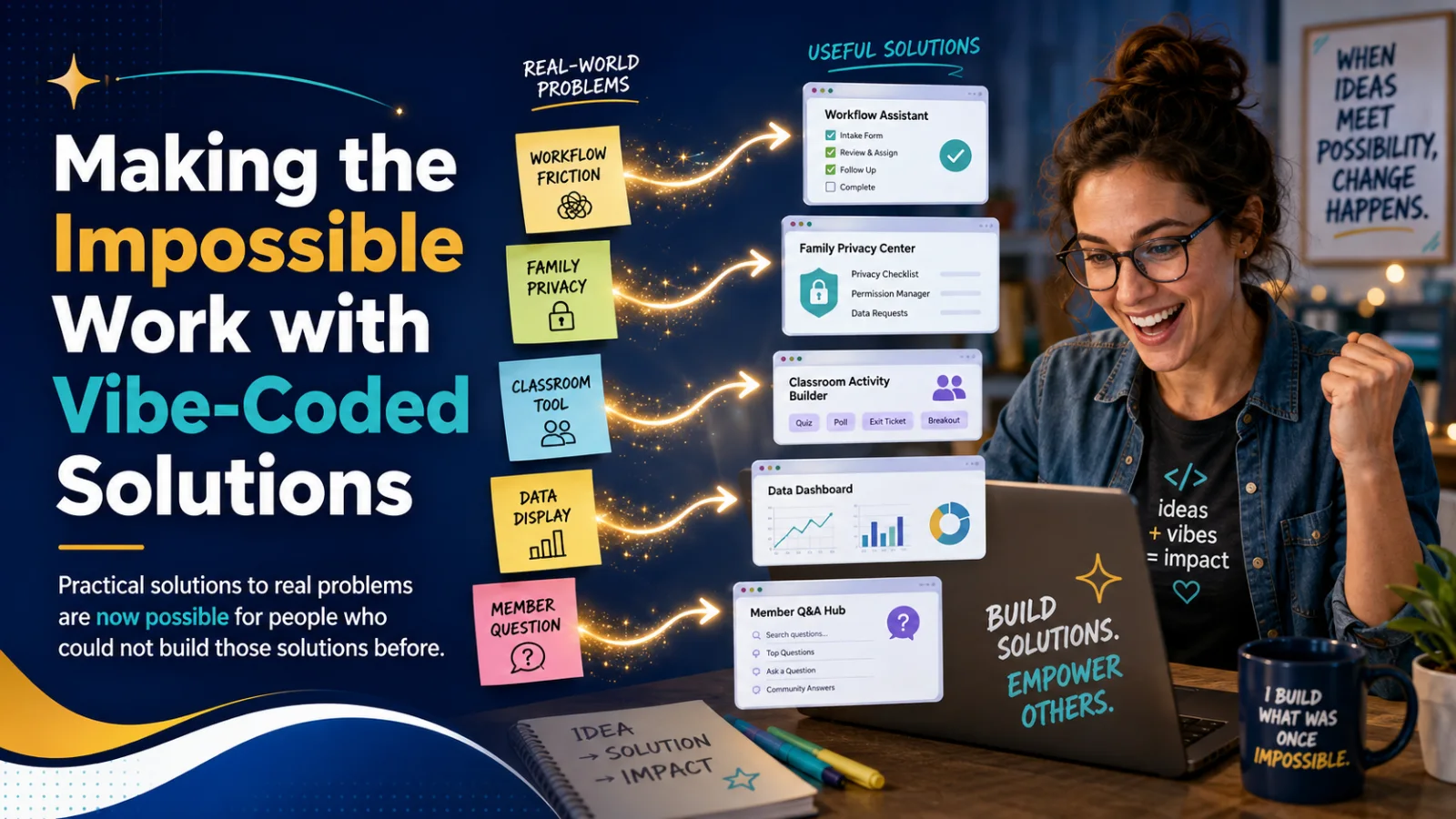
Over the last few months, I’ve noticed a significant change in my writing output. Instead of writing about other people’s solutions, I’m writing more and more about solutions that I’ve developed using vibe-coding. This has been wonderful given vibe-coding’s empowering aspect to make solutions that are relevant to problems I’ve noticed. Those problems, obstacles are ones that, in the past, I would have had to wait around on someone who knew how to code to solve. Now, I can take those topics on myself.
One Big Obstacle Facing Organizations
One point before I get into the main part of this blog entry. That is, what a challenge slow-moving organizations face when their staff start creating with vibe-coded solutions. Their first inclination is to greet it with suspicion, to drag their feet in providing a server to host content. Think of the rich efforts vibe-coders in work settings are able to produce, then finding that they have to find any port in the storm (web server host) to put their creations. As a technology director, I never saw the point of these top-down, network command-n-control types who restrict access to any new technology out of fear or move so glacially slow (before climate change, of course, started melting everything) to implement new solutions.
It’s a tough issue, and this reflection is provoked, not by my situation, but The Artificial Intelligence Show podcast episodes these past few weeks with Paul Roetzer and Mike Kaput. They are sounding the alarm regarding slow-moving businesses and organizations who may wake up to find their best workers, who embraced Gen AI and are vibe-coding solutions, have innovated their way into different spaces. I’ve been here before with blogging, seeing people who blogged accelerate their own learning that moved them outside their current sphere into a new one. Gen AI with vibe-coding has that potential as well.
That quick reflection aside, let me share with you a growing realization about my own work.
Solving Problems: Documenting Vibe-Coded Solutions
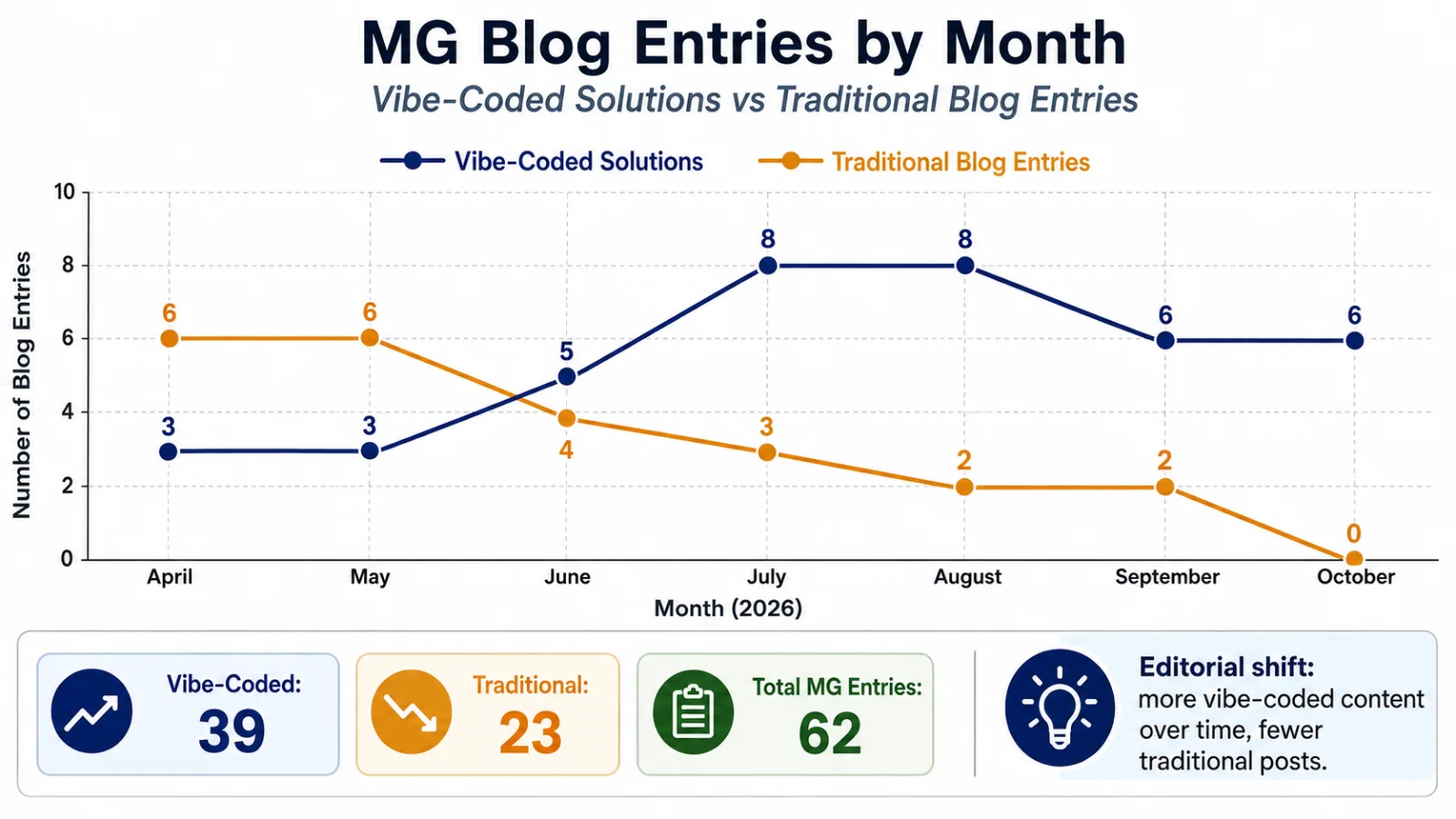
The place where this is most visible, this idea of solved problems using vibe-coding, is the blog entries I write for my employer’s blog. I find that now, when I read about a problem a non-profit organization member is having in the shared community space, I am able to design and create a solution that works. Consider this list of blog entries, from April through October, 2026 that I have either written and published, or written and scheduled for publication.
I am SO grateful to have had that support and opportunity to use Gen AI to support our organization’s members. It’s an organization I’ve been a part of since 1990s and I’m thrilled about the opportunity to take a leadership role in encouraging the use of Gen AI in schools. After all, even with all the screen time backlash, using technology to empower teaching, learning, and leading is what we’re about.
And, boy, do I feel empowered.
Quick Totals
Of the 63 blog entries I’ve submitted for publication from April - October, 2026, thirty-nine are vibe-coded solutions of some sort, or include vibe-coded elements. Twenty-three do not rely on vibe-coded solutions at all. This is a real shift in my approach to writing, and has made my production work much more satisfying and rewarding. While my work provides Claude, I have often relied on my personal ChatGPT account to generate images, or fill in when Claude says, “No mas!” (No more due to running out of tokens).
Honestly, I can’t really imagine schools and organizations failing to realize the potential of vibe-coded solutions to problems their staff and/or members face every day. Instead of saying, “Oh well, we can’t afford someone or we have to find some company to do that,” now, people can say, “Let me see if I can develop a solution for that using vibe-coding.”
To me, this is the real benefit of Generative AI…and we miss it when we focus on the “cheating” aspect. That’s not to say productive struggle isn’t critical for K-16 learners, or any age learner, but the real power of this tool is empowering people like me, who can’t code at all even if their life depended on it, to leverage Gen AI to make things not previously possible.
Vibe-Coded Solutions (39)
Linked blog entries have been published; the rest have not.
- AI Maker Magic, Part 3: Save FunQuiz Results to Google Sheets
- Become an AI-Powered Newsletter Architect
- When Disaster Strikes: Cyber Edition
- Vibe-Coded Solutions for Educators
- Vibe-Coding an Oreo Personality Test
- TCEA Responds: When Your Tech Buyback Company Ghosts You
- Five Steps to a 15-Minute Family App Privacy Audit
- The Augmented K-16 AI Framework: Six Tools You Can Use
- Make Data Displays Without Writing Code
- Turn Entry Tickets Into Smart Item Analysis
- Drop the Subscriptions: Vibe-Code Your Own Library Tools
- Celebrate America’s 250th Birthday with Fourth of July Digital Breakouts
- Crack the Case with CLEAR, Smart Thinking (Part 1)
- Science Detectives: Critical Thinking Online Breakouts (CTOBs) for Your K-2 Classroom
- Three Critical Thinking Digital Breakouts for 2026-2027 (CLEAR, Part 2)
- Vibe-Coding for Librarians
- Five New Digital Math Tools for PreKindergarten and Kindergarten Students
- Science Detectives: Critical Thinking Online Breakouts (CTOBs) for Your 3–5 Classroom
- Science Detectives: Critical Thinking Online Breakouts (CTOBs) for Your 6-8 Classroom
- Back to School: Get Students Lab-Ready with Free Safety Certification Activities
- Back to School: Five Reasons Getting to Know You Activities Are Worth the Time (scheduled for August 7, 2026; no public link yet)
- Critical Thinking Online Breakouts for K–12 Classrooms: Bible as Literature (scheduled for August 11, 2026; no public link yet)
- Turn Literature Study into an Investigation with PlotPoint (scheduled for August 14, 2026; no public link yet)
- Idioms and Sayings: A CTOB Suite for Multilingual Learners (scheduled for August 24, 2026; no public link yet)
- Women’s Equality Day: The Vote Was a Milestone, Not the Finish Line (scheduled for August 26, 2026; no public link yet)
- Build a Better Handbook in Five Steps (scheduled for August 28, 2026; no public link yet)
- TCEA Responds: Binder Check Rubrics for Your Science Classroom (scheduled for August 31, 2026; no public link yet)
- ACE Image Inquiry: Reading Paintings Like Historical Evidence (scheduled for September 1, 2026; no public link yet)
- Instructional Rasquachismo (scheduled for September 9, 2026; no public link yet)
- A11Y Digital Accessibility (scheduled for September 17, 2026; no public link yet)
- Make T-TESS Observations Less Painful with Gen AI (scheduled for September 23, 2026; no public link yet)
- Seven Ways to Use Bellringers in High School Science (scheduled for September 25, 2026; no public link yet)
- Back to School: Step Into the Vanished Classroom and Investigate School History (scheduled for September 28, 2026; no public link yet)
- How Principals Can Use Gen AI to Create Engaging Staff Meetings (scheduled for October 2, 2026; no public link yet)
- Say It, Make It: Turn Clear Communication into a STEAM Challenge (scheduled for October 8, 2026; no public link yet)
- Problem-Solving Teaching: PBL Units for Texas Social Studies (scheduled for October 13, 2026; no public link yet)
- Build Better Online Judgment with Digital Citizenship CTOBs (scheduled for October 26, 2026; no public link yet)
- Teach Digital Citizenship with CipherSplat Encryption (scheduled for October 28, 2026; no public link yet)
- Gen AI Literacy Activities (scheduled for October 29, 2026; no public link yet)
Not Vibe-Coded (23)
- Stop the Spam: Tips for Filtering Unwanted Phone Calls
- Stop Fixing Students: Coaching for Equity Through Universal Design
- TCEA Responds: Navigating Resistance, Part Two
- Does Your District Have an AI Plan, or Just an AI Problem?
- When AI Tutors Backfire
- Digital Mapping Your School District
- The 20% AI Policy Won’t Work. Here’s What May.
- Four Free Tools to Cut Workflow Friction in 2026
- Navigating Academic Integrity in the AI Classroom
- NoPaperTest: A Multilingual Quiz Tool
- Six Free Tools That Put Privacy First
- Library Grants Worth Knowing About (Spring 2026 Edition)
- TCEA Responds: Refurbished Chromebooks That Survive a Middle School Year
- ACE It: Three Steps from Surface to Transfer Learning
- TCEA Responds: Will Jigsaw Help My Third Graders on Individual Tests?
- Five Browser Add-Ons Worth Installing This Week
- Should Districts Block Canva? The K-12 Control Question
- Build Student-Ready Study Kits: AI Prompts
- Hands-On: Student Learning in the AI Era
- Choosing a District Assessment System Without Starting With Vendor Demos (scheduled for August 6, 2026; no public link yet)
- 8 Canva Easter Eggs to Liven Up Your Presentations (scheduled for August 27, 2026; no public link yet)
- Sharing 130+ Social Studies Entry and Exit Tickets for Grades 3-11 (scheduled for September 3, 2026; no public link yet)
- The 60-Second PEIMS Check That Can Save Hours (scheduled for September 11, 2026; no public link yet)
Reflecting on the Journey
What a fun journey it’s been so far, and it’s only getting better, faster. The question going around in my head is, “What new challenges are educators facing today? And, how can I vibe-code a solution to address it?” From a professional learning perspective, that question changes a bit to, “How can I best support educators who are embracing vibe-coded solutions for their own work and effort?”