
7. What Will You Stop Doing?
“We can change hearts and minds to change schools.”
— Paul Fleming, Learning Forward
New initiatives often pile onto existing work because ending a program, publication, meeting, or tradition feels more dangerous than adding another responsibility.
That approach eventually creates an organization where staff maintain dozens of low-impact obligations while promising ideas wait for capacity that never arrives. The human cost matters, too. The 2025 State of Nonprofits report found nonprofit leaders continuing to report serious concerns about staffing, financial uncertainty, and employee burnout.
I have watched organizations preserve weak programs because someone worked hard to create them. Respecting that history does not require funding the program forever.
One Thing to Do
Require every department to recommend one program, process, meeting, report, or technology expense for elimination before proposing new work. Redirect the recovered time and money toward the organization’s highest-priority service redesign.
Subtraction should become part of strategy, not an emergency response after the budget tightens.
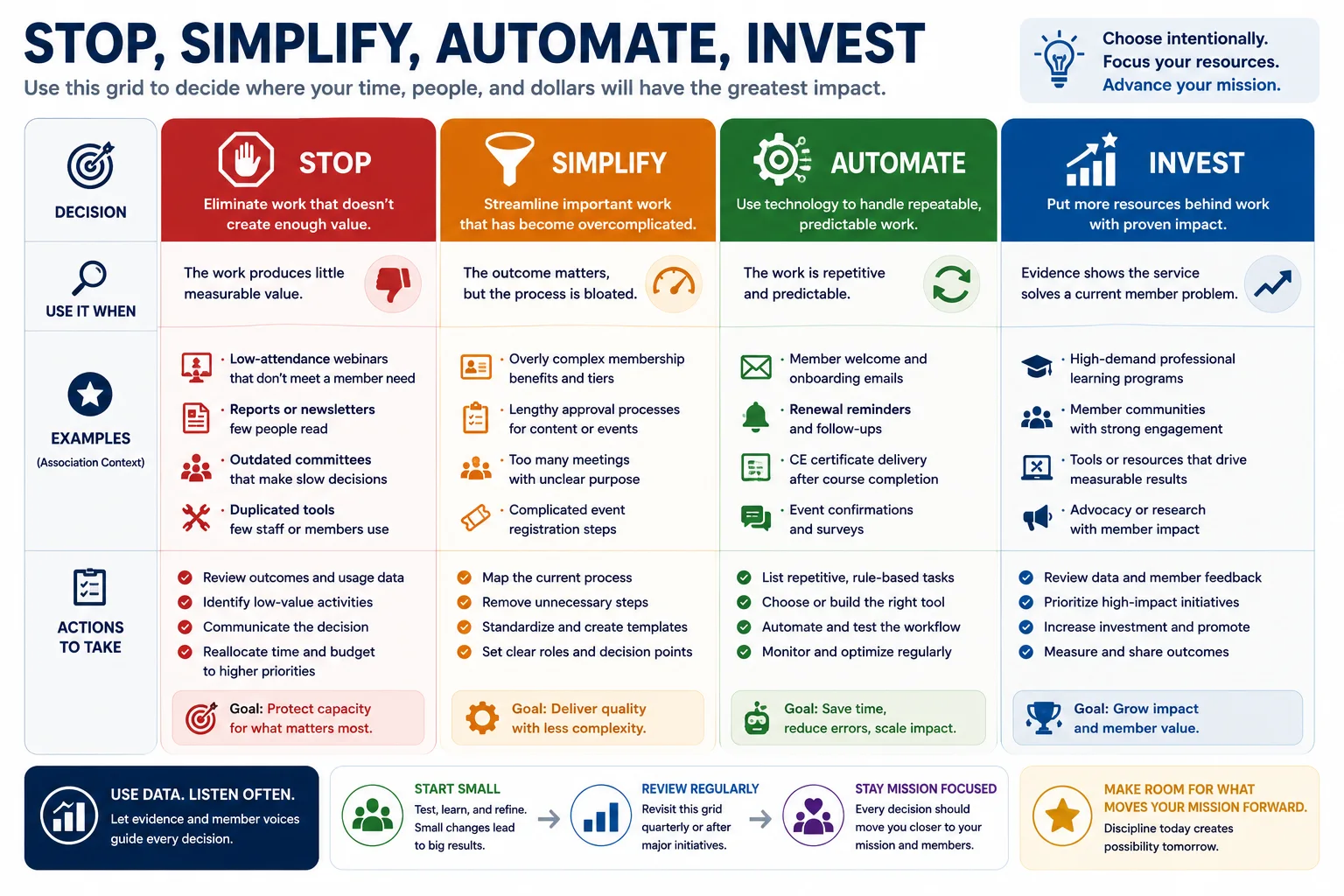
Create a Stop, Simplify, Automate, Invest decision grid:
| Decision | Use It When |
|---|---|
| Stop | The work produces little measurable value |
| Simplify | The outcome matters, but the process is bloated |
| Automate | The work is repetitive and predictable |
| Invest | Evidence shows the service solves a current member problem |