
Reading this KQED post on “‘Cognitive Surrender’: Faster Solutions, Lower Test Scores Show How AI is Eroding Math Skills,”, I was not surprised to see this assertion:
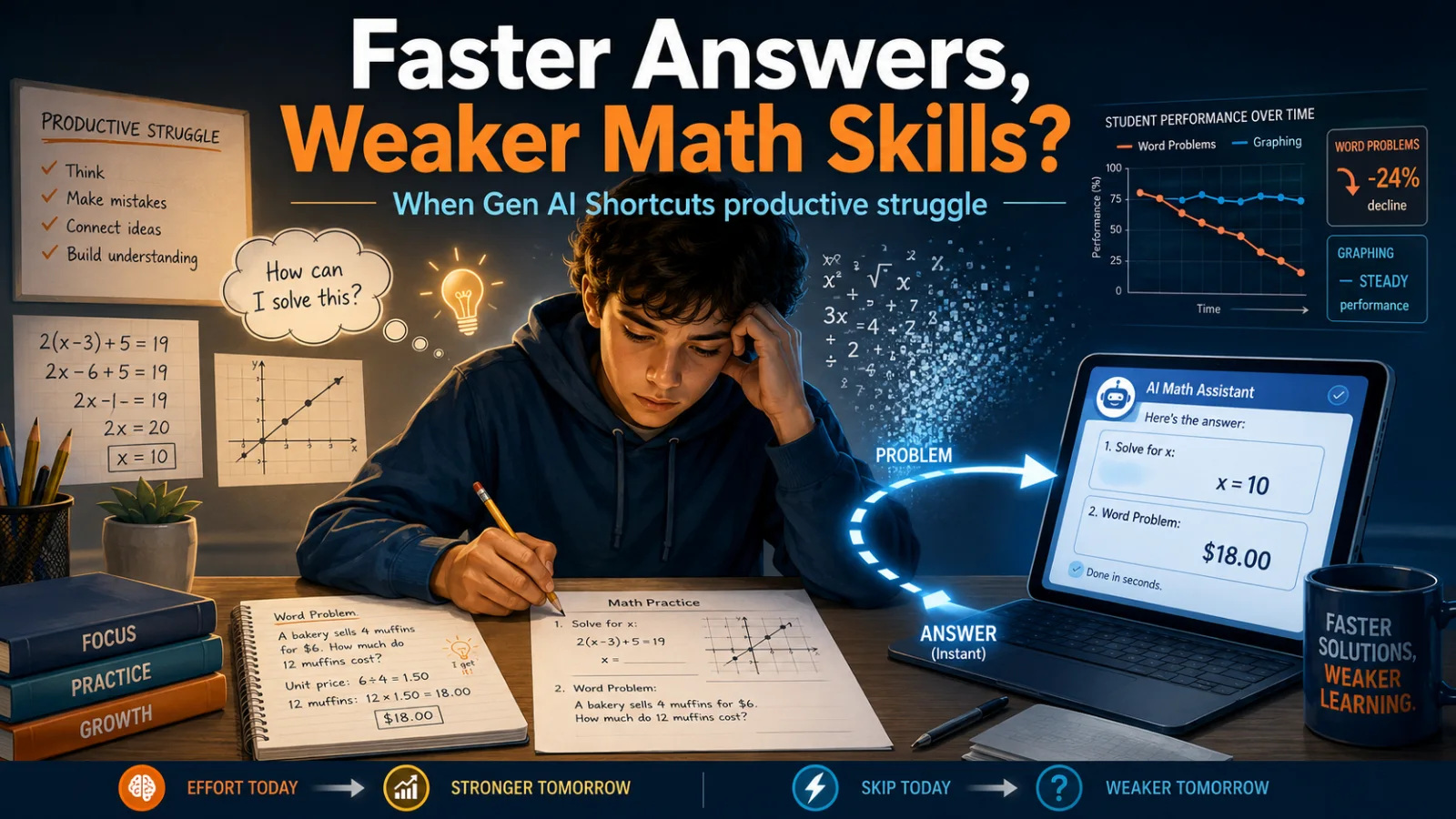
Many students appear to be completing assignments faster while learning less from them.
Given that Gen AI tools, when used by students, allow them to shortcut the productive struggle they need to thoroughly learn a topic, it’s not much of a surprise. What IS a surprise is the expectation that students won’t want to do the same thing adults do…that is, get the job done as quick as possible so they can go do something else. That productive struggle that we all endure as students, that slow rush of accomplishment after solving a particularly difficult problem or working through a series of tasks that require mental elbow grease, er, effort, is denied to students. Our society today prizes results above all else, even the education of our children.
Another Interesting Finding
If students’ math skills had generally deteriorated because of pandemic learning loss, weaker high school preparation or digital distraction, graphing performance should have deteriorated too. It didn’t.
That’s pretty interesting, too. While I’m not ready to jump on the “Burn Gen AI down, it’s hurting humanity and the world [ok, it is],” I can definitely agree that Gen AI really shouldn’t be used in classrooms by students unless non-coders, non-programmers (hey, like me) are using it to do coding or stuff they are NEVER going to learn.
Let’s see that list of things I can’t do…
- Fix a car
- Change a tire
- Build a rocket ship
- Code (this whole blog, including the editor I’m using right now to add this blog entry, is vibe-coded)
- A bunch of other stuff
This makes ask, “Without Gen AI, what can I do?” That question will probably be one students will find themselves asking sooner or later. Employers will certainly ask it.
Quick Stats and Takeaways
Here are some key statistics and points:
Key Statistics
- 📊 3.2 million ALEKS interactions analyzed
- 👩🎓 4+ million annual ALEKS users
- ⏱️ High school word-problem time: -31%
- ⏱️ College word-problem time: -27%
- ⏱️ Middle school decline: -9%
- 📉 Placement test accuracy: 80% → 60%
- 📉 Correct-answer odds dropped 25%
Key Points
- Faster work, weaker learning
- Word problems most affected
- Graphing skills stayed stable
- Unproctored scores artificially improved
- Proctored scores significantly declined
- AI encourages cognitive surrender
- Thinking outsourced before learning
- AI tutors can help, thoughtfully used
- Students fear thinking-skill decline
- Value learning over convenience